What Actually Separates Gemstones and Crystals From Each Other
Vikas July 5, 2026 in
Astrology What Actually Separates Gemstones and Crystals From Each Other
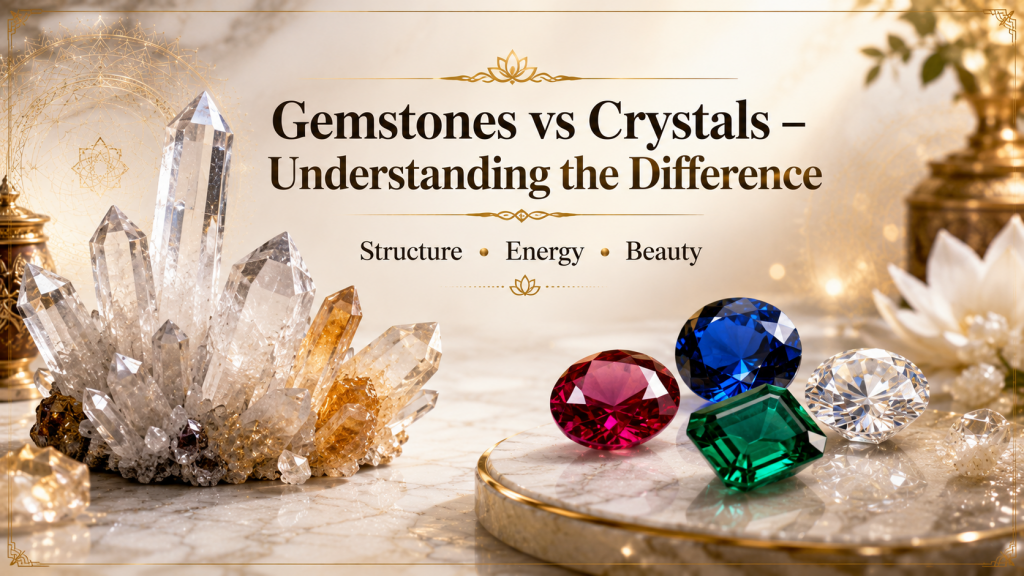
You’re drawn to the look of these stones long before you’re thinking about technical definitions. The colour, the way light catches inside them, some kind of energy people have written about for centuries. Most buyers use crystal and gemstone interchangeably without much thought, and honestly, in casual conversation that’s fine. Nobody’s checking your vocabulary at the jewellery counter. But once you’re actually trying to understand what you’re buying — or why one stone gets used in a meditation grid while another ends up set into an engagement ring — the distinction starts mattering quite a bit more.
Crystals come down to structure, basically
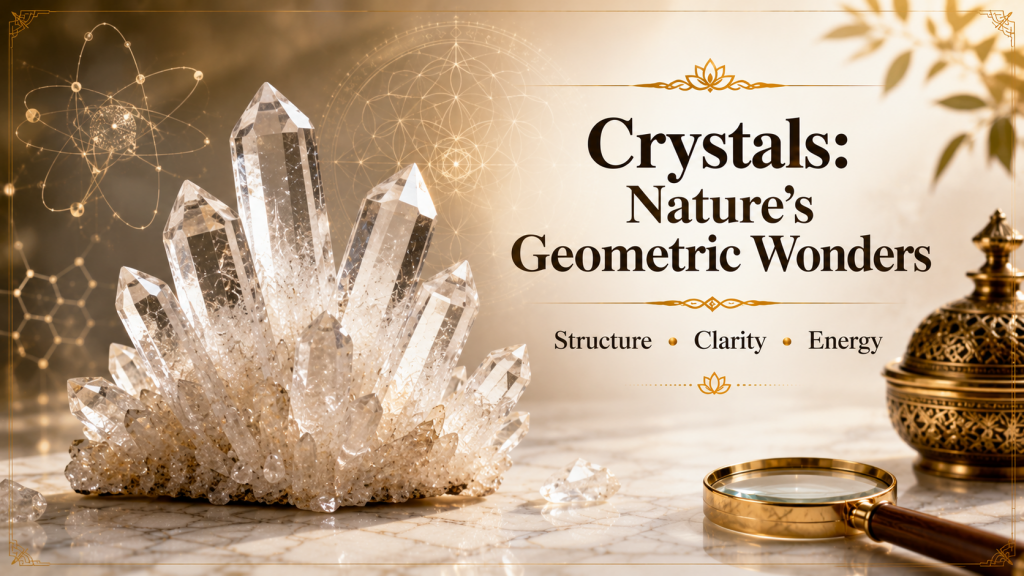
Strip away everything else and a crystal is defined by its internal architecture. Atoms, molecules, ions — arranged in a precise pattern that repeats consistently in all three dimensions. Not decorative language. A genuine structural fact about how the material forms, usually underground, usually through the slow cooling of magma over timescales that are hard to fully picture.
That internal order isn’t just an abstract chemistry fact either. It shows up physically — flat faces meeting at exact, predictable angles, what gets called a facet, with the overall geometric arrangement known as the crystal structure. Which is exactly why crystals turn up in electronics and medical equipment as much as they do in spiritual practice. The same precision that makes a crystal useful inside a watch movement is part of what gives it that particular visual clarity people respond to instinctively, even without knowing why.
Gemstones are more about what happens after they’re found
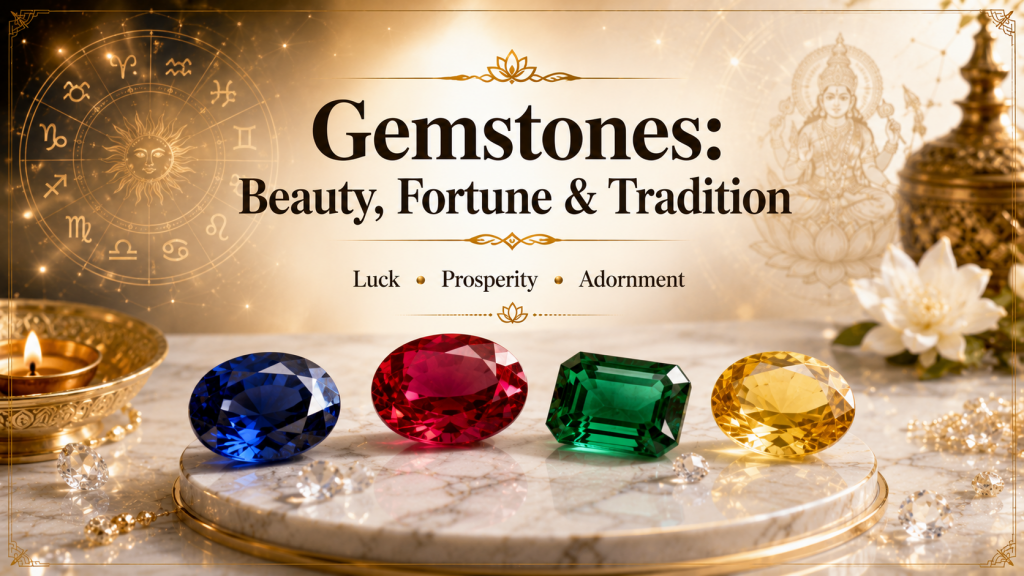
Gemstones are natural minerals or rocks that get cut, polished, and faceted specifically for jewellery and decorative use. Most are mined. Some are synthetic now, grown in lab conditions rather than pulled from the ground, though that’s a separate conversation entirely.
Durability matters a lot more here than with crystals generally, mostly because gemstones need to actually survive daily wear — knocking against things, getting caught on fabric, sitting in a ring for decades. They split into two recognized tiers. Precious stones: diamond, ruby, sapphire, emerald, the short and well-known list. Semi-precious stones cover everything else — quartz, agate, jade, amethyst, turquoise, tourmaline, opal, garnet, lapis lazuli, a genuinely long catalogue beyond that.
Where the actual differences show up, one at a time
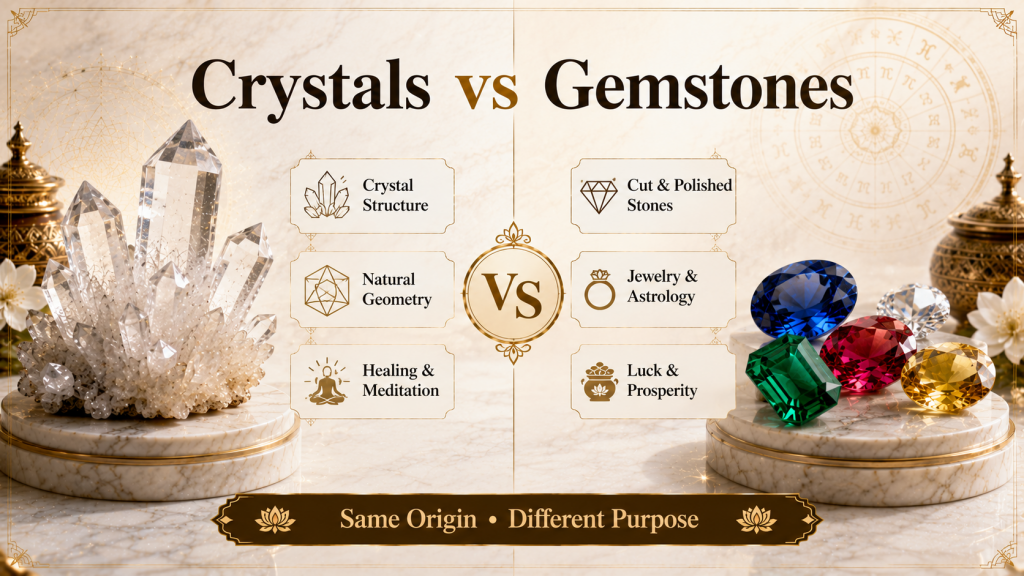
Structure first, since it’s the root of everything else. Crystals carry that specific, repeating atomic arrangement — generally making them stronger and more durable than gemstones lacking the same internal regularity. Gemstones come in whatever shape a jeweller decides to give them. No built-in geometric consistency the way crystals naturally have it.
Shape follows directly from that. Each crystal type has its own predictable geometric form, specific to that mineral. Gemstones don’t carry anything comparable — shape is mostly a cutting decision made after the raw material’s already been pulled from the ground.
Colour tends to lean differently too, though this one’s softer as a rule than the others. Crystals often run more vibrant and vivid. Gemstones settle into something more muted on average. Not universal — plenty of exceptions exist on both sides — but common enough to be worth noting.
Clarity and brilliance generally favour crystals, which tend to show higher transparency and stronger light performance than a lot of gemstones manage. And then there’s the part that actually matters most to people buying these stones for reasons beyond how they look. Crystals get associated with healing, specifically through their believed energy-storing capacity. Gemstones get tied instead to luck, wealth, general fortune for whoever’s wearing them. Different category of belief entirely, even when two stones look almost identical sitting next to each other on a shelf.
How each one actually gets used
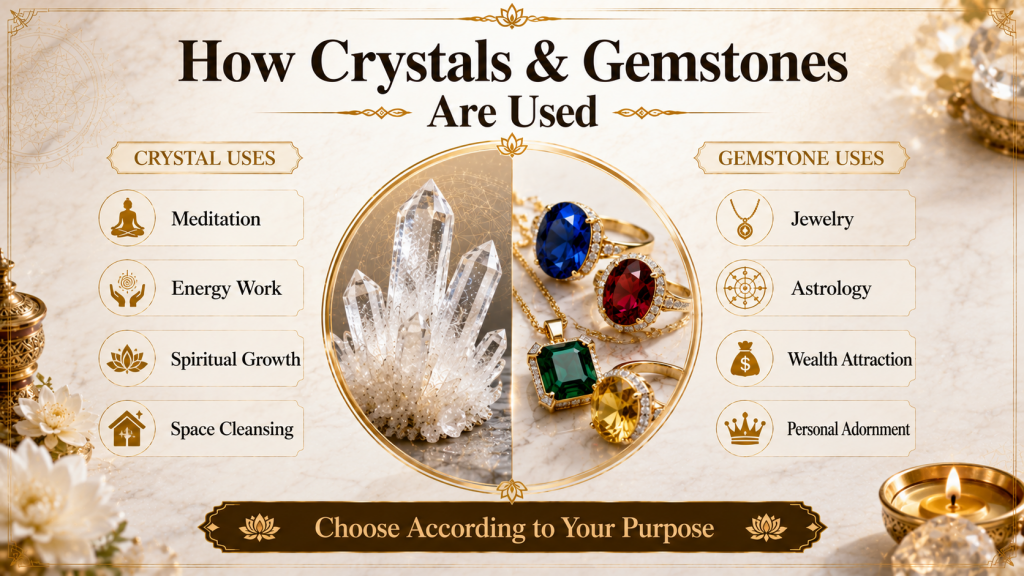
Both show up in spiritual and energetic practice, but the specifics diverge once you look closely.
Crystals lean heavily into healing work — protection, clearing blocked energy, supporting meditation, that sense of connecting to something larger than the everyday. People build grids with them. Or just set individual pieces around a home to shift how the space feels. There’s a manifestation angle too, crystals used as a kind of focal tool for someone working actively toward a specific goal rather than just hoping things improve.
Gemstones lean harder into their reputation for attracting specific outcomes. Plenty of people believe particular stones carry energy tied to particular goals — wealth, love, protection, whatever the specific stone is associated with. They show up in healing rituals regularly too. Crystal baths, focused meditation, anything aimed at clearing negative energy and strengthening someone’s broader connection to the world around them.
And obviously, both serve a purely aesthetic purpose as well, set into rings and necklaces and earrings as genuine statement pieces rather than just background decoration.
Why bothering to know the difference is actually worth it
Both crystals and gemstones come from the same ultimate source — the natural world, shaped over geological time most of us can’t really hold in our heads properly. But they’re genuinely distinct materials. Different structure, different appearance, different specific properties people attribute to each one. Treating the two words as interchangeable isn’t a crime against vocabulary, but it does mean missing something real about what you’re actually choosing.
Whether you’re drawn to a stone for its structural precision, its believed healing capacity, its connection to luck and money, or just because it’s genuinely beautiful — knowing which category you’re actually working with, and what that category tends to be associated with, helps you pick something that fits your actual intention. Rather than choosing on looks alone and just hoping the rest sorts itself out.
Tags:
buying gemstones and crystals,
crystal energy,
crystal formation,
Crystal healing,
crystal properties,
crystal structure,
crystal vs gemstone,
difference between gemstones and crystals,
Gemstone benefits,
Gemstone Guide,
gemstone jewelry,
Gemstone meaning,
gemstone uses,
gemstones and crystals explained,
gemstones vs crystals,
Healing Crystals,
natural crystals,
Precious Gemstones,
semi precious gemstones,
spiritual stones