















Yellow Sapphire Stone (Pukhraj Stone): Complete Guide to Properties, Benefits & Buying
Yellow sapphire stone doesn’t carry the same caution that follows blue sapphire everywhere. Jupiter’s stone is generally considered benevolent — expansive, generous, growth-oriented. The tradition around Pukhraj is less “test it carefully before committing” and more “make sure you’re getting a real one.”
That second part is where buyers consistently run into trouble.
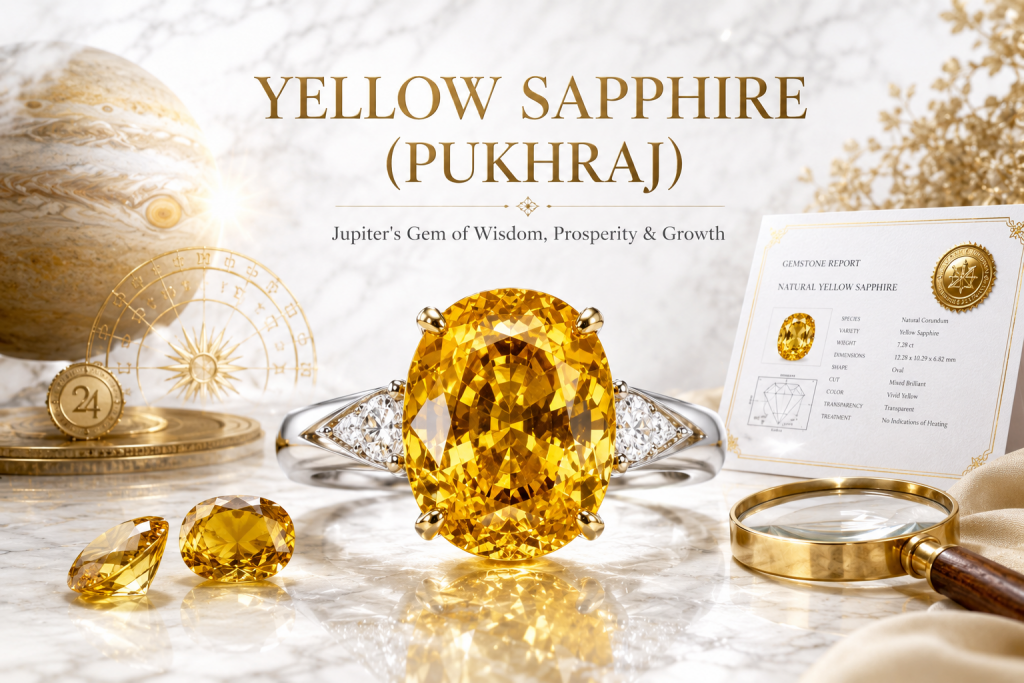
The yellow sapphire market has more treated, synthetic, and misrepresented material than most people realize. A stone that looks identical to a genuine untreated Ceylon Pukhraj can be a heated commercial-grade stone worth a fraction of the price, or a synthetic corundum worth almost nothing astrologically. Knowing what separates them — and what to ask before handing over money — matters more here than with almost any other gemstone.
What Yellow Sapphire stone Is
Same mineral as blue sapphire and ruby. Corundum — aluminum oxide — with yellow color produced by trace iron during crystal formation. Hardness 9 on the Mohs scale, no cleavage planes, excellent durability for daily wear. One of the few gemstones that gemologists and Vedic astrologers both consider genuinely practical for rings worn every day, which is a rarer alignment than it sounds.
The color range runs from pale lemon yellow through medium golden yellow to deep intense gold. Most prized sits in the vivid golden yellow range — pure color, no brownish or orange cast, even distribution throughout the stone. Pale washed-out stones and heavily tinted stones leaning toward orange or brown are considered less valuable and less effective astrologically. The tradition and the gemological market agree on this, which doesn’t always happen.
Some yellow sapphires show fluorescence under UV light. Natural characteristic of the mineral, not a defect, doesn’t affect value or astrological effectiveness either way.
Jupiter’s Stone
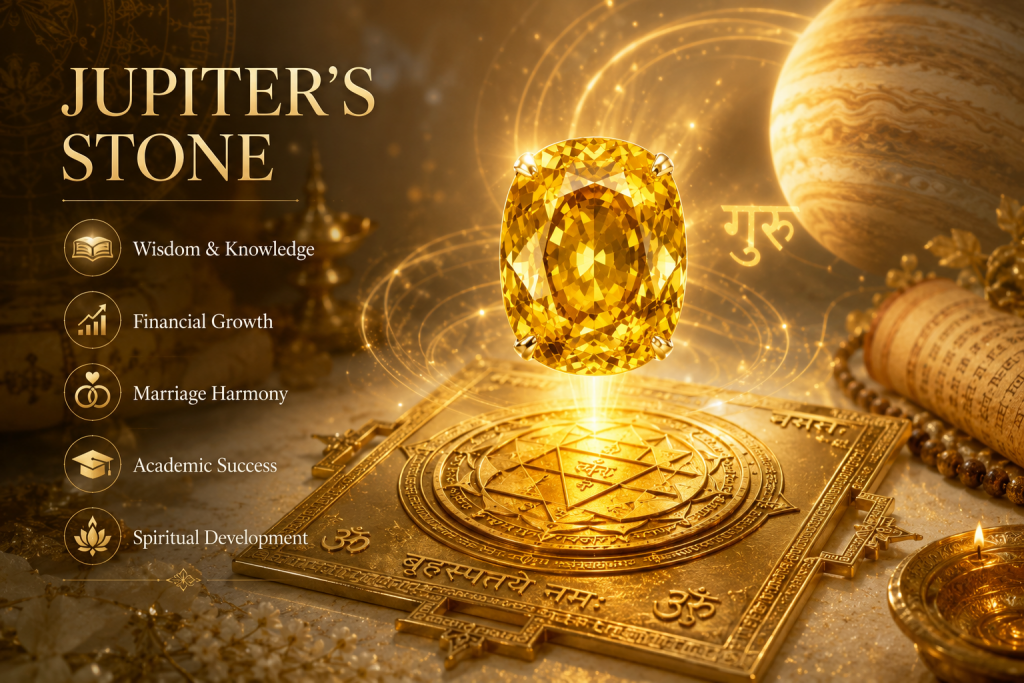
In Vedic astrology, yellow sapphire belongs to Jupiter — Guru — the planet of wisdom, growth, abundance, and good fortune. Where Saturn’s stone requires caution because his influence cuts both ways, Jupiter is generally considered the most benefic planet in the system. He expands what he touches: wealth, knowledge, spiritual understanding, family. Wearing his stone isn’t the same calculated risk as wearing Neelam.
A weak or poorly placed Jupiter in the birth chart shows up as financial instability, lack of direction, difficulties in marriage, poor judgment, or struggles in education. Yellow sapphire is worn to strengthen that placement — to give Jupiter’s energy a vehicle through which to work more directly in the wearer’s life.
The signs most commonly associated with Pukhraj are Sagittarius (Dhanu) and Pisces (Meen), both ruled by Jupiter. For these ascendants and moon signs, the stone is considered naturally beneficial and relatively safe to adopt. Aries and Scorpio ascendants sometimes receive the same recommendation because Jupiter rules auspicious houses for both — but this depends on the full chart, not the ascendant alone.
The general point: yellow sapphire is considered broadly safer to adopt than blue sapphire. The trial period anxiety that accompanies Neelam recommendations is mostly absent from Pukhraj guidance. But “safer” isn’t “universal,” and self-prescribing from sun sign alone remains a bad idea.
Who Actually Benefits
The clearest candidates are Sagittarius and Pisces ascendants or moon signs, or people in Jupiter’s major period (Guru Dasha) in the Vimshottari system.
Beyond those primary cases it gets more specific. Teachers, academics, lawyers, judges, writers, bankers, spiritual practitioners — professionals whose work is built on knowledge, judgment, and communication. Jupiter governs all of these. The stone tends to be most noticeable in careers where wisdom and integrity are the actual product.
Students in competitive academic environments come up consistently in classical sources. Jupiter governs learning and memory. The associations are with sharper retention, improved focus, better performance under pressure — not inspiration, exactly, but the disciplined mental clarity that makes preparation stick.
Relationship and marriage stability. Jupiter governs the institution of marriage in the Vedic framework. Yellow sapphire is specifically associated with harmony in marriage and is frequently recommended for women experiencing difficulties in relationships or seeking them. This appears too consistently across too many classical sources to dismiss as coincidence.
Financial instability. Not the gambling-win variety of financial luck — Jupiter’s abundance tends to arrive as the rightful result of sustained effort finally clearing its obstacles. People who are working hard but feel blocked from converting that work into material results are a common profile in Pukhraj recommendations.
How to Wear Pukhraj stone
Weight: roughly one-twelfth of body weight in carats. A 60 kg person, approximately 5 carats. Heavier stones carry stronger effects in the tradition’s framework. Confirm with an astrologer based on your chart before finalizing.
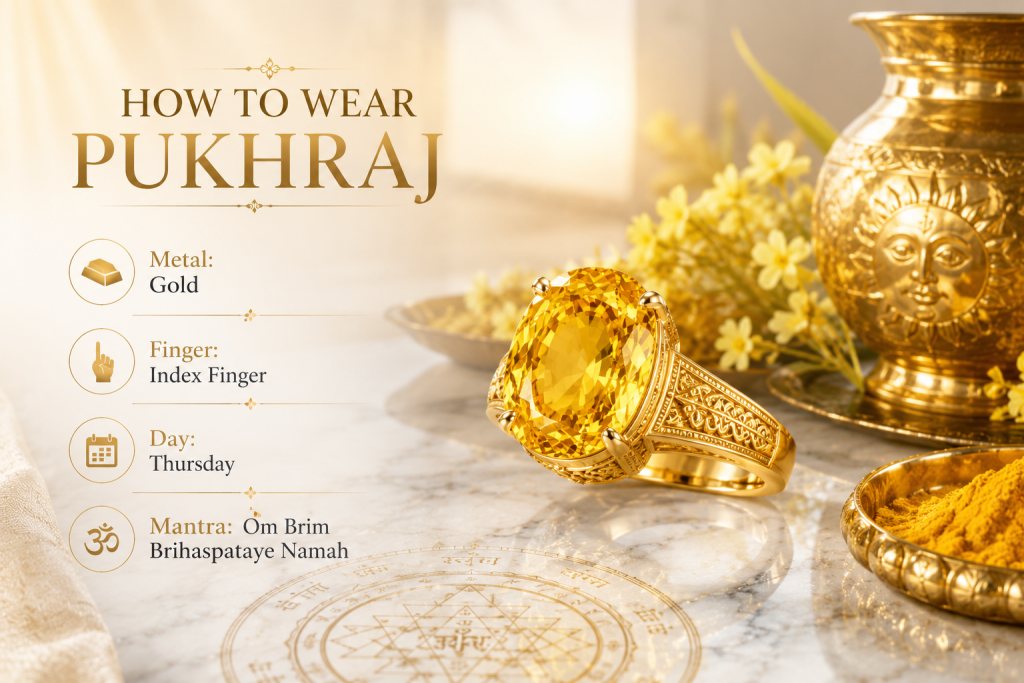
Metal: gold. This is near-universal for Pukhraj — the warm color of the stone and the metal are considered complementary both aesthetically and energetically. Silver is generally not recommended here, unlike with blue sapphire where silver is preferred.
Finger: index finger of the right hand. Jupiter’s finger in palmistry. This placement is consistent across virtually every Jyotish source.
Day and Time: Thursday morning, 5 to 7 AM, waxing moon. Thursday is Jupiter’s day.
Ritual: purify in raw milk and Ganga Jal before first wearing. Chant the Jupiter mantra 108 times:
(ॐ बृं बृहस्पतये नम:)
Gemstone Compatibility: pearl and red coral are generally compatible with Pukhraj. Blue sapphire, emerald, and diamond combinations require chart-specific assessment — don’t combine based on aesthetics or generic advice.
Properties
| Property | Detail |
|---|---|
| Mineral Family | Corundum (aluminum oxide) |
| Coloring Agent | Trace iron |
| Mohs Hardness | 9 |
| Color Range | Pale lemon to deep golden yellow |
| Transparency | Transparent to translucent |
| Cleavage | None |
| Fluorescence | Present in some specimens — not a defect |
| Optimal Color | Medium to deep golden yellow, no brown or orange undertone |
What Makes a Yellow Sapphire Actually Valuable
Color quality first, by a significant margin…
Price Reality
Yellow sapphire pricing in India runs from approximately ₹2,000 per carat for commercial-grade heated stones to ₹1,00,000 per carat and above for fine untreated Ceylon specimens with exceptional color.
The spread is that wide because the factors compound…
Buying Without Getting Deceived
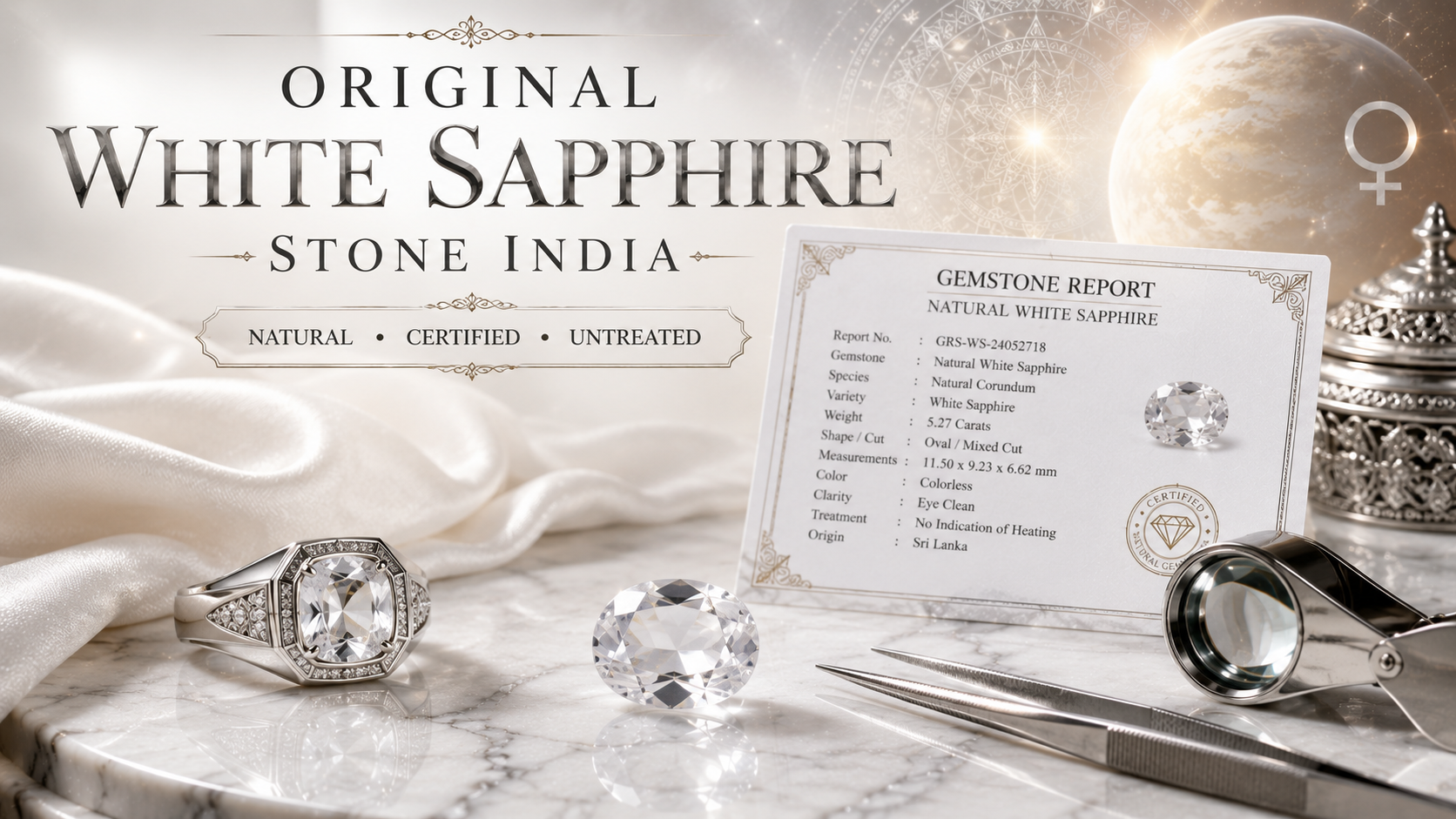
Certification first. An independent laboratory report — GIA, IGI, GRS, Gübelin, SSEF — that specifies natural origin, treatment status, color description, and weight.
Natural inclusions are expected and their presence is actually reassuring…
Color should look natural…
Price floors exist for a reason…
Origin claims need documentation…
Caring for Yellow Sapphire
Hardness 9, no cleavage — daily wear is practical without excessive anxiety.
Warm water, mild soap, soft brush around the setting, thorough rinse, air dry.
Store separately from other jewelry.
Questions Worth Answering Properly
What is Pukhraj exactly?
The Hindi name for yellow sapphire — a yellow variety of corundum colored by trace iron.
Does Pukhraj suit everyone?
No, and the answer depends on the full birth chart rather than the sun sign.
How do I know if a yellow sapphire is genuine?
Natural stones have minor inclusions, consistent color throughout under different lighting, and stable appearance.
Can Pukhraj be worn alongside other gemstones?
Pearl and red coral are generally compatible.
What separates genuinely fine yellow sapphire from commercial grade?
Five factors together: untreated natural origin, vivid pure golden yellow color, eye-clean clarity, quality cut, and certification.
The wearing ritual — is it actually necessary?
Within the Vedic framework, yes.