More than 4 generations old family tradition (Since 1937) of dealing in Pure Astro-Vedic quality jyotish gemstones, high quality genuine Rudrakshas and Authentic Vedic Yagyas.
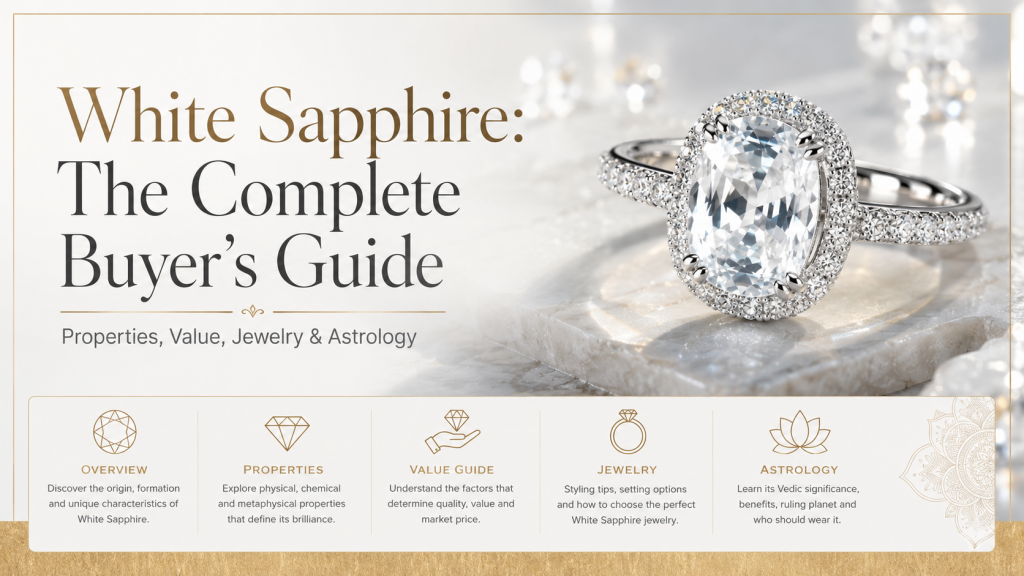
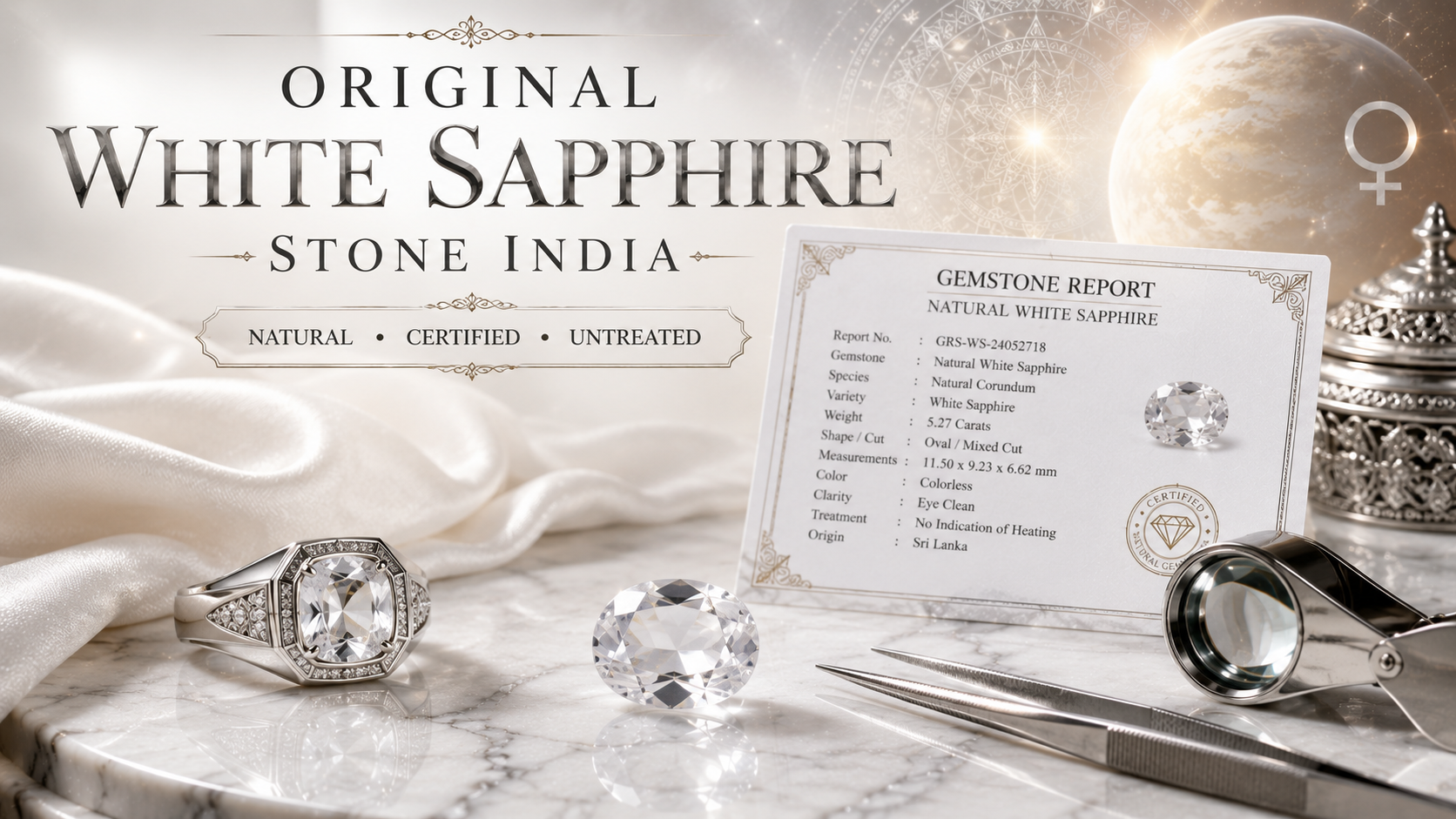
White Sapphire: The Complete Buyer’s Guide to Properties, Value & Jewelry
Here’s something most jewelry buyers don’t know until after they’ve bought: white sapphire isn’t a diamond alternative in the way moissanite is. Moissanite was engineered to mimic diamond. White sapphire just happens to be colorless — and has been, naturally, for millions of years before anyone thought to compare it to anything.
That framing matters. Going into this purchase thinking “budget diamond” sets the wrong expectations. Going in thinking “genuinely precious colorless gemstone with its own character” sets the right ones.
The Stone Itself
White sapphire is corundum — aluminum oxide — the same mineral that makes blue sapphire blue and ruby red. Color in corundum comes entirely from trace impurities. Iron and titanium produce blue. Chromium makes pink and red. When the mineral forms in unusually pure conditions, with almost no trace elements present, you get colorless. That’s it. That’s white sapphire.
The paradox is that “colorless” — which sounds like the absence of something — is actually the result of purity. It’s harder to achieve naturally than color is. Which is why most white sapphires on the market aren’t naturally colorless. They’ve been heat-treated to remove residual tint, or they’ve been grown in a lab. Both routes produce a legitimate, wearable stone. But they’re different things, and the price difference between them is real.
One more thing worth getting straight: this is a precious gemstone. Not semi-precious, not decorative — precious, in the traditional classification that includes diamond, ruby, and emerald. Whatever color a sapphire is, it holds that status. White sapphire doesn’t get a demotion for lacking color.
Technical Properties
Property
Detail
Mineral Family
Corundum (aluminum oxide)
Mohs Hardness
9
Color
Colorless to white
Refractive Index
1.76–1.77
Dispersion
0.018
Density
3.98–4.10
Crystal Structure
Hexagonal (trigonal)
Cleavage
None
Luster
Adamantine, vitreous, or pearly
Transparency
Transparent to opaque
Optical Effects
Asterism or chatoyancy in some specimens
Two numbers deserve attention here. Hardness 9 means this stone resists scratching from nearly everything in daily life — only diamond is harder in practical terms. And “no cleavage” means there are no weak planes in the crystal structure that make it prone to splitting.
The Diamond Question
Let’s just address this properly, because it’s what half the people reading this actually want to know.
Diamond sparkles more. Full stop. The refractive index, dispersion, scintillation — all of it is stronger in diamond. That rainbow-fire effect that diamonds are famous for is a product of optical physics, and white sapphire’s numbers don’t get there.
What white sapphire has instead is a softer, more diffused brightness. Less fire, more glow. Some buyers genuinely prefer it — it reads as elegant rather than flashy.
Durability is basically a wash in everyday wear. Yes, diamond is a 10 and sapphire is a 9, but you’re not going to notice that difference making dinner or typing.
The cloudiness issue is real and worth mentioning honestly. White sapphire picks up surface residue — skin oils, lotion, soap — faster than diamond does.
Price: white sapphire runs roughly one-quarter the cost of a comparable diamond. At larger sizes, the gap gets more dramatic.
What to Look for When You’re Actually Buying
Color
Most white sapphires aren’t perfectly colorless. They carry faint tints — usually blue or yellow, sometimes grey.
The most valuable specimens are as close to true colorless as possible.
Cut
This is where buyers tend to underinvest attention. White sapphire has no rich color to carry its visual weight. It lives and dies by how it handles light.
Round brilliant cuts maximize light return and are standard for engagement ring center stones. Oval and cushion cuts also work well.
Clarity
Sapphires are a Type II gemstone — some inclusions are normal and expected. Eye-clean is the practical standard.
The common inclusions are: hexagonal growth lines, fingerprint patterns, zircon crystals with dark fracture halos around them.
Transparency and the Milky Problem
A lot of white sapphires are hazy. Not dirty — genuinely hazy, from microscopic internal inclusions that scatter light rather than transmit it.
Pricing
There are price jumps at 3 and 5 carats — the per-carat cost steps up at each threshold.
Treatments: What the Market Looks Like
Untreated natural — rarest, most valuable, always needs documentation.
Heat-treated natural — the default.
Fracture filling, diffusion, irradiation — different category entirely.
Lab-grown — chemically identical to natural, costs considerably less.
Meaning, History, and Astrology
White sapphire’s symbolism — purity, clarity, new beginnings — fits the stone visually in a way that blue sapphire’s symbolism of loyalty and royalty doesn’t quite.
Ancient Greeks found white sapphire on the island of Naxos and connected it to Apollo — light, prophecy, the sun.
Vedic Astrology
In Jyotish, white sapphire belongs to Venus — Shukra — the planetary governor of love, beauty, luxury, and partnership.
Birthstone and Anniversary Notes
September birthstone for all sapphires
Alternative April birthstone for white sapphire specifically
Traditional gem for the 5th, 45th, and 75th anniversaries
Zodiac stone for Taurus
Crystal Healing
Crown chakra stone. That’s the primary association — the energy center at the top of the head, linked to clarity, higher awareness, and connection beyond the everyday.
Emotionally, white sapphire is traditionally associated with clearing negative thought loops, building confidence, and developing one’s own talents.
Formation and Sources
Corundum needs aluminum-rich, silica-poor rock and an environment nearly free of trace elements.
Hardness 9 means scratching isn’t a real concern. No cleavage means splitting isn’t either.
Standard cleaning: warm water, mild dish soap, 20–30 minute soak, soft toothbrush, rinse thoroughly, air dry.
Keep all white sapphire away from boric acid. Store away from other gemstones to prevent contact scratching in both directions.
Who This Stone Is For
White sapphire suits a specific kind of buyer — someone who’s thought through what they actually want from a gemstone rather than what they’re supposed to want.
It will look clean and elegant every day, survive decades of wear without special handling, hold meaning in multiple traditions, and cost a fraction of what visual equivalents in other stones would run.
FAQ
Is white sapphire practical for an engagement ring?
Yes — genuinely. Hardness 9, no cleavage, widely available in ring-appropriate cuts and sizes.
Why is it cheaper than other sapphires?
Demand. Blue sapphire and Padparadscha command premiums because collectors and buyers want them.
How do I know if it’s natural or lab-grown?
Curved growth lines, gas bubbles, smoky veils are common lab indicators. For meaningful purchases, get a GIA or AGL certificate.
The cloudiness — is that permanent?
No. It’s surface residue. Warm soapy water and a toothbrush clears it.
What treatments should concern me?
Fracture filling, irradiation, diffusion. Heat treatment is standard industry practice.
White sapphire vs. white topaz — same thing?
No. Different mineral, different hardness, different durability.
What’s the spiritual meaning?
Purity, clarity, new beginnings. Venus stone in Vedic astrology and crown chakra stone in crystal healing traditions.
Is daily wear realistic?
Yes. One of the more practical choices for daily jewelry.
Key Takeaways
Precious gemstone — same classification as diamond, ruby, emerald
Hardness 9, no cleavage: suited to daily wear
Less sparkle than diamond; roughly one-quarter the price
Most market stones are heat-treated
Eye-clean transparency is the standard that matters
Clouds with wear; cleans easily
Venus stone in Vedic astrology
Lab-grown is legitimate when disclosed properly
Independent gemological certification is worth it
If you’re seeking authentic guidance for career, health, or relationship concerns, or wish to explore genuine Vedic remedies, visit our webpage at purevedicgems. Our site features trusted astrology consultations, high-quality gemstones, Rudrakshas, and Vedic rituals, all rooted in deep knowledge and traditional practices. Discover how our holistic approach can support your well-being and spiritual growth.
Genuine Products and Satisfied Customers are our first and foremost priority
Firstly, I want to give compliment to the website. By chance, I came to know the shop from the Internet only. The design of the website attract me a lot as well as it gives many useful knowledge about Astrology, gemstones, etc. After that, I feel thankful to Mr.Vikas Ji and his staffs for their understanding, support me from A to Z and help me solve all my problems. Whatever I don\'t understand, they guide me very slowly, clearly and remove all my doubts. They are great people - I have to say!!! Thanks a ton. Finally, the products are very good and give me positive result till now (nearly 3 months). The rings are well-designed - even many Indians, they also gave me compliments on the rings; the gems are high quality - very stunning. Just only compliments - no any doubts. I definitely come back and purchase more products from this shop. In the future, if anyone need Astrology products, I will highly recommend Pure Vedic Gems to them!!! With love and all my best wishes to all of you! Yen Van (VietNam)
As recommended by Astrologer, I purchased the gemstones. I must say that they have a Unique role. After 3 months of wearing them, intuitively these have guided me in the right direction and given me a lot of strength in my convictions and getting beyond false sense of securities in life. Rest future will tell, how these prisms actually affect one. I am grateful to Vikas Mehra Ji for his time, his advice and detailed and patient way of dealing with customers. Thank you! Regards
The service was wonderful. Delivery and updates were very prompt and the pictures were incredibly appreciated. The ring itself has been fantastic. I wear it everyday and can feel the effects of it. Very grateful to have found you and will recommend you to friends looking for gamestones and use your service for any of my own future needs!
Hare Krishna All I bought two gem stones from Pure Vedic Gems. I was bit confused about gem stones because it was my first time experience. I cruised around many websites and made phone calls in India, but didn\'t get any satisfactory answers. I contacted Pure Vedic Gems, they followed up my quiries nicely. Vikas ji the owner of Vedic Gems gave me very valuable advices. It took me long time to finalize the products, but staff had lots of patience. Pure Vedic Gems team answered all my questions and helped me to select the products. They helped me on every step of this process. I will highly recommend Pure Vedic Gems to any customers especially Overseas Clients, because it is very hard to find right place to buy gems with complete package (including rings). They have given certificates of Gems and done the proper puja process too. And one more thing to mention, they have Astrologer Team which can help you out if you are not sure of right gem for you on very nominal charges. Full marks to Vikas Mehra ji and his team. Thanks a million Regards Baljit Bains
It was great talking to Vikas, I found him very knowledgeable, and he helped me choose the right product. Pure Vedic Gems team equally is very very helpful, He always sorted out all my quaries & was very responsive.I received the product on time & its a wonderful peace of gem. One doesn’t need to worry about product’s authenticity when buying from Purevedicgems.
Right away as soon as I started my order i was contacted by pure vedic gems team to make sure everything was set up perfectly for my ring to be made. They walked me through the whole process up to delivery. The stone was very good quality and well energized and I felt the difference as soon as I started wearing it. The craftsmanship of the ring was great aswell. I am grateful to have found purevedicgems and I cant wait to make my next purchase :)
Hi Vikasji, Its my pleasure to write feedback about the interaction that we had. I am very impress with the quality of the gemstone, reasonable pricing, finishing and perfection with with it is embedded into ring. The overall services such as - day to day interaction , resolving queries with quick responses and delivery on time in secure packing. I had received excellent customer service for first purchase of a another gemstone last year, the same experience this time as well. I would continue to use Purevedic for future purchases and would highly recommend to others.
A Final end, destination when u are searching for pure unheated untreated Vedic Gemstones. The Very first day when I saw website and videos of oceanic knowledge and an unsaid promise for pure Ratana and consultation. I wish Mr Vikas ( whom I have never met ). But I wish to..... But I bought Emerald from Pure Vedic Gems. It\'s really very nice quality as promised. Nowadays when every one in market promises for true stones, the one trusted stop is Mr Vikas whose true and valuable guidance will surely make u go for a real stone , none other than Pure Vedic Gems. My best wishes are with them and Vikas ji too.. May the supreme power, lord of us all shower blessings on them...
I bought 2 gemstones (Yellow Sapphire & Red Coral) from Pure Vedic Gems and I am very pleased with the products and customer services. The gemstones were high quality and very beautiful. PURE VEDIC GEMS teams was very helpful throughout the journey. He helped me from the purchase to delivery of the product. Thank you