More than 4 generations old family tradition (Since 1937) of dealing in Pure Astro-Vedic quality jyotish gemstones, high quality genuine Rudrakshas and Authentic Vedic Yagyas.
The Strange and Enduring Legends of Blue Sapphire Stone
People have been afraid of blue sapphire for a long time.
Not afraid the way you’re afraid of something dangerous. Afraid the way you’re afraid of something that actually works — that carries real consequence and doesn’t particularly care about your intentions. That specific flavor of fear runs through almost every culture that encountered this stone seriously, from ancient India to medieval England, and it shaped the mythology in ways that are still visible if you know where to look.
Neelam in Vedic tradition. The sky stone to the Persians. The bishop’s gem in medieval Europe. Same mineral, entirely different frameworks. What’s remarkable isn’t that the stories differ — every culture builds its own meanings onto things it finds extraordinary. What’s remarkable is that they all landed on the same basic conclusion: this stone is not passive.
What It Is, Before the Stories
Blue sapphire is corundum. Aluminum oxide, colored by iron and titanium during crystallization. The same mineral — exactly the same mineral, not a cousin or a relative — produces ruby when chromium is present instead. One trace element separates blue sapphire from ruby. Worth sitting with.
Hardness 9 on the Mohs scale. No cleavage planes. From a purely material standpoint, one of the most practical gemstones for jewelry that exists. It resists scratching from essentially everything you’ll encounter in normal life and won’t split along a weak plane the way tanzanite or topaz can.
None of that explains why civilizations built cosmologies around it. The material properties are almost beside the point in the mythology. What mattered was the color — that particular depth of blue that doesn’t look quite like anything else in nature — and whatever it seemed to represent to people who’d never seen the ocean or the open sky through glass.
Saturn’s Stone
Start here, because this tradition carries the most ongoing consequence.
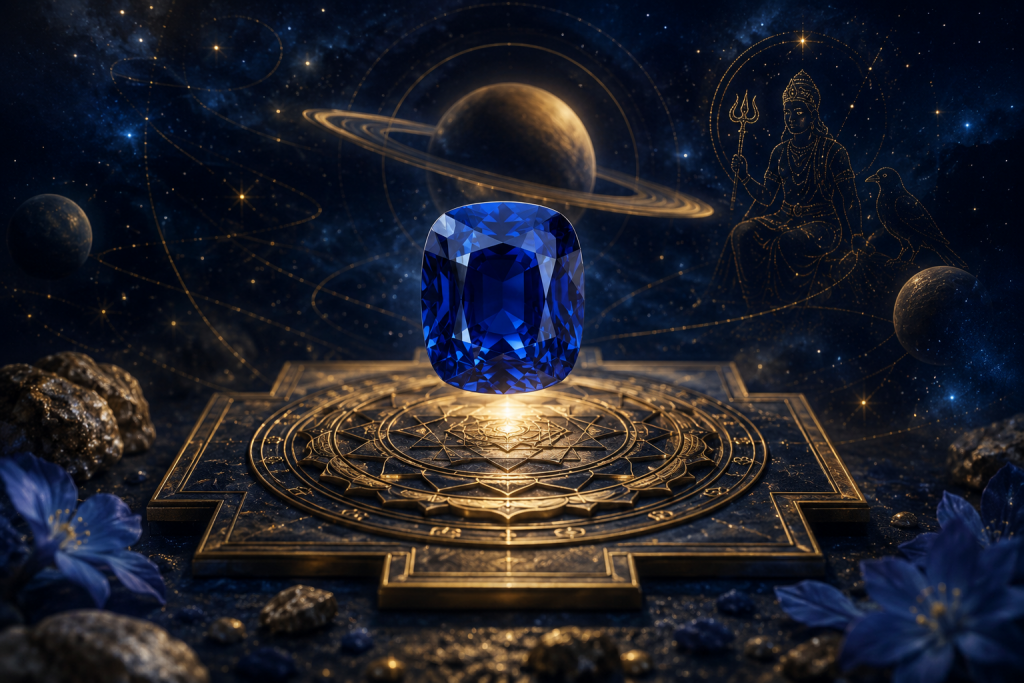
In Jyotish — Vedic astrology — Saturn is Shani Dev, and Shani is not gentle. He governs karma, discipline, consequence. He delivers what’s owed. Ancient texts don’t describe him as cruel, exactly — more like precise. Which is almost worse, depending on where you stand karmically.
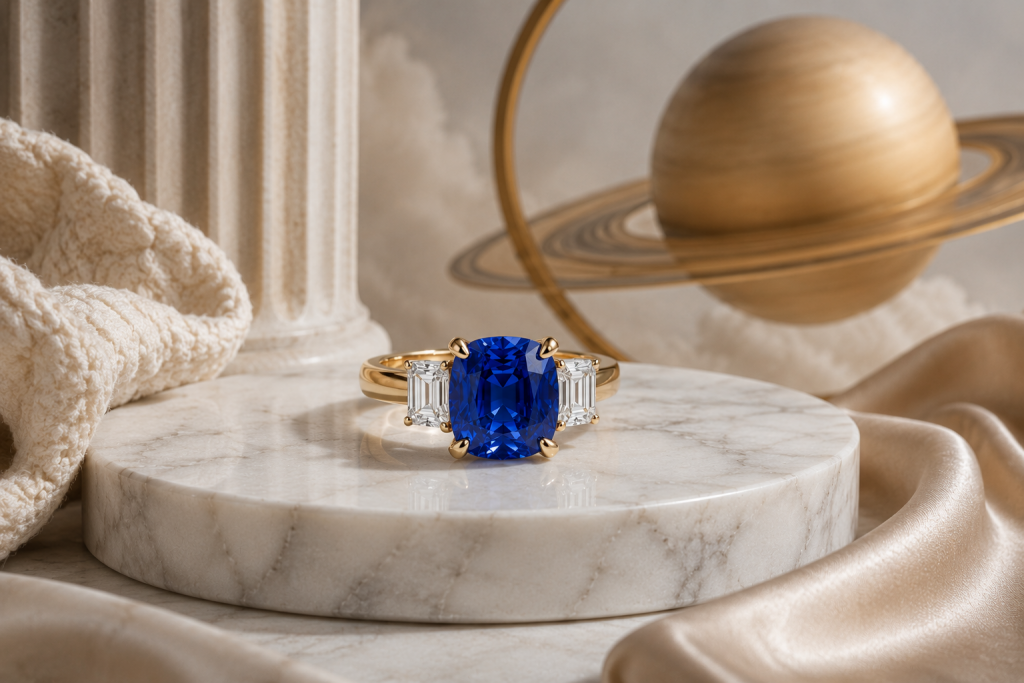
Blue sapphire is his stone. And because Saturn’s influence can transform a life or devastate one, sometimes in the same transit period, his stone carries that same dual possibility. This is why — unlike essentially any other gemstone in Vedic tradition — blue sapphire comes with a standing recommendation to test it before committing. Wear it for a few days. Pay attention. Some practitioners say three days is enough. Some say a week. The reasoning is consistent: if Saturn’s placement in your chart isn’t favorable, you want to find that out before you’ve been wearing his stone for six months.
The legend most people know involves King Vikramaditya. One of the most celebrated rulers in Indian history — by reputation just, wise, militarily successful. And Saturn still found him. The planet held a difficult position in his chart, and the consequences were real according to the story: genuine loss, a period of misfortune that matched his earlier prosperity in intensity if not direction. Advisors eventually suggested a blue sapphire to rebalance things. It worked. Fortunes turned.
Is it history? Probably not in the literal sense. But as an instructional myth it’s been remarkably effective — the message has survived intact for centuries: powerful stone, responds to your specific karma, rewards caution over enthusiasm.
Persia Built Its Sky on Sapphire
The Persian tradition takes a different angle entirely. Less about individual fate, more about the structure of the cosmos itself.
Ancient Persian belief held that the Earth rested on an enormous blue sapphire. The sky’s blue color was its reflection. That’s the whole theory — and it meant that wearing blue sapphire wasn’t wearing a beautiful stone. It was carrying a fragment of the thing holding the world together.
Persian kings took this seriously. Sapphires appeared in crowns, on sword hilts, in ceremonial objects. The stone was believed to guard against envy — a rational concern if you’re a king with enemies — and to repel hostile forces more broadly. One legend describes a ruler who dreamed of a divine figure presenting him with a blue sapphire, and whose reign afterward was defined by unusual clarity of judgment and lasting success. Court historians treated such accounts as meaningful, not decorative.
What’s interesting is that Persian courts also understood quality distinctions. The finest Neelam stones were actively sought out, collected, and distinguished from lesser specimens. The mythology didn’t make all blue sapphires equal — it made the best ones more important.
Medieval Europe: Bishops, Kings, and a Loyalty Test
By the time blue sapphire became prominent in European courts, it had already accumulated centuries of reputation from other directions. Europeans reframed it through Christian theology and the specific anxieties of feudal society, which mostly meant: divine favor and loyalty.
The clergy got there first. Bishops and cardinals wore blue sapphire rings on the logic that the stone’s color reflected the divine — heavenly blue, clarity of spiritual purpose, protection for those in sacred office. Some medieval theological writing treated it as the gem most appropriate for religious authority. Whether that belief was genuine piety or useful symbolism, the effect was the same: blue sapphire became the stone of men who claimed to speak for God.
The royal courts used it differently. A legend — its exact origin is genuinely disputed among historians, which is itself interesting — describes a king who gave his queen a blue sapphire as a test of faithfulness. The stone would shine for a pure-hearted person and dull in the presence of betrayal. The story circulated widely. Whether anyone actually believed it literally or whether it served as a kind of social fiction that helped courts manage loyalty anxieties is hard to say from this distance. Both probably.
One thing worth noting separately: sapphire engagement rings existed in ancient Rome. Long before diamond rings became fashionable in the 1400s. The medieval European association with fidelity wasn’t invented from scratch — it was inherited and reinforced by traditions much older than the courts that promoted it.
The Buddhist Approach
Quieter than the others, and worth understanding on its own terms rather than as a lesser version of the dramatic traditions.
Buddhist symbolism associates blue with the infinite sky — boundless, clear, not belonging to any particular moment or concern. A blue sapphire in this framework becomes a meditation object, something to anchor attention when the mind won’t settle. The tradition isn’t asking the stone to do something powerful. It’s asking it to be still.
An old story describes a monk who meditated with a blue sapphire and reached a depth of clarity and peace he hadn’t accessed before. No divine figure. No reversal of fortune. Just a monk, a stone, and sustained stillness. The story spread through monastic communities because it described something practitioners recognized as possible — not supernatural, just deeply focused.
Some Buddhist-influenced meditation practices still use blue sapphire as a focal object. The reasoning is essentially unchanged from whatever century that monk first wrote down his experience.
Why These Stories All Point the Same Direction
Four cultures, no meaningful contact with each other during the periods when these traditions formed. And all four landed on: this stone does something.
Hindu tradition: it amplifies Saturn’s karmic influence.
Persian tradition: it’s a fragment of the foundation of the world.
Medieval European tradition: it responds to moral character.
Buddhist tradition: it facilitates stillness and clarity.
Different frameworks, different metaphysics, different practical applications. But the shared premise — that blue sapphire isn’t passive, that it interacts with whoever wears or uses it — is consistent across all of them. That pattern is interesting regardless of what you believe about gemstone metaphysics. Objects that generate this quality of consistent attention across unrelated civilizations are rare. There are maybe a dozen of them in human history. Blue sapphire is one.
For buyers approaching the stone through Vedic tradition, a few things come up consistently across sources:
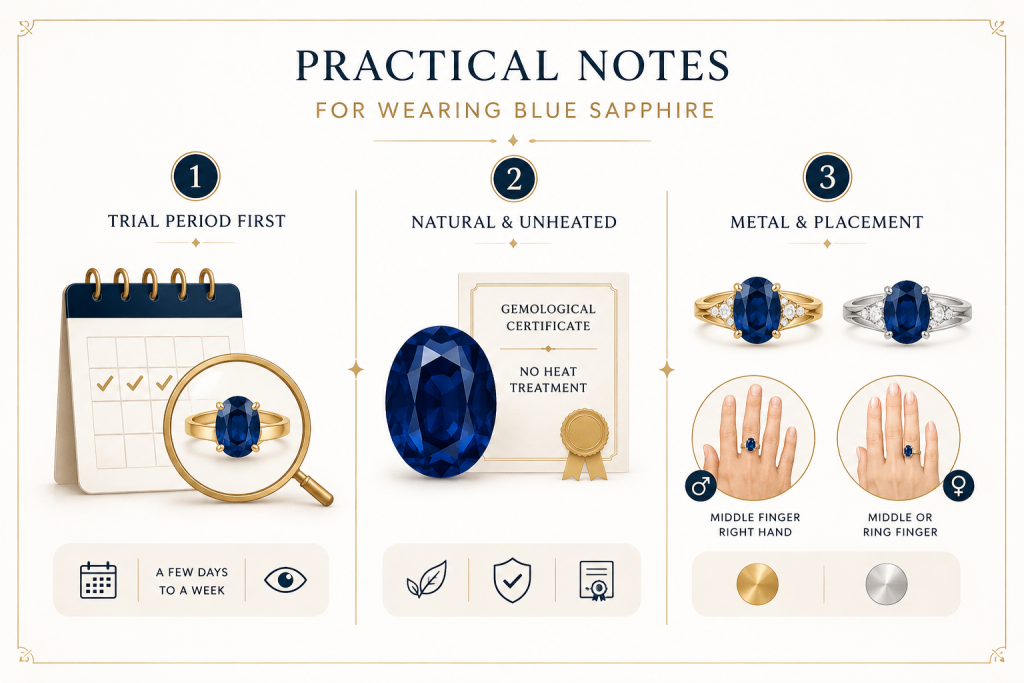
Trial period first. This is the near-universal recommendation and the one that distinguishes blue sapphire from almost every other Jyotish stone. Wear it briefly — a few days, a week — and observe.
Natural and unheated. For astrological purposes, heat treatment is considered to diminish effectiveness. A gemological certificate confirming no heat treatment is the standard expectation for serious use.
Metal and placement. Gold and silver are the traditional setting materials. The middle finger of the right hand is conventional for men; women typically wear it on the middle or ring finger.
Some Questions Worth Answering
Why the trial period? Is it really necessary?
Within the Vedic framework, yes — and the reasoning is coherent even if you’re skeptical of astrology generally.
The Vikramaditya legend — history or myth?
Almost certainly instructional myth rather than documentary history.
Did Persians literally believe the sky was blue from a sapphire?
Ancient Persian cosmological texts do describe the Earth resting on a blue sapphire.
Why clergy specifically?
The color association was the primary driver — blue for heaven, for divine clarity, for things beyond ordinary human concern.
Is it actually good for an engagement ring?
Better question might be: why did diamonds displace it? Sapphire engagement rings are older and carry a long tradition of fidelity and commitment.
Kashmir vs. Sri Lanka — does it matter?
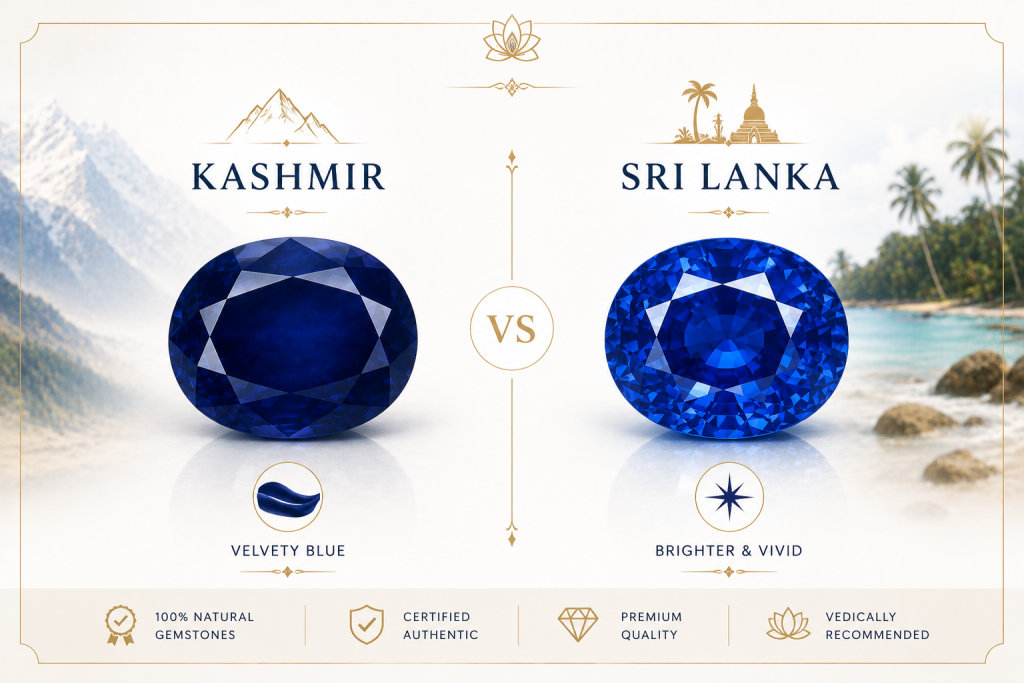
Yes. Kashmir sapphires are famous for their velvety blue appearance, while Sri Lankan sapphires are often brighter and more vivid.
What to Actually Take Away From All This
Blue sapphire is a stone with a longer and stranger cultural history than most people who buy it realize. The Vedic tradition alone — with its specific guidance about Saturn, trial periods, and the immediate nature of the stone’s effects — is more detailed and internally consistent than most gemstone traditions.
None of this requires belief in astrology or mythology to be interesting. It requires recognizing that blue sapphire is one of the handful of objects in human history that multiple unrelated civilizations decided was worth building systems of belief around.
Wear it because it’s beautiful if you want. But knowing why it was considered extraordinary for two thousand years before you arrived makes it more interesting to own.
If you’re seeking authentic guidance for career, health, or relationship concerns, or wish to explore genuine Vedic remedies, visit our webpage at purevedicgems. Our site features trusted astrology consultations, high-quality gemstones, Rudrakshas, and Vedic rituals, all rooted in deep knowledge and traditional practices. Discover how our holistic approach can support your well-being and spiritual growth.
Genuine Products and Satisfied Customers are our first and foremost priority
Firstly, I want to give compliment to the website. By chance, I came to know the shop from the Internet only. The design of the website attract me a lot as well as it gives many useful knowledge about Astrology, gemstones, etc. After that, I feel thankful to Mr.Vikas Ji and his staffs for their understanding, support me from A to Z and help me solve all my problems. Whatever I don\'t understand, they guide me very slowly, clearly and remove all my doubts. They are great people - I have to say!!! Thanks a ton. Finally, the products are very good and give me positive result till now (nearly 3 months). The rings are well-designed - even many Indians, they also gave me compliments on the rings; the gems are high quality - very stunning. Just only compliments - no any doubts. I definitely come back and purchase more products from this shop. In the future, if anyone need Astrology products, I will highly recommend Pure Vedic Gems to them!!! With love and all my best wishes to all of you! Yen Van (VietNam)
As recommended by Astrologer, I purchased the gemstones. I must say that they have a Unique role. After 3 months of wearing them, intuitively these have guided me in the right direction and given me a lot of strength in my convictions and getting beyond false sense of securities in life. Rest future will tell, how these prisms actually affect one. I am grateful to Vikas Mehra Ji for his time, his advice and detailed and patient way of dealing with customers. Thank you! Regards
The service was wonderful. Delivery and updates were very prompt and the pictures were incredibly appreciated. The ring itself has been fantastic. I wear it everyday and can feel the effects of it. Very grateful to have found you and will recommend you to friends looking for gamestones and use your service for any of my own future needs!
Hare Krishna All I bought two gem stones from Pure Vedic Gems. I was bit confused about gem stones because it was my first time experience. I cruised around many websites and made phone calls in India, but didn\'t get any satisfactory answers. I contacted Pure Vedic Gems, they followed up my quiries nicely. Vikas ji the owner of Vedic Gems gave me very valuable advices. It took me long time to finalize the products, but staff had lots of patience. Pure Vedic Gems team answered all my questions and helped me to select the products. They helped me on every step of this process. I will highly recommend Pure Vedic Gems to any customers especially Overseas Clients, because it is very hard to find right place to buy gems with complete package (including rings). They have given certificates of Gems and done the proper puja process too. And one more thing to mention, they have Astrologer Team which can help you out if you are not sure of right gem for you on very nominal charges. Full marks to Vikas Mehra ji and his team. Thanks a million Regards Baljit Bains
It was great talking to Vikas, I found him very knowledgeable, and he helped me choose the right product. Pure Vedic Gems team equally is very very helpful, He always sorted out all my quaries & was very responsive.I received the product on time & its a wonderful peace of gem. One doesn’t need to worry about product’s authenticity when buying from Purevedicgems.
Right away as soon as I started my order i was contacted by pure vedic gems team to make sure everything was set up perfectly for my ring to be made. They walked me through the whole process up to delivery. The stone was very good quality and well energized and I felt the difference as soon as I started wearing it. The craftsmanship of the ring was great aswell. I am grateful to have found purevedicgems and I cant wait to make my next purchase :)
Hi Vikasji, Its my pleasure to write feedback about the interaction that we had. I am very impress with the quality of the gemstone, reasonable pricing, finishing and perfection with with it is embedded into ring. The overall services such as - day to day interaction , resolving queries with quick responses and delivery on time in secure packing. I had received excellent customer service for first purchase of a another gemstone last year, the same experience this time as well. I would continue to use Purevedic for future purchases and would highly recommend to others.
A Final end, destination when u are searching for pure unheated untreated Vedic Gemstones. The Very first day when I saw website and videos of oceanic knowledge and an unsaid promise for pure Ratana and consultation. I wish Mr Vikas ( whom I have never met ). But I wish to..... But I bought Emerald from Pure Vedic Gems. It\'s really very nice quality as promised. Nowadays when every one in market promises for true stones, the one trusted stop is Mr Vikas whose true and valuable guidance will surely make u go for a real stone , none other than Pure Vedic Gems. My best wishes are with them and Vikas ji too.. May the supreme power, lord of us all shower blessings on them...
I bought 2 gemstones (Yellow Sapphire & Red Coral) from Pure Vedic Gems and I am very pleased with the products and customer services. The gemstones were high quality and very beautiful. PURE VEDIC GEMS teams was very helpful throughout the journey. He helped me from the purchase to delivery of the product. Thank you