Original Pukhraj Stone Price in India: Cost, Quality & Buying Guide
Vikas June 13, 2026 in
Astrology Original Pukhraj Stone Price in India: What You’ll Actually Pay and Why
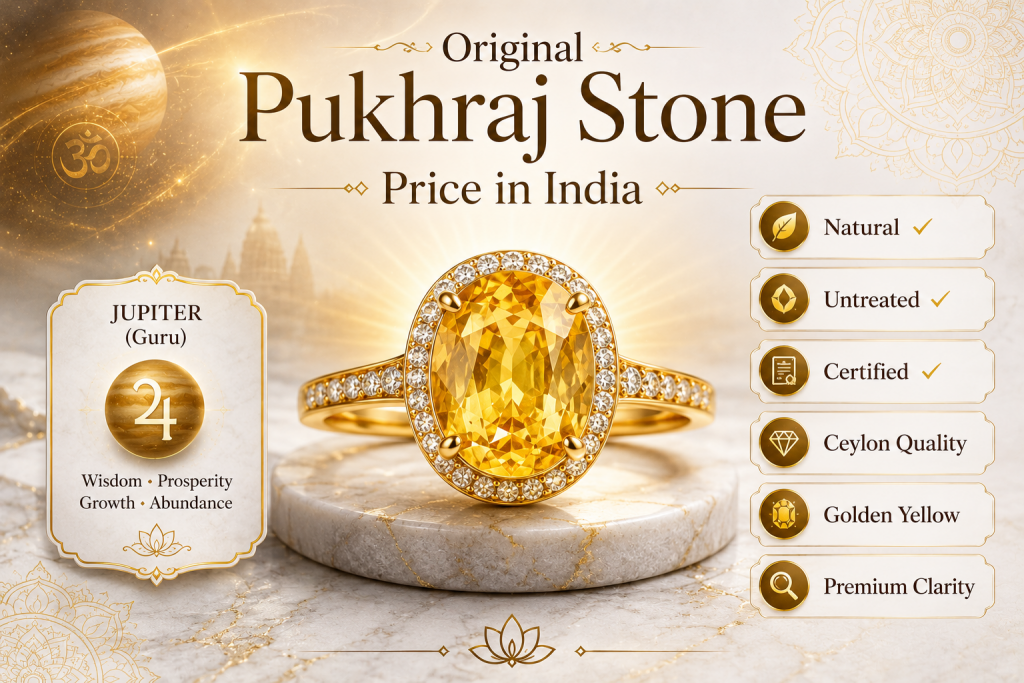
The original Pukhraj stone price in India ranges from approximately ₹2,100 per ratti to ₹50,000 per ratti and above. That’s not a vague estimate — it’s a genuine reflection of how dramatically quality factors compound in yellow sapphire.
Two stones of identical carat weight, both marketed as “natural Pukhraj,” can sit at opposite ends of that range for entirely legitimate reasons. Understanding what creates the spread is the difference between making an informed purchase and paying premium prices for commercial-grade material — or budget prices for something that won’t deliver the astrological results you’re buying it for.
Why the Market Is Confusing
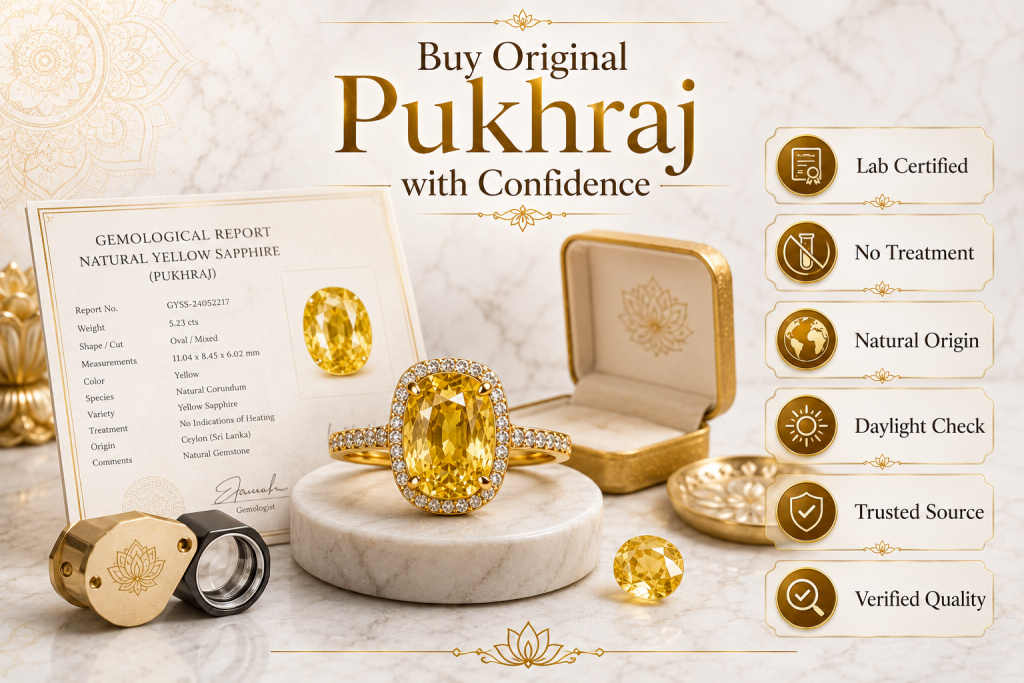
Before getting into price factors, something worth saying directly: the Pukhraj market in India has a significant problem with treated stones sold without proper disclosure.
Beryllium diffusion treatment artificially infuses color into lower-grade yellow sapphire, making pale or colorless material appear vivid golden yellow. Heat treatment improves color and clarity. Both are common. Both are sometimes sold without disclosure, or with certificates from laboratories whose independence and standards are difficult to verify.
For jewelry purposes, a treated Pukhraj might look beautiful and serve its purpose well. For astrological purposes — where the stone’s natural energetic signature is what you’re paying for — the Vedic tradition is consistent: treated stones have marginal astrological value compared to natural untreated material. The price difference between them exists for a reason, and buyers who don’t know to ask about treatment status end up paying natural prices for treated material regularly.
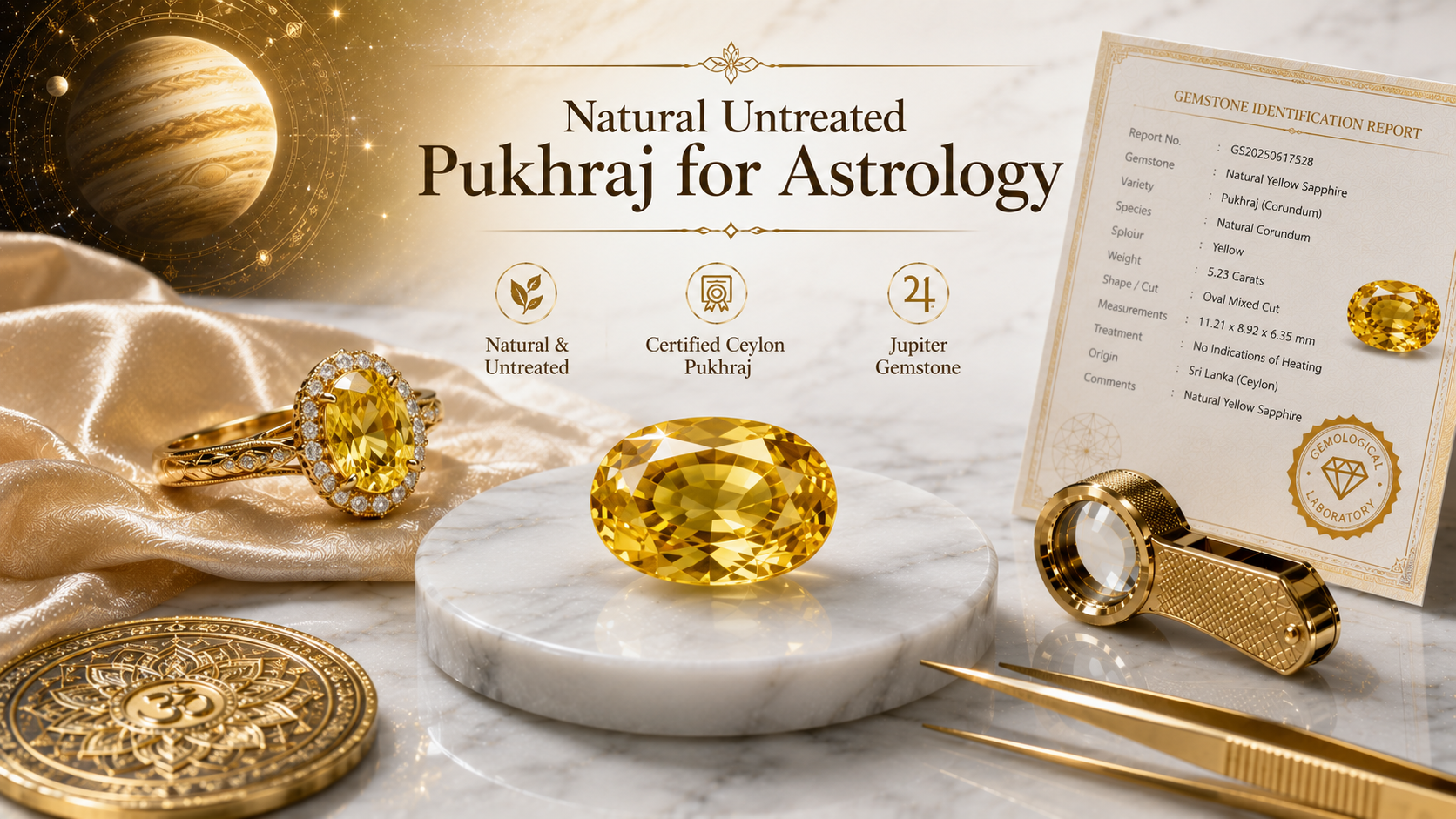
Independent certification from GIA, IGI, GRS, or an equivalent recognized laboratory is what distinguishes a verifiable purchase from one taken on faith. The certificate should specifically confirm natural origin and no treatment — not just natural origin alone.
What Determines Original Pukhraj Stone Price in India
Color drives more of the price than any other single factor. The most valued shade is a vivid, pure golden yellow — warm and saturated, with no brown or orange cast, even distribution throughout the stone, and that quality of looking lit from within rather than simply reflecting light. Pale, washed-out stones and heavily orange-tinged stones are less desirable and priced accordingly. The gap between a vivid golden yellow and a dull pale stone of the same weight and origin can be three to five times in per-ratti price.
Origin creates the clearest price tier. Ceylon (Sri Lanka) Pukhraj is considered the benchmark for astrological use — consistent color, good transparency, and a higher availability of natural untreated material than most other sources. Fine untreated Ceylon yellow sapphire starts from approximately ₹5,000 per ratti at entry quality and reaches ₹40,000 to ₹50,000+ per ratti for exceptional specimens.
Burma (Myanmar) produces excellent yellow sapphire with deep golden color at premium prices. Madagascar and Thailand offer more accessible price points for commercial quality material. Indian Pukhraj from Rajasthan and Karnataka exists and carries its own character, though Ceylon and Burmese material dominates serious astrological recommendations.
Treatment status creates the most consequential price difference for astrological buyers. Natural untreated yellow sapphire of fine color commands a significant premium over heated material of equivalent appearance — often two to three times the price at comparable quality levels. This premium exists because untreated material is genuinely rarer and because the astrological market specifically values it.
Clarity. Natural yellow sapphires contain minor inclusions — this is expected and normal. Eye-clean or near-eye-clean specimens with good transparency command higher prices. Heavily included, cloudy stones are less effective astrologically and less valuable gemologically. A completely flawless stone under magnification is worth questioning — it may be synthetic or treated.
Cut and carat weight. Well-proportioned cuts that maximize color and light return command premiums over poorly cut material of identical rough quality. Carat weight premiums step up significantly above 3 carats, 5 carats, and 10 carats for quality material — large natural untreated yellow sapphires with fine color are genuinely scarce.
Price Ranges in Practice
For context on what original Pukhraj stone price in India looks like across quality tiers:
Commercial grade heated material — pale color, visible inclusions, treated — runs approximately ₹1,100 to ₹2,500 per ratti. This is what dominates the lower end of the market and what most buyers encounter without realizing it’s treated.
Mid-grade natural material — decent color, some inclusions, possibly heated — falls in the ₹2,500 to ₹8,000 per ratti range.
Fine natural untreated Ceylon Pukhraj with good color and eye-clean clarity — ₹8,000 to ₹25,000 per ratti.
Exceptional untreated Ceylon or Burmese material with vivid golden yellow color, excellent clarity, and documented origin — ₹25,000 to ₹50,000+ per ratti and above.
For astrological weight requirements — the classical guideline is 1 ratti per 12 kg of body weight, so a 60 kg person should wear approximately 5 ratti — multiply the per-ratti price by the required weight to get a realistic budget expectation.
How to Identify Original Pukhraj Stone
Natural shine and density. Genuine yellow sapphire has a warm, radiant glow and feels noticeably dense in the hand compared to glass or synthetic material. It warms slightly from body heat but feels cool initially — the same quality that applies to all natural corundum.
Natural inclusions under magnification. Real Pukhraj almost always contains minor internal characteristics — growth lines, silk, small crystal inclusions. A stone that appears completely flawless under a 10x loupe at a moderate price is suspicious. Genuine inclusion-free natural yellow sapphire exists but is extremely rare and priced accordingly.
Color consistency under different lighting. Natural golden yellow holds reasonably consistent color across different lighting conditions. Beryllium-diffused stones sometimes show color concentrated near the surface or behave oddly under different light — though this requires expertise and sometimes advanced testing to confirm.
Independent certification. This is the only reliable confirmation for any buyer without gemological training. A certificate from GIA, IGI, GRS, or equivalent confirming natural origin and no treatment is the document that makes all other quality claims verifiable.
How to Wear Pukhraj for Astrological Benefit
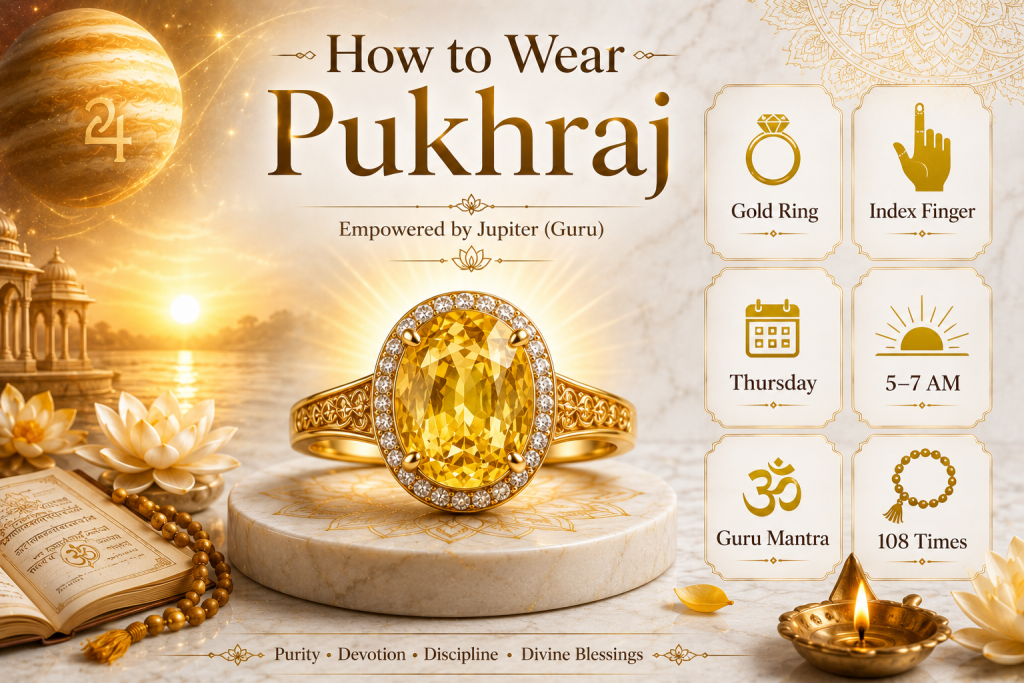
Gold setting is the universal recommendation — Jupiter’s metal, aligned with the planet’s warmth and expansive energy.
Index finger of the right hand. Thursday morning between 5 and 7 AM, Shukla Paksha. These are Jupiter’s day and the auspicious lunar phase for beginning to wear a new planetary stone.
Before first wearing, purify the ring in Ganga Jal or milk. Chant the Jupiter beej mantra 108 times:
Om Graam Greem Graum Sah Guruve Namaha
(ॐ ग्रां ग्रीं ग्रौं सः गुरवे नमः)
Care After Purchase
Lukewarm water, mild soap, soft toothbrush around the setting, gentle scrub, rinse thoroughly, dry with soft cotton cloth. Do this monthly. Yellow sapphire at hardness 9 doesn’t scratch easily, but surface residue from daily wear dulls the luster over time.
No harsh chemicals, no ultrasonic cleaners for treated material, no prolonged heat exposure. Store separately in a soft pouch to prevent contact scratching with other jewelry.
The Short Version
Original Pukhraj stone price in India reflects genuine quality differences — not arbitrary pricing. Color quality, treatment status, and origin together create the range from ₹2,100 to ₹50,000 per ratti. For astrological use, natural untreated Ceylon Pukhraj with vivid golden yellow color and independent certification is the consistent recommendation. For budget considerations, fine quality within your range outperforms large size with compromised quality every time Jupiter’s stone is involved.
Tags:
authentic pukhraj stone,
buy original pukhraj online,
certified pukhraj stone,
ceylon pukhraj price,
guru ratna pukhraj,
how to identify original pukhraj,
natural pukhraj price,
natural yellow sapphire india,
original pukhraj online,
original pukhraj stone price in india,
original yellow sapphire cost,
pukhraj gemstone price per ratti,
pukhraj price per carat,
pukhraj stone benefits,
pukhraj stone buying guide,
pukhraj stone price,
sri lankan pukhraj price,
untreated pukhraj stone,
yellow sapphire for astrology,
yellow sapphire price india