















Neelam Stone: What You Actually Need to Know Before Buying Blue Sapphire

There’s a version of this guide that opens with “Blue sapphire is a powerful gemstone ruled by Saturn.” You’ve read that sentence a hundred times already. It tells you nothing useful.
So instead, start here: blue sapphire is the one gemstone in Vedic astrology that practitioners almost universally recommend testing before you commit to wearing. Not because it’s dangerous in some mystical sense — but because its effects, within the Jyotish framework, are considered fast and significant. If Saturn is well-placed in your chart, the stone can accelerate career momentum, sharpen focus, improve finances. If he isn’t — or if you’re in a difficult Saturn transit — wearing his stone can intensify that difficulty rather than ease it.
That’s the essential fact. Everything else follows from it.
The Stone Itself
Mineralogically: corundum, aluminum oxide, colored by iron and titanium. Hardness 9 on the Mohs scale — second only to diamond, harder than anything you’ll encounter in daily life. No cleavage planes, which means it won’t split along a structural weakness the way some beautiful but fragile stones do. From a purely practical standpoint, it’s one of the best choices for jewelry worn every day.
The color range is wider than most people expect. Pale cornflower blue at one end, deep almost-navy at the other. The sweet spot gemologically — and astrologically — sits in the medium to deep royal blue range. Vivid, clean color with no grey or green cast. Stones at the extremes — too pale or too dark — are considered less effective and less valuable by both gemologists and Jyotish practitioners, which is a rare case of the two traditions actually agreeing.
Some blue sapphires display asterism — a six-rayed star visible on the surface when the stone is cut as a cabochon. This happens when fine rutile needles align within the crystal during formation. Star sapphires have their own following, their own price dynamics, and the same astrological standing as faceted stones.
Saturn, and Why the Caution Is Rational
Shani Dev — Saturn — governs karma, discipline, patience, and consequence in Vedic astrology. He’s associated with hard work and the slow settling of accounts. Ancient texts don’t describe him as cruel. More like precise. He delivers what’s owed, in both directions, which is almost more unsettling than cruelty because it removes the possibility of appeal.
Two Saturn transit periods get the most attention in Jyotish. Sade Sati — the seven-and-a-half year passage of Saturn through a person’s moon sign and the two adjacent signs — is watched carefully because it tends to bring significant life restructuring, not always comfortable. Shani Dasha is Saturn’s nineteen-year major period in the Vimshottari system. During both, Saturn’s influence is at its most direct.
Wearing blue sapphire during a favorable Saturn period is believed to amplify the positive: discipline, career momentum, financial stability, mental clarity. The same stone during an unfavorable period or with a badly placed Saturn is where the tradition urges caution. This is not about the stone being good or bad. It’s about Saturn’s energy being either supportive or challenging in a specific chart — and his stone intensifying whichever condition is already present.
Test it first. Three days, some say. A week, according to others. Pay attention to what changes. That’s the consistent practical advice across virtually every Jyotish source, and it’s worth taking seriously on its own internal logic even if you approach astrology skeptically.
Who the Stone Is Actually For
The clearest candidates are people with Capricorn or Aquarius rising or as their moon sign. Saturn rules both, and for these natives he tends to be a natural benefactor. Beyond that, Gemini, Virgo, and Taurus ascendants are sometimes recommended blue sapphire depending on how Saturn sits in the individual chart — this isn’t a blanket prescription, it requires looking at the specific nativity.
Professionally, the associations cluster around fields where sustained discipline matters more than inspiration: law, politics, business, research, academia, geology. Saturn rewards methodical effort over time, and so does his stone — it’s not particularly associated with creative breakthroughs or sudden luck of the gambling variety. The financial gains linked to Neelam are described as “sudden” in the literature, but they tend to arrive as the belated result of long consistent effort rather than from nowhere.
Health-wise, Saturn governs bones, teeth, joints, and the nervous system. The stone is sometimes recommended for chronic issues in these areas — nerve pain, joint problems, dental health, asthma. This sits within a traditional healing framework, not a medical one, but the associations are internally consistent with Saturn’s domain.
Wearing It Correctly
Weight first, because this surprises people. The traditional guideline is roughly one-twelfth of your body weight in carats. Sixty kilograms bodyweight suggests a five-carat stone. Heavier stones are considered more potent — not necessarily better, just stronger. Always confirm with an astrologer before finalizing weight, particularly if you’re new to the stone.
Silver is the recommended metal. Gold is traditionally not preferred for Neelam in Vedic practice unless the individual chart specifically calls for it — something that does come up occasionally but isn’t the default. Some practitioners recommend Panchdhatu, a five-metal alloy, as an alternative.
Wear it on the middle finger of your working hand. The logic comes from palmistry — the middle finger is Saturn’s finger. Right hand for right-handed people, left for left-handed.
Saturday morning, between five and seven, during the waxing moon. This is the timing the tradition specifies — Saturn’s day, Saturn’s hours, the lunar phase associated with growth rather than release.
Before wearing for the first time, the ring is purified in raw milk and Ganga Jal, then the Shani mantra is chanted 108 times:
Om Sham Shanicharaya Namah
(ऊँ शं शनैश्चराय नमः)
The ritual is understood as establishing a conscious connection between the stone, the planet, and the wearer. Whether you approach this as spiritual practice or symbolic gesture, the tradition is consistent about its importance.
What It’s Supposed to Do
Career is what most people come for…
Financial improvement comes up constantly…
Mental clarity — sharper decision-making…
Protection from negative energies and jealousy…
Health support in Saturn’s domains…
Spiritual discipline and meditation depth round out the picture.
Price and What Drives It
The range is ₹1,500 to ₹3,00,000 per carat and above. That spread requires explanation because it confuses first-time buyers badly.
Color
Color is the dominant factor…
Origin
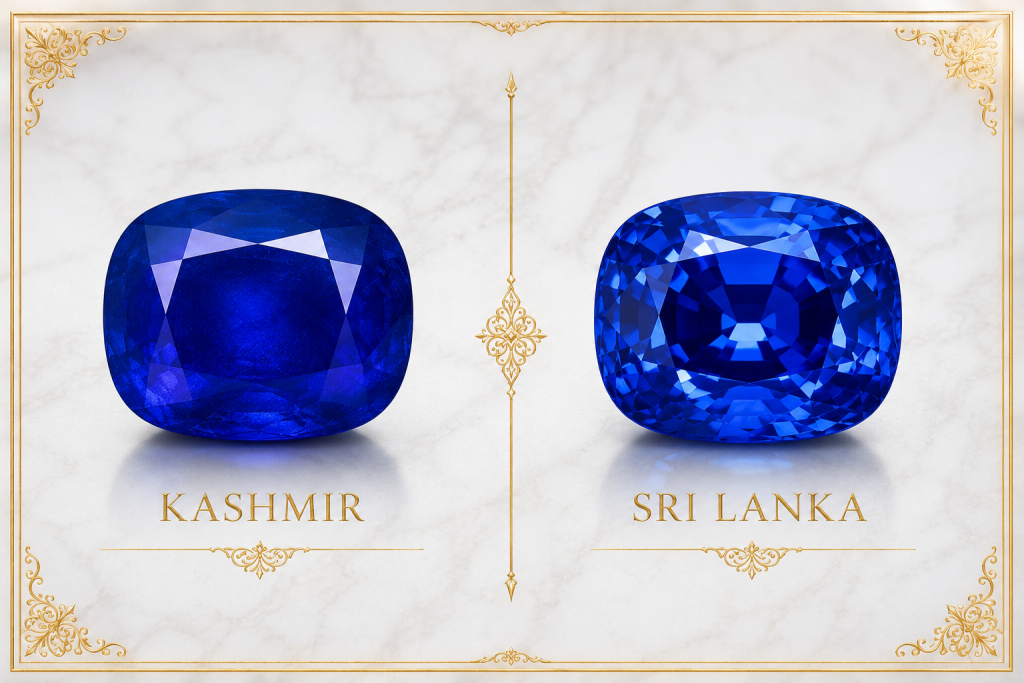
Origin creates significant tiers…
Treatment Status
Treatment status might be the most underestimated price factor…
Carat Weight
Carat weight follows the standard logic…
Buying Without Getting Burned
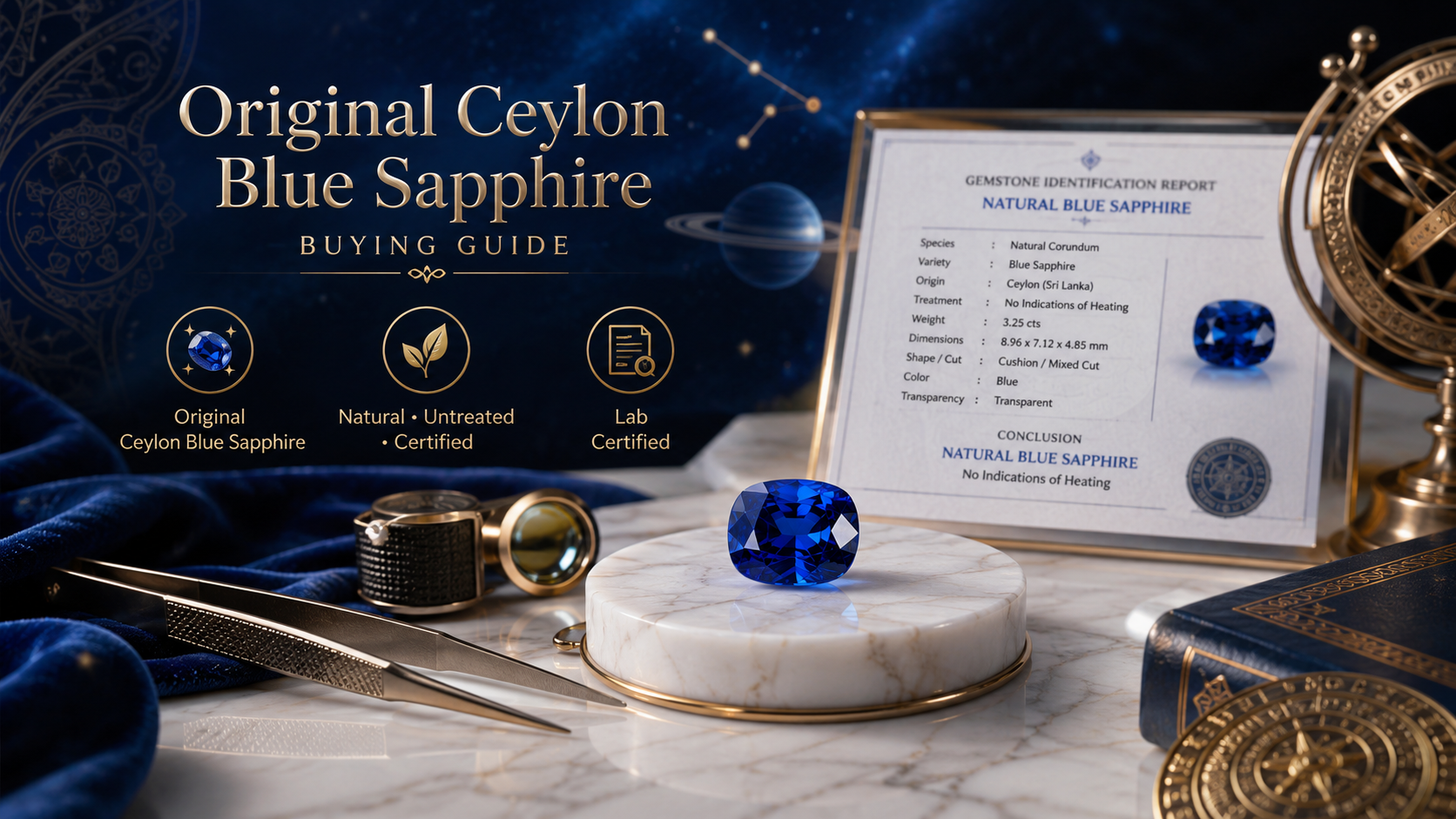
- Certification from an independent laboratory is not optional.
- Inclusions in a natural stone are normal.
- Prices that seem too low are a signal, not a bargain.
- Kashmir origin claims need laboratory documentation.
Cleaning and Storage
Warm water and mild soap, soft brush around the setting, rinse thoroughly, air dry or soft cloth.
Ultrasonic cleaners, steam, and harsh chemical cleaners should be avoided.
Treated stones — particularly fracture-filled or surface-coated ones — are vulnerable to mild acids.
Store separately from other jewelry.
Questions That Come Up Often
Is the price range really that wide?
Yes, and it’s legitimate…
Do real sapphires always have inclusions?
Almost always, yes…
Can I self-prescribe based on my zodiac sign?
Sun sign alone isn’t enough…
What if I’m not sure whether the stone is working?
The tradition suggests paying attention to the first few days of wearing…
Is heated sapphire worthless for astrology?
worthless — the tradition considers untreated stones significantly more effective.