Moti Gemstone Price in India: Original Pearl Price and Quality
Vikas June 13, 2026 in
Astrology Moti Gemstone Price in India: Complete Guide to Pearl Quality & Value
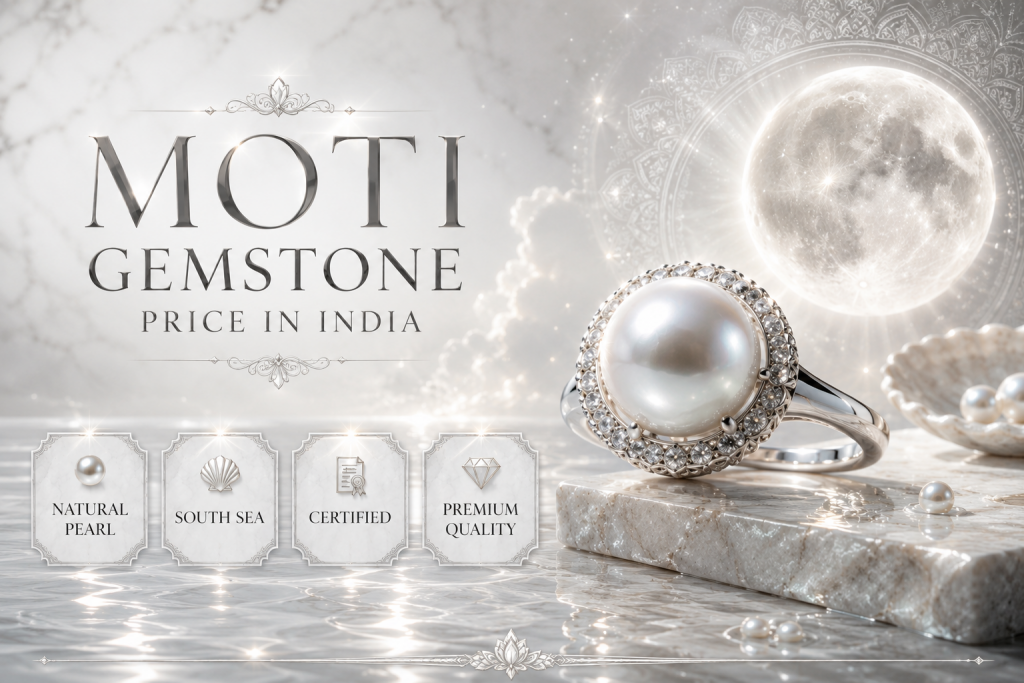
Pearl is the only gemstone made by a living creature.
Every other stone in fine jewelry — sapphire, ruby, emerald, diamond — formed over millions of years through geological processes deep in the earth. Pearl forms inside a mollusk, layer by layer, as the animal coats an irritant with nacre. The result is something that has a warmth and glow no mineral can replicate. That quality isn’t incidental — it’s structural, and it’s been recognized as extraordinary across virtually every culture that encountered it.
In Vedic astrology, pearl is the stone of the Moon — Chandra — governing emotions, mind, intuition, and the quality of inner life. Moti gemstone price varies enormously depending on origin, nacre quality, treatment status, and size. Understanding what drives that variation is what separates an informed purchase from an expensive mistake.
Moti Gemstone Price in India: The Real Range
Original Moti gemstone price in India runs from approximately ₹500 per ratti for basic freshwater cultured material to ₹50,000 per ratti and above for fine natural saltwater specimens from premium origins.
That hundred-fold range isn’t arbitrary. It reflects genuine differences in what you’re actually buying — differences that affect both the pearl’s appearance and its astrological potency.
The major price tiers in practice:
- Freshwater cultured pearl — the most widely available category — runs ₹500 to ₹2,500 per ratti depending on size, luster, and surface quality. Widely available, accessible prices, legitimate but generally considered less potent for astrological use than saltwater varieties.
- South Sea cultured pearl — large, thick-nacred, saltwater origin — runs ₹3,000 to ₹15,000 per ratti for quality specimens. The most commonly recommended variety for astrological use given the combination of quality and relative accessibility.
- Natural saltwater pearl — formed entirely without human intervention — starts at ₹10,000 per ratti for modest quality and reaches ₹50,000 per ratti and above for fine specimens. Genuine natural Basra pearl commands the highest premiums in the Indian astrological market.
What Creates the Price Difference
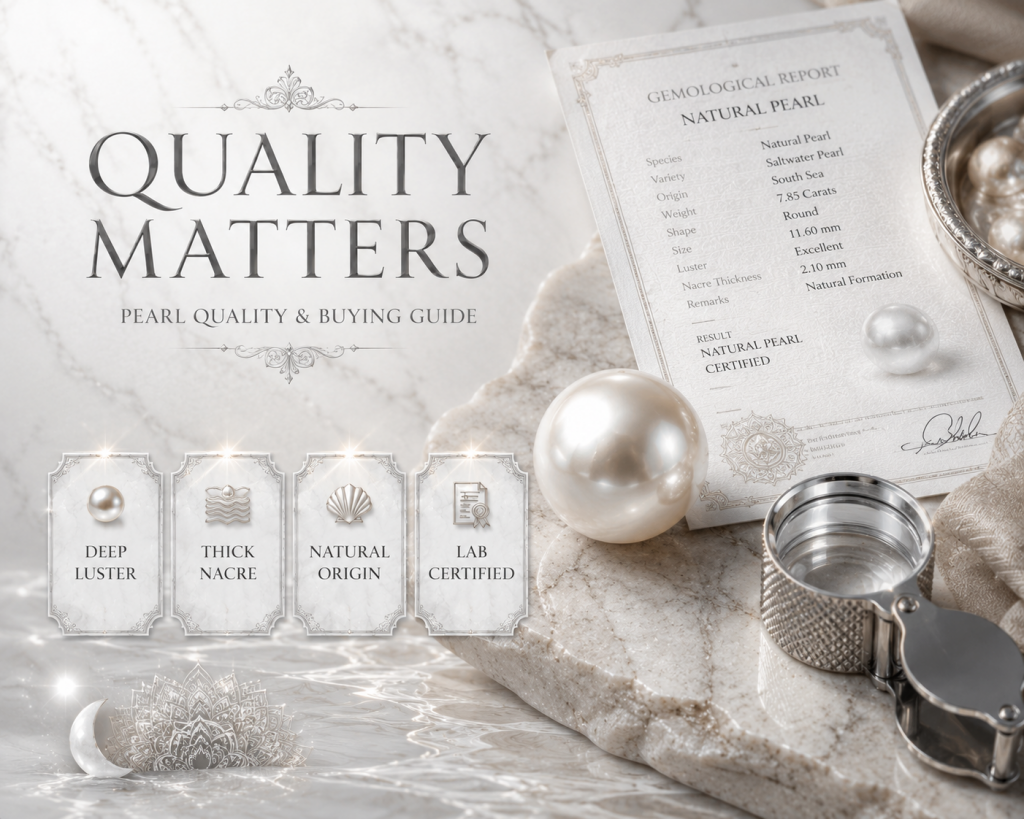
Luster is the single most important quality factor — more important than size, shape, or even surface cleanliness. Luster is the depth and intensity of light reflecting from and just below the nacre surface. Fine pearl luster appears almost wet, with reflections that are sharp and deep rather than chalky or flat. This quality is what makes a pearl look alive rather than simply white and round.
When evaluating Moti gemstone price against quality, luster is what you’re primarily paying for at the high end. A smaller pearl with exceptional luster outperforms a larger pearl with flat, chalky surface quality in both appearance and astrological effectiveness.
Nacre thickness directly affects both luster and durability. Cultured pearls formed around a nucleus can be harvested too early, producing thin nacre that looks good initially but may show the nucleus through the surface over time. Thick nacre — built up over longer cultivation periods — produces better luster and longer-lasting quality. South Sea pearls are specifically prized for thick nacre.
Origin creates significant price tiers in the Moti market. Natural Basra pearl — from the Persian Gulf — commands the highest premiums in Indian astrological tradition and is among the most frequently misrepresented origins. South Sea pearl from Australian, Philippine, and Indonesian waters is the most accessible high-quality option. Sri Lankan saltwater pearl has historical significance in Vedic tradition. Freshwater pearl from Chinese cultivation is the most affordable.
Natural vs. cultured is the most fundamental distinction in Moti gemstone pricing. Natural pearls formed entirely without human intervention are rare — genuinely rare, not marketing-rare. Most natural pearl in the current market comes from antique jewelry or estate sales. The natural-origin premium is real and substantial.
Shape and size. Round and near-round pearls command the highest premiums because they’re the hardest to produce consistently in cultured varieties and rarest in natural material. Oval, button, and drop shapes are also valued. Size premiums increase significantly above 8mm for round specimens.
Types of Moti and Their Astrological Relevance
Natural pearl — the rarest and most astrologically valued. Formed without any human intervention, typically identified only through X-ray examination. The Vedic tradition places the highest value on natural Moti for Chandra’s energy.
South Sea pearl — cultured in saltwater mollusks, known for large size and thick nacre. The most widely recommended option for serious astrological use given quality and availability.
Basra pearl — natural Persian Gulf pearl. Historically the most prized variety in Indian astrological tradition. Genuine Basra pearl is rare and expensive. Also one of the most frequently misrepresented origins in the Indian market — laboratory documentation is essential before paying Basra premiums.
Freshwater pearl — cultured in rivers and lakes, primarily from China. Accessible prices, wide availability, significant variety in shapes and sizes. Considered less potent for astrological purposes than saltwater varieties but legitimate for jewelry use.
Keshi pearl — formed as a byproduct of the culturing process, composed entirely of nacre with no nucleus. Irregular shapes but all-nacre composition makes them valued in some Jyotish traditions.
How to Identify Original Moti
The tooth test. Rub the pearl lightly against the edge of your front teeth. Real pearl feels slightly gritty — the surface texture of genuine nacre. Imitation pearls feel smooth and slippery. Not definitive, but catches the most obvious glass and plastic substitutions.
Surface characteristics. Natural and cultured pearls almost always show minor surface irregularities — slight texture variations, faint marks, minor blemishes in the nacre. A completely perfect surface can indicate imitation coating.
Luster under different lighting. Genuine Moti shows depth in its luster — reflections have a three-dimensional quality. Glass or plastic imitations look flat and surface-only in their reflection.
Weight. Real pearl feels noticeably dense. Glass imitations are heavier than plastic but lighter than genuine nacre. Natural pearl has a specific gravity that distinguishes it from most common imitations.
Laboratory certification is the only reliable confirmation for any serious purchase. A certificate from GIA, IGI, or equivalent should specify: natural vs. cultured origin, mollusk species, treatment status, and nacre thickness where measurable.
Wearing Moti Correctly
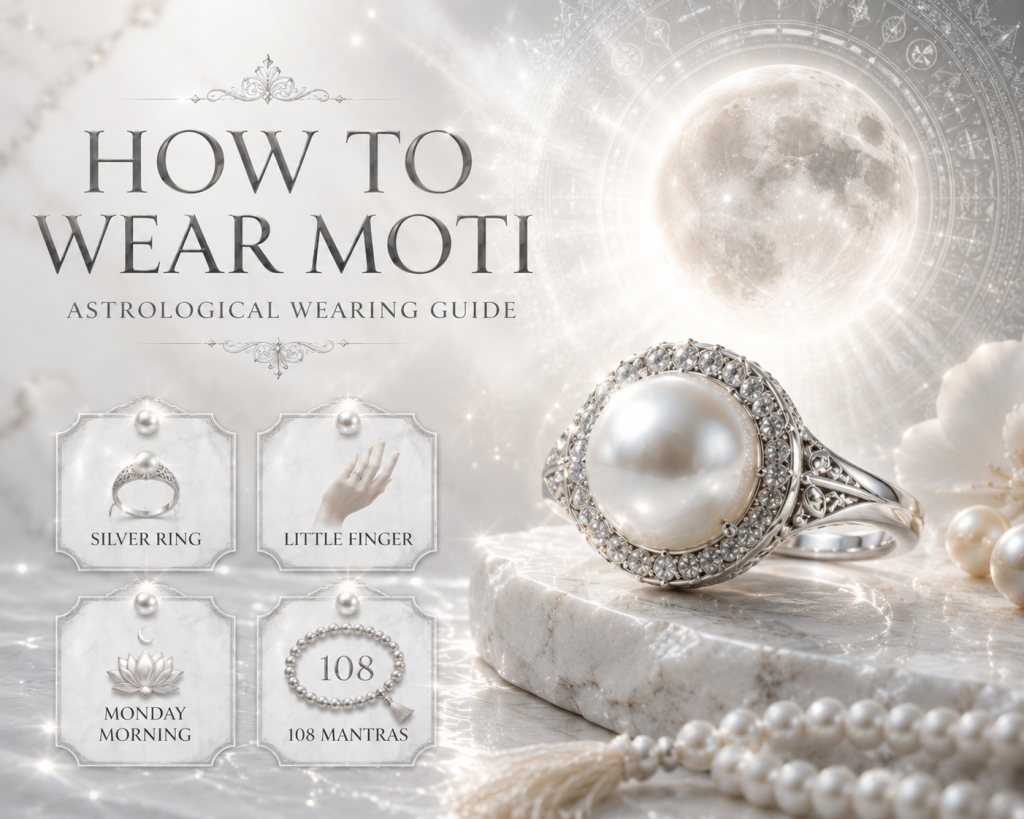
Silver is the metal — universal recommendation for pearl across Jyotish sources. Gold is not recommended for Moti in Vedic tradition.
Little finger of the working hand. Monday morning — Somvaar — between 5 and 7 AM, Shukla Paksha. Chandra’s day, waxing moon phase.
Before first wearing, purify in raw milk and Ganga Jal. Chant the Chandra beej mantra 108 times:
Om Shram Shreem Shraum Sah Chandraya Namah
(ॐ श्रां श्रीं श्रौं स: चंद्राय नमः)
Weight: one-twelfth to one-fifteenth of body weight in carats. A person weighing 60 kg should wear approximately 5 to 6 carats. Confirm with a Jyotish astrologer based on the individual birth chart.
Care
Pearl is softer than most gemstones — hardness approximately 2.5 to 4.5 — and calcium carbonate nacre dissolves in acid. Perfume, hairspray, lemon juice, vinegar, household cleaners — all are risks for pearl worn regularly.
Last on, first off. Put pearl jewelry on after applying products, remove before swimming, bathing, or chemical exposure. Clean with a soft damp cloth only — no soaking, no ultrasonic cleaners, no steam. Store in a soft pouch separately from other jewelry. Have pearl necklace strings checked and restrung periodically.
The Short Version
Moti gemstone price in India reflects genuine quality differences — luster, nacre thickness, origin, and natural vs. cultured status together create the range from ₹500 to ₹50,000 per ratti. For astrological use, natural or South Sea saltwater pearl with strong luster, independent certification confirming origin and treatment status, and chart suitability confirmed by a Jyotish astrologer is the consistent recommendation. Luster is what you’re paying for at the quality end — prioritize it over size every time.
Tags:
basra pearl price,
certified pearl stone,
moon stone astrology,
moti for astrology,
moti gemstone price in india,
moti ratna online india,
moti ratna price,
natural moti online,
natural pearl price,
original moti price,
original moti stone,
original pearl price,
pearl buying guide,
pearl gemstone price,
pearl stone price in india,
south sea pearl price