How to Tell If an Emerald Is Real
Vikas May 31, 2026 in
Products How to Tell If an Emerald Is Real
What Dealers Know That Most Buyers Don’t
Most people first see emeralds the way they’re meant to be seen — in jewelry, under warm lighting, looking exactly as good as they possibly can.
Which is, unfortunately, exactly the environment where fakes thrive too.
Dealers can spot a fake emerald in seconds. Not because they have some mystical gift, but because they know what real ones actually look like up close. Once you know, it’s hard to unsee. This guide covers everything from what you can check with your bare hands to when you genuinely need a lab.
Start With What You Can See Right Now
Before picking up any tools, just look at the stone.
A surprising number of imitation emeralds aren’t a single stone at all. They’re assembled — two pieces of colorless material glued together at the girdle, which is the thin band running around the widest part of the gem. The adhesive carries the green color. The cut bounces it through the stone convincingly enough to fool a casual glance.
But here’s the thing about assembled fakes: they always give themselves away at the girdle. Look at it straight on. On a real emerald, green runs all the way through. On a glued doublet, that band is completely colorless — because the dye is in the glue layer sitting just below it.
Another version is the foil-back stone — colored foil lining the underside of the gem to fake depth and color. It works until it doesn’t. Foil scratches off easily, and any colorless patches or peeling on the pavilion (the bottom facets) are an immediate red flag.
What About Gas Bubbles?
Many assembled fakes also trap gas bubbles between their joined layers, and sometimes show a faint seam line where the pieces meet. Neither is easy to see without a loupe, which is the pocket-sized 10x magnifier most jewelry stores keep at the counter. Worth asking to use one.
Note: Natural emeralds can also have gas bubbles. The difference is that natural ones are irregular, oddly shaped, and scattered throughout the stone in multiple directions — not neatly sandwiched in a single plane between two glued pieces.
The Color Is the Biggest Tell
This sounds obvious. It isn’t.
Emerald green is specific. It has a slightly bluish depth and a soft internal shimmer that honestly doesn’t photograph well — cameras consistently flatten it. In person, a real emerald has a presence to it. A weight to the color, if that makes sense.
Compare that to peridot, which runs yellowish-green, almost lime in some lights. Or tsavorite garnet, which is pure and vivid and frankly beautiful, but noticeably brighter and cleaner than an emerald’s slightly hazy warmth. Green tourmaline can come close in photographs, but falls apart in person.
If the stone looks too clean, too bright, or too uniform in color — it probably isn’t an emerald.
The Inclusion Thing Nobody Talks About Enough
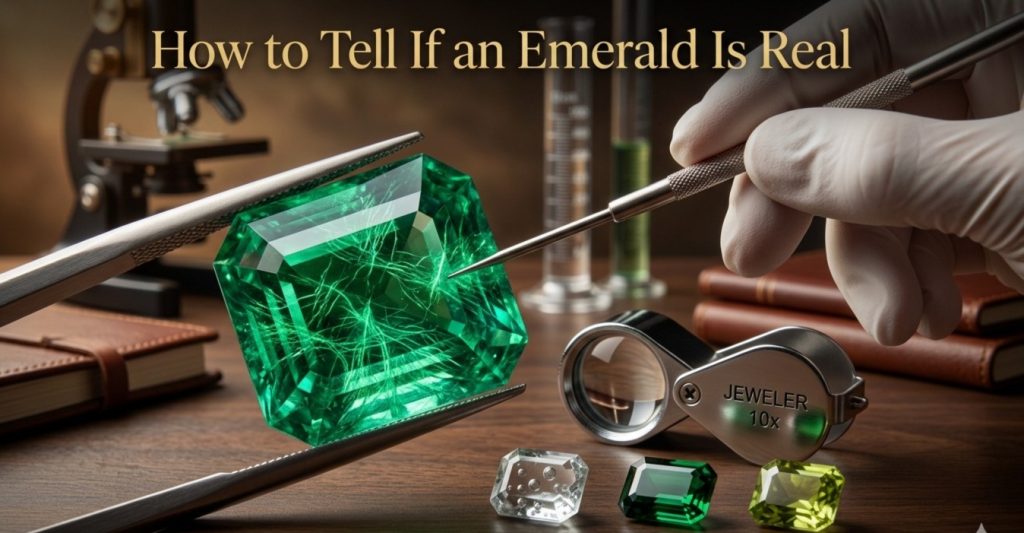
Real emeralds are almost always included. Meaning they have internal fractures, growth marks, tiny crystals — a whole internal world of imperfection. French gemologists called it jardin, which means “garden.” Look at a natural emerald under magnification and you’ll see why — the fractures branch and tangle like something organic.
This is so expected that over 99% of emeralds sold commercially are treated with cedar oil or resin to fill those surface fractures and improve how they look. It’s standard practice, not a scandal. The oil sometimes makes the stone slightly tacky to touch. Under a loupe, it shows up as swirly, semi-transparent material sitting in the cracks, sometimes with small flattened bubbles trapped inside.
Glass imitations can’t pull this off. A glass stone with visible fractures like that would chip and break in normal wear. One specific imitation to know: quench-crackled quartz, which is deliberately fractured then dyed green. The dye pools visibly at the crack lines instead of being distributed evenly through the stone. In a real emerald, the color is part of the crystal itself — not something added after.
Does Touching It Actually Tell You Anything?
Kind of, yes — under the right conditions.
Natural gemstones feel cold to the touch. Glass warms to body temperature much faster. Pick up an emerald that’s been sitting undisturbed and it should feel noticeably cool, almost the way metal does when you first grab it.
The catch is that this only works if the stone hasn’t already been warmed up — by a display light, by sitting in someone’s hand, by being in a warm case. If the stone’s already warm, the test tells you nothing useful.
Weight and Luster: Supporting Clues, Not Proof
Emeralds are denser than glass. Two stones that look identical in size will feel different — the real emerald will be slightly heavier. It’s subtle but noticeable once you’ve held a few.
Higher density also tends to produce a richer surface shine. Technically that’s called luster, and emeralds have a vitreous-to-resinous quality that looks deeper than glass under direct light.
That said, because most emeralds are oil-treated, surface appearance can vary depending on how recently the stone was oiled or re-oiled. Luster is a useful supporting detail, not something to lean on alone.
What a Loupe Actually Shows You
Ten-times magnification doesn’t just confirm what you suspect — it often reveals things that settle the question entirely.
Three-Phase Inclusions
This is one of the most definitive things you can find in a natural emerald. A three-phase inclusion is a tiny pocket containing three things at once: liquid, a gas bubble, and a solid mineral crystal. The crystal is the key part. Synthetic emeralds grow in controlled laboratory conditions that don’t allow outside mineral contamination. Finding a foreign crystal inside an emerald is about as close to a guarantee of natural origin as you can get without lab equipment.
Crystal Inclusions
Same logic applies to any trapped mineral crystal on its own. These form because natural emeralds grow surrounded by a geological environment full of other minerals. That mess leaves evidence. Synthetics don’t have that mess.
Fractures and the Jardin
Under magnification, the internal fracture network becomes genuinely visible. The oiling treatment is visible too — swirling, slightly hazy material filling the cracks, occasionally with small gas bubbles flattened inside them. It’s distinct from the clean, sterile interior of a synthetic or glass stone.
Synthetic Emeralds: The Hardest Fake to Catch
Here’s where it gets complicated.
Synthetic emeralds are chemically and optically identical to natural ones. Same mineral — beryl. Same chemical makeup — beryllium aluminum silicate colored by chromium. Same refractive index. Same color. Even seasoned dealers cannot tell them apart without a loupe, and sometimes not even then.
The formation environment is what differs. Natural emeralds grow over millions of years in geological conditions full of contamination — other minerals, other crystals, trapped liquids. All of that leaves inclusions that are organic and chaotic. Synthetics grow in a clean lab environment. Their inclusions, if they have any at all, look completely different: curved growth lines, flux veils, or hydrothermal fingerprints rather than the wild internal garden of a natural stone.
For definitive confirmation, labs use spectroscopic or laser ablation analysis — essentially a chemical fingerprint that distinguishes the formation environment precisely. This is why high-value natural emeralds always come with independent lab documentation.
Green Gems Commonly Confused with Emeralds
It happens more than people realize.
| Gem | Color | Inclusions | Oil Treated? | Tip-Off |
|---|
| Emerald | Bluish green, shimmery | Heavy, always present | Almost always | Internal ‘garden’ |
| Peridot | Yellowish green | Moderate | Never | Too yellow |
| Tsavorite Garnet | Pure vivid green | Light | Never | Too clean |
| Green Tourmaline | Variable green | Moderate | Rarely | Lacks depth |
| Glass Imitation | Any shade | Bubbles, swirls | Never | Too perfect |
The cleaner and more flawless a green stone looks, the more skeptical you should be — especially if no inclusions are visible at all.
When Do You Actually Need a Lab Certificate?
Not always. But sometimes absolutely.
For everyday emerald jewelry at moderate prices, a certificate isn’t usually necessary. For anything described as untreated, high-clarity, rare, or high-value — documentation from an independent gemological laboratory isn’t a nice-to-have. It’s the whole point.
The recognized names are GIA (Gemological Institute of America), AGL (American Gemological Laboratories), Gübelin, and SSEF. Each issues reports covering origin, treatment status, and natural versus synthetic determination.
Every legitimate report includes a verification method — usually a report number and a website, sometimes a QR code. Always check that the report is real before trusting it. Fake certificates exist.
If a seller is offering an untreated, eye-clean emerald with no documentation? That should give you pause. Untreated emeralds with strong clarity are genuinely rare. They carry significant price premiums. They don’t typically show up unpapered.
Final Thought
A real emerald is not a perfect stone. That’s actually the point.
Its inclusions are evidence of how it formed — millions of years underground, surrounded by geological chaos, growing slowly under enormous pressure. That internal imperfection is part of what makes it what it is.
Fakes and synthetics skip all of that. Assembled stones borrow color from glue. Synthetics grow in pristine lab conditions over weeks. Glass just looks the part until you hold it.
Once you know what an emerald actually looks like on the inside, the shortcuts become obvious. And the real ones start to look even better than they did before.
Planning a significant purchase? Always request an independent lab report from GIA, AGL, Gübelin, or SSEF. Any reputable seller will provide one without hesitation.
If you’re seeking authentic guidance for career, health, or relationship concerns, or wish to explore genuine Vedic remedies, visit our webpage at purevedicgems. Our site features trusted astrology consultations, high-quality gemstones, Rudrakshas, and Vedic rituals, all rooted in deep knowledge and traditional practices. Discover how our holistic approach can support your well-being and spiritual growth.

Tags:
how to tell if an emerald is real,
real emerald identification