More than 4 generations old family tradition (Since 1937) of dealing in Pure Astro-Vedic quality jyotish gemstones, high quality genuine Rudrakshas and Authentic Vedic Yagyas.
Gomed Stone (Hessonite): What You Actually Need to Know About Rahu’s Gemstone
Rahu is the planet nobody wants problems with.
In Vedic astrology, Rahu is a shadow planet — no physical body, no light of its own, just an astronomical point where the moon’s orbit crosses the sun’s path. Yet Jyotish treats him as one of the most powerful forces in a birth chart. He produces sudden reversals, obsessive desires, chronic anxiety, and a restless quality that no amount of achievement seems to satisfy. The mythology describes him as a being of pure hunger — just a head, no body, able to consume everything and be satisfied by nothing.
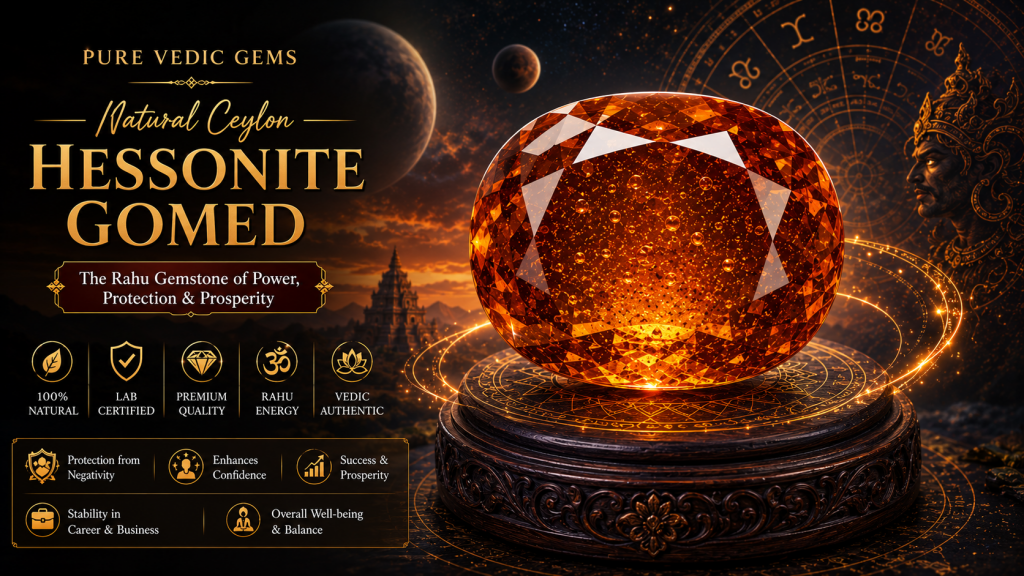
Gomed stone — Hessonite Garnet — is the gemstone assigned to Rahu. And unlike most planetary stones, which are worn primarily to strengthen a planet’s positive influence, Gomed is worn specifically to manage Rahu’s difficult qualities. The stone grounds what Rahu destabilizes. That specific function is worth understanding properly before deciding whether this stone is relevant to your situation.
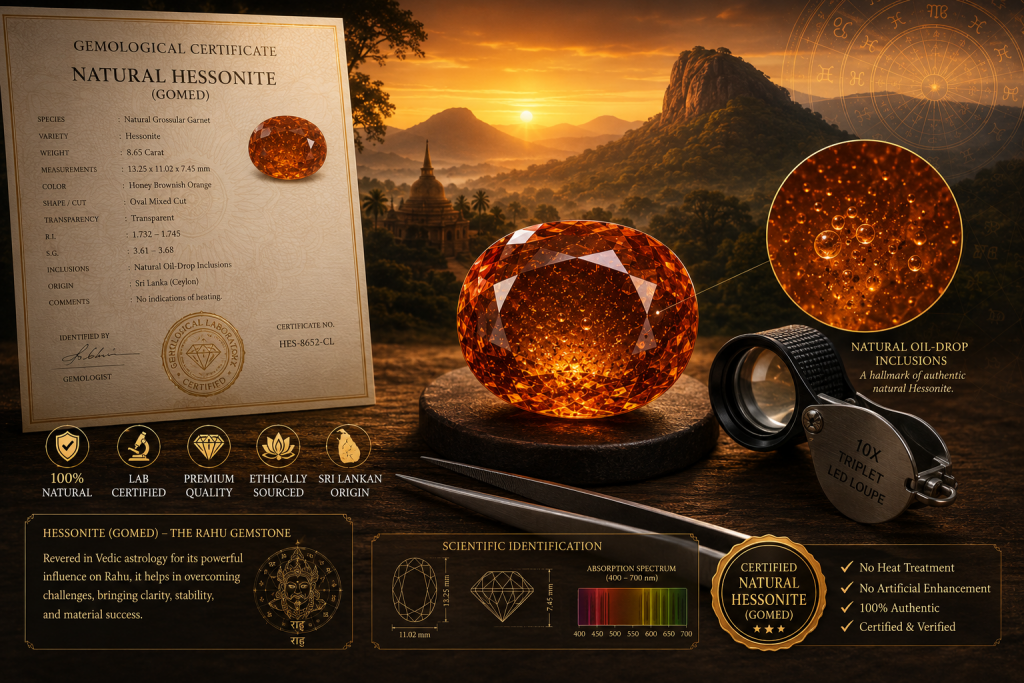
Hessonite is a variety of grossular garnet — calcium aluminum silicate — colored by iron and manganese. The characteristic color is a warm honey-brown, sometimes described in classical texts with the specific phrase “the color of cow’s urine,” which is more precise than it sounds: a particular golden-amber-orange-brown that sits in a narrow range and is visually distinctive once you know it.
The name Hessonite comes from the Greek hesson — inferior — a reference to the stone’s lower density compared to other garnets, not a quality judgment. The Vedic tradition clearly doesn’t share that assessment.
Hardness 6.5 to 7.5 on the Mohs scale. Reasonable for daily wear — harder than opal by a significant margin, though not approaching sapphire or ruby. The luster ranges from glassy to resinous. Transparency in quality specimens runs translucent to transparent.
One thing specific to hessonite that buyers should know: the stone characteristically shows oil-drop or treacle-like internal features under magnification. These are caused by heat-induced distortions during crystal formation and are specific to this variety. Their presence confirms natural origin. A completely inclusion-free hessonite is actually worth questioning rather than celebrating.
Mineral family: grossular garnet. Origins: Sri Lanka, Africa, India. Colors: deep honey to reddish-brown. Hardness 6.5 to 7.5. Transparent to translucent. Vitreous to resinous luster.
Rahu, and Why This Stone Exists
Understanding Gomed requires understanding Rahu first — at least enough to grasp what the stone is actually supposed to do.
Rahu in Jyotish governs obsession, illusion, sudden change, foreign matters, technology, politics, and the kind of material desire that’s never satisfied regardless of how much is acquired. He amplifies and distorts whatever planet he sits near in the natal chart. He’s associated with fear, anxiety, overthinking, and the specific quality of a mind that races constantly without arriving anywhere useful.
The mythology is instructive. Rahu was a demon who disguised himself among the gods to drink the divine nectar of immortality. The Sun and Moon recognized the deception and alerted Vishnu, who cut off the demon’s head before he could swallow. The head became Rahu — immortal, incorporeal, existing only as hunger and desire. A being with no body. Able to consume but never digest.
People with a prominent or badly placed Rahu in their charts often describe this quality directly without knowing the mythology behind it — a persistent dissatisfaction, a tendency toward obsession, an overactive mind that won’t quiet regardless of how well life is going. Rahu Mahadasha — his eighteen-year major period in the Vimshottari system — intensifies all of it.
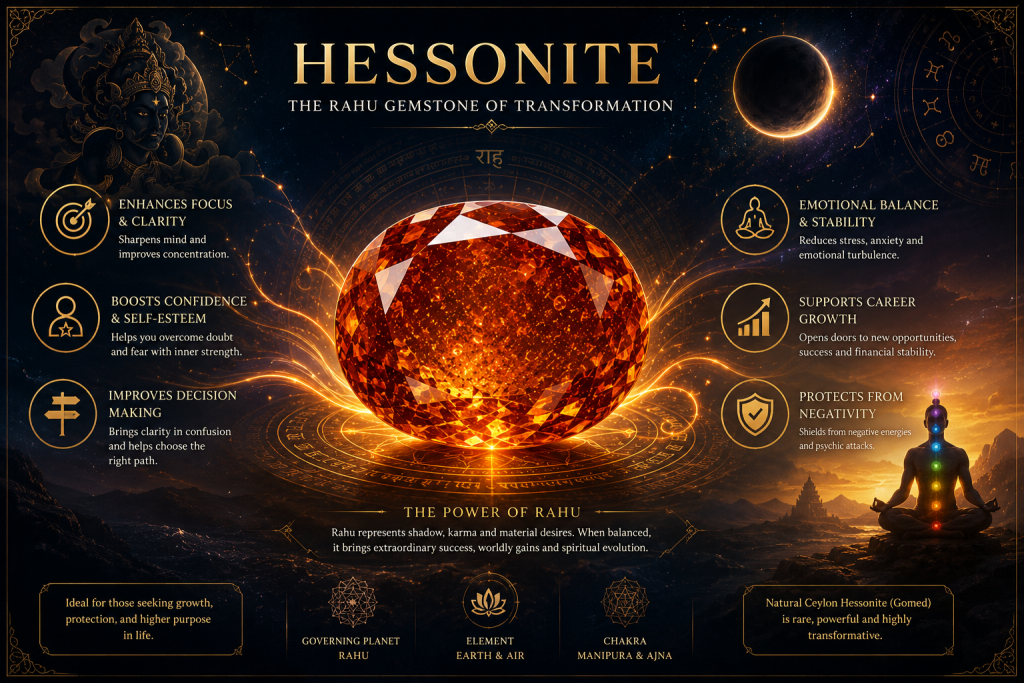
Gomed is worn to channel that energy rather than be consumed by it. Not to eliminate Rahu’s influence — that’s not how Jyotish works — but to make it more navigable. The stone grounds the restlessness, improves clarity, reduces fear-based decision-making, and helps the wearer work with Rahu rather than against him.
Who the Stone Is Actually For
People in Rahu Mahadasha are the clearest recommendation. Eighteen years is a long time to be in a difficult planetary period, and the stone’s specific function — grounding Rahu’s energy — is most directly relevant during this window. The intensity varies enormously depending on Rahu’s natal placement, but the stone’s usefulness during his period is consistent across Jyotish sources.
Aquarius, Taurus, and Gemini ascendants and moon signs find Gomed particularly recommended — Rahu is considered exalted in Taurus in some traditions, and the stone is generally considered favorable for these configurations. The specific recommendation still requires looking at the full chart rather than applying a blanket rule.
People with a badly placed Rahu regardless of ascendant — experiencing its characteristic signatures: persistent anxiety, obsessive thinking, chronic restlessness, confusion in decision-making, or that particular quality of being driven by desires that can’t be satisfied. These are the patterns that point toward a Rahu remedy.
January birthdays by Western birthstone tradition. Independent of Vedic astrology, hessonite is January’s stone.
Beyond chart specifics, certain professional profiles come up consistently in classical sources. Politicians and people in power positions — Rahu is literally described as the karaka of politics in Jyotish, the planet of strategy, illusion, and the kind of intelligence that understands how power actually operates. Gomed helps channel that toward effective leadership rather than manipulation.
Stock traders and people in high-risk financial roles. Rahu’s gambling quality — his willingness to risk everything for the possibility of more — can be genuinely dangerous in financial contexts when unbalanced. Gomed is associated with improving decision clarity and reducing impulsive behavior in exactly these situations. There’s something almost poetically appropriate about a stone linked to an eternal gambler being recommended for people who trade for a living.
Students, researchers, and anyone whose work demands sustained concentration. The focus benefits are specific — not generic “mental clarity” but the particular single-pointed attention that Rahu can produce when his energy is channeled rather than scattered. His fixation on the nectar despite all obstacles is one of the few unambiguously positive qualities in the mythology, and Gomed is associated with channeling exactly that.
What It Does
The mental grounding effects are the most consistently reported. Reduction in anxiety and restlessness, clearer thinking, improved decision-making, a quieting of the obsessive background noise that Rahu’s energy tends to generate. People who’ve worn it through Rahu Mahadasha often describe a reduction in a quality of mental interference they’d normalized — you don’t fully notice how loud it was until it quiets.
Career benefits cluster around Rahu-governed fields: politics, business, technology, research, media, foreign trade, finance. In all of these, Rahu’s qualities — unconventional thinking, strategic intelligence, the ability to navigate ambiguous and rapidly changing situations — are genuine professional assets when properly channeled. The stone is credited with doing the channeling.
Financial decision clarity shows up repeatedly and specifically. Not the sudden wealth associated with blue sapphire or the career authority of ruby — more the ability to make clear financial decisions without Rahu’s characteristic greed and impulsivity distorting the judgment. For traders and investors this distinction is meaningful.
Focus and concentration. The mythology again provides the clearest framework: Rahu’s single-pointed fixation, his ability to maintain concentration under extraordinary pressure, is one of his genuine strengths. The stone is associated with accessing that quality productively rather than having it expressed as obsession.
Physical health associations in Rahu’s domain: skin allergies, eye infections, digestive issues, certain nervous system conditions. Traditional beliefs, not medical claims. Internally consistent with the Jyotish framework in the way these associations usually are.
Wearing It Correctly
Silver is the metal. Near-universal recommendation for Gomed across Jyotish sources. Platinum and white gold are acceptable modern alternatives. Panchdhatu — the five-metal traditional alloy — works for some practitioners. Gold is generally avoided for Rahu stones.
Middle finger of the working hand. Rahu is associated with the middle finger in palmistry tradition — right hand for right-handed individuals, left for left-handed.
Weight of one-tenth to one-twelfth of body weight in ratti. Someone weighing 60 kg should wear approximately 6 to 7 ratti. Confirm this with an astrologer based on the specific chart — this is a baseline, not a fixed prescription.
Saturday morning, 5 to 7 AM, Shukla Paksha. Rahu doesn’t have his own day in the classical Jyotish system, but Saturday is used given Rahu’s association with Saturn’s qualities and energy.
Before wearing for the first time, purify in raw milk and Ganga Jal. Chant the Rahu beej mantra 108 times with full attention:
Om Bram Brim Brom Sah Rahave Namah
(|| ॐ भ्रां भ्रीं भ्रौं सः राहवे नमः ||)
One thing most wearing guides don’t mention clearly: Rahu absorbs and amplifies the energy of whatever planet he sits near in the natal chart. This means the effects of Gomed are more chart-specific than most other planetary stones. Two people both in Rahu Mahadasha with Gomed worn correctly can have very different experiences depending on which planet Rahu is conjunct in their individual chart. This is why astrological consultation matters more for Gomed than it does for yellow sapphire or even blue sapphire.
Price and Quality
Original hessonite stone price in India runs from approximately ₹400 to ₹500 per carat for African material to ₹2,000 to ₹5,000 per carat and above for fine Ceylon specimens. That spread reflects genuine differences.
Color is the primary driver. The most prized shade is a rich cinnamon-honey — warm golden-brown with subtle orange undertones, clear and alive-looking. Too dark and the stone loses its characteristic warmth. Too pale and it lacks the depth considered most astrologically potent. Stones with blackish or heavily murky tones are considered lower quality regardless of carat weight.
Origin creates the clearest tier. Sri Lankan hessonite — Siloni or Ceyloni Gomed — is the benchmark in both Jyotish practice and the gemological market. Consistent color, good clarity, and strong provenance. African hessonite is a legitimate second choice at more accessible prices. The price difference between fine Ceylon and good African material is roughly four to five times per carat at equivalent quality levels.
Clarity in hessonite needs to be understood with the characteristic inclusions in mind. The oil-drop internal features are normal and expected — they confirm natural origin. What’s undesirable is heavy black spotting, obvious cloudiness, or inclusions that significantly disrupt transparency. Clean honey-colored stones that transmit light well are the quality standard.
Cut matters more in hessonite than in some other stones because the internal features need to be oriented correctly and the proportions need to show the color and transparency at their best. A well-cut faceted hessonite looks noticeably brighter than poorly cut material of identical rough quality.
Natural untreated hessonite is preferred for astrological use. Treated stones may look better cosmetically but are considered less effective for Rahu’s energy. Request certification confirming treatment status.
What to Watch Out For When Buying
Ceylon origin misrepresentation is the most common issue. The price premium for certified Ceylon hessonite over African material is significant enough to make false origin claims financially worthwhile for unscrupulous sellers. Laboratory origin testing is the only reliable confirmation — a seller’s verbal claim about Ceylon origin without documentation means nothing.
Color assessment under shop lighting is misleading. Hessonite looks dramatically different under warm incandescent light versus natural daylight. Stones that appear a perfect warm honey under a jeweler’s lamp can look noticeably darker or more orange in natural light. Always ask to see the stone in multiple lighting conditions and ideally outdoors before making a serious purchase decision.
The oil-drop inclusions question catches buyers off guard both ways — some assume inclusions mean a defect and prefer cleaner-looking stones that turn out to be synthetic, while others accept heavily spotted material under the impression that more inclusions means more natural. The characteristic oil-drop features of natural hessonite sit in a specific range. Their complete absence is suspicious. Their heavy dominance reduces quality. Clean material with moderate natural internal features is what you’re looking for.
For anything above a basic purchase, an independent gemological certificate from GIA, IGI, GRS, or an equivalent laboratory is worth the cost. It specifies natural origin, treatment status, and weight — which addresses the three most common misrepresentation points simultaneously.
Cleaning and Storage
Lukewarm water with a few drops of mild soap, soak for 20 to 30 minutes, gentle cleaning around the setting and stone surfaces with a soft toothbrush. Rinse thoroughly. Dry with a soft cotton cloth. This removes accumulated skin oils and environmental residue that dull the luster over time — do it regularly rather than waiting until the stone looks obviously dirty.
Avoid harsh chemicals, ultrasonic cleaners, and excessive heat. These can affect both the stone and the setting, particularly for stones with any treatment or with pre-existing fractures. Store in a soft velvet pouch or padded jewelry box separately from other pieces — hessonite can scratch softer stones and its own surface can be scratched by harder materials.
Some Honest Answers
Does Gomed suit everyone in Rahu Mahadasha?
No, and this is important enough to say directly. Rahu’s effects during his Mahadasha depend enormously on his natal placement and the planets he’s conjunct or aspecting in your specific chart. Someone with Rahu well-placed and associated with benefic planets may navigate the period productively even without gemstone intervention. Someone with Rahu conjunct a difficult planet in a sensitive house faces a different situation entirely. The eighteen-year period is real and significant, but whether Gomed helps — and how it helps — is chart-specific. Don’t wear it based on being in Rahu Mahadasha alone.
Ceylon vs. African — does it actually matter for astrology?
Most Jyotish practitioners say yes, at least for serious astrological use. Ceylon material has more consistent color and clarity than African, and the tradition specifically values natural, high-quality material for its energetic potency. For someone working within a budget, African hessonite is a legitimate option — it’s genuinely the same mineral and it genuinely works for many wearers. But if the priority is maximum astrological effectiveness rather than budget, Ceylon is the consistent recommendation.
Why is consultation more important for Gomed than for other stones?
Because Rahu doesn’t operate in isolation. He absorbs and amplifies the energy of the planet sitting near him in the natal chart. Two charts with Rahu in the same sign can behave very differently if one has Rahu conjunct Jupiter and the other has Rahu conjunct Mars. This means Gomed’s effects are more individual and less predictable from general sign-based advice than most other planetary stones. Sun sign and moon sign guidance provides a starting framework, but the chart analysis needs to go deeper for this stone than for most others.
Is hessonite safe to self-prescribe?
Less so than yellow sapphire or even ruby, for the reasons above. The general guidance — Aquarius, Taurus, Gemini ascendants, people in Rahu Mahadasha — is a reasonable starting filter. But the complexity of Rahu’s interactions with other natal planets makes Gomed one of the stones where astrological consultation genuinely changes the outcome rather than just being a formality. This isn’t said to create unnecessary friction. It’s said because the stone can intensify things, and what it intensifies depends on what’s already in the chart.
If you’re seeking authentic guidance for career, health, or relationship concerns, or wish to explore genuine Vedic remedies, visit our webpage at purevedicgems. Our site features trusted astrology consultations, high-quality gemstones, Rudrakshas, and Vedic rituals, all rooted in deep knowledge and traditional practices. Discover how our holistic approach can support your well-being and spiritual growth.
Genuine Products and Satisfied Customers are our first and foremost priority
Firstly, I want to give compliment to the website. By chance, I came to know the shop from the Internet only. The design of the website attract me a lot as well as it gives many useful knowledge about Astrology, gemstones, etc. After that, I feel thankful to Mr.Vikas Ji and his staffs for their understanding, support me from A to Z and help me solve all my problems. Whatever I don\'t understand, they guide me very slowly, clearly and remove all my doubts. They are great people - I have to say!!! Thanks a ton. Finally, the products are very good and give me positive result till now (nearly 3 months). The rings are well-designed - even many Indians, they also gave me compliments on the rings; the gems are high quality - very stunning. Just only compliments - no any doubts. I definitely come back and purchase more products from this shop. In the future, if anyone need Astrology products, I will highly recommend Pure Vedic Gems to them!!! With love and all my best wishes to all of you! Yen Van (VietNam)
As recommended by Astrologer, I purchased the gemstones. I must say that they have a Unique role. After 3 months of wearing them, intuitively these have guided me in the right direction and given me a lot of strength in my convictions and getting beyond false sense of securities in life. Rest future will tell, how these prisms actually affect one. I am grateful to Vikas Mehra Ji for his time, his advice and detailed and patient way of dealing with customers. Thank you! Regards
The service was wonderful. Delivery and updates were very prompt and the pictures were incredibly appreciated. The ring itself has been fantastic. I wear it everyday and can feel the effects of it. Very grateful to have found you and will recommend you to friends looking for gamestones and use your service for any of my own future needs!
Hare Krishna All I bought two gem stones from Pure Vedic Gems. I was bit confused about gem stones because it was my first time experience. I cruised around many websites and made phone calls in India, but didn\'t get any satisfactory answers. I contacted Pure Vedic Gems, they followed up my quiries nicely. Vikas ji the owner of Vedic Gems gave me very valuable advices. It took me long time to finalize the products, but staff had lots of patience. Pure Vedic Gems team answered all my questions and helped me to select the products. They helped me on every step of this process. I will highly recommend Pure Vedic Gems to any customers especially Overseas Clients, because it is very hard to find right place to buy gems with complete package (including rings). They have given certificates of Gems and done the proper puja process too. And one more thing to mention, they have Astrologer Team which can help you out if you are not sure of right gem for you on very nominal charges. Full marks to Vikas Mehra ji and his team. Thanks a million Regards Baljit Bains
It was great talking to Vikas, I found him very knowledgeable, and he helped me choose the right product. Pure Vedic Gems team equally is very very helpful, He always sorted out all my quaries & was very responsive.I received the product on time & its a wonderful peace of gem. One doesn’t need to worry about product’s authenticity when buying from Purevedicgems.
Right away as soon as I started my order i was contacted by pure vedic gems team to make sure everything was set up perfectly for my ring to be made. They walked me through the whole process up to delivery. The stone was very good quality and well energized and I felt the difference as soon as I started wearing it. The craftsmanship of the ring was great aswell. I am grateful to have found purevedicgems and I cant wait to make my next purchase :)
Hi Vikasji, Its my pleasure to write feedback about the interaction that we had. I am very impress with the quality of the gemstone, reasonable pricing, finishing and perfection with with it is embedded into ring. The overall services such as - day to day interaction , resolving queries with quick responses and delivery on time in secure packing. I had received excellent customer service for first purchase of a another gemstone last year, the same experience this time as well. I would continue to use Purevedic for future purchases and would highly recommend to others.
A Final end, destination when u are searching for pure unheated untreated Vedic Gemstones. The Very first day when I saw website and videos of oceanic knowledge and an unsaid promise for pure Ratana and consultation. I wish Mr Vikas ( whom I have never met ). But I wish to..... But I bought Emerald from Pure Vedic Gems. It\'s really very nice quality as promised. Nowadays when every one in market promises for true stones, the one trusted stop is Mr Vikas whose true and valuable guidance will surely make u go for a real stone , none other than Pure Vedic Gems. My best wishes are with them and Vikas ji too.. May the supreme power, lord of us all shower blessings on them...
I bought 2 gemstones (Yellow Sapphire & Red Coral) from Pure Vedic Gems and I am very pleased with the products and customer services. The gemstones were high quality and very beautiful. PURE VEDIC GEMS teams was very helpful throughout the journey. He helped me from the purchase to delivery of the product. Thank you