Natural Yellow Sapphire Price What Nobody Tells You Before You Buy Pukhraj
Vikas July 5, 2026 in
Astrology 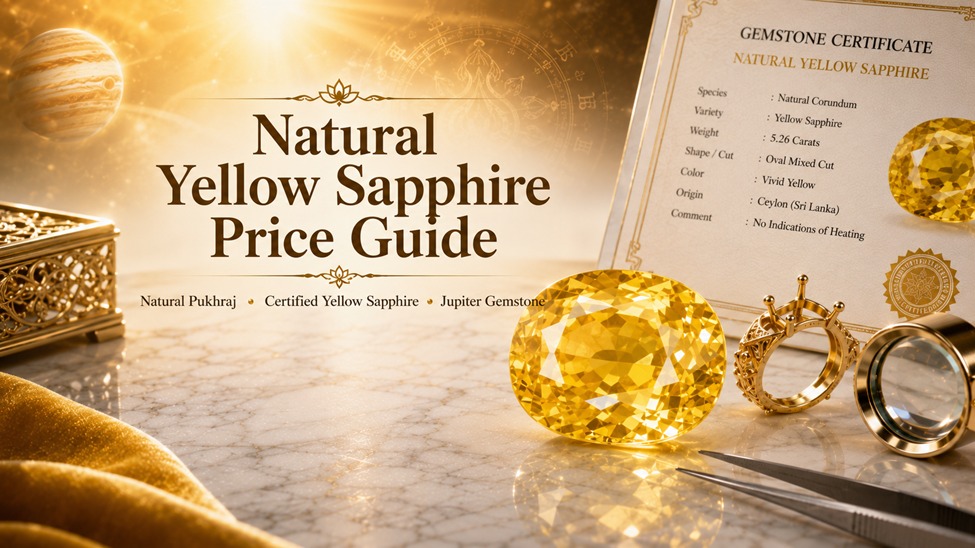
Two sellers. Same stone description. One asks ₹2,000 per carat. The other wants ₹75,000.
Both call it natural yellow sapphire. Both say Ceylon origin. Both have certificates of some kind.
This happens constantly in the Pukhraj market and it confuses people badly enough that they either overpay, underpay for something worthless, or give up entirely. None of those outcomes are good. So let me walk through what natural yellow sapphire price actually depends on — and why the gap between ₹2,000 and ₹75,000 is completely real and explainable.
Yellow Sapphire Belongs to the Corundum Family — and That Matters for Price
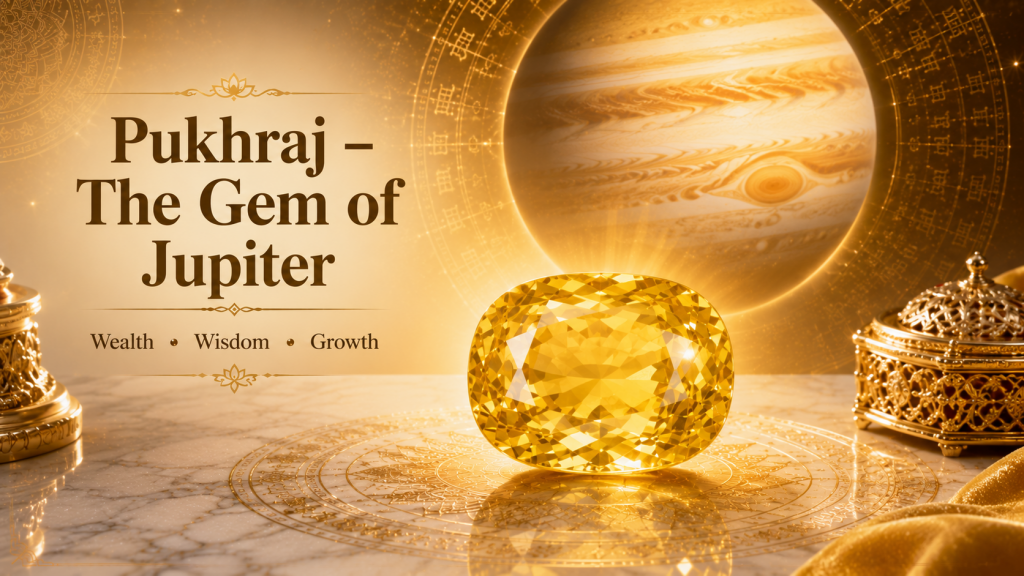
Pukhraj is a Corundum. Same mineral family as ruby, same family as blue sapphire. That’s relevant because Corundum is genuinely hard, genuinely durable, and forms in conditions that don’t produce large clean crystals easily. A big, clean, naturally yellow Corundum is rare. Rarity drives price. This isn’t marketing language — it’s basic mineralogy.
In Vedic astrology, yellow sapphire represents Jupiter (Brihaspati). It’s prescribed for career stability, marriage prospects, business growth, and conception difficulties. The astrological application only works — according to every serious Jyotishi I’ve spoken with — with a stone that’s natural, untreated, and from a quality origin. Which immediately rules out a large percentage of what’s being sold.
The Four Things That Set Natural Yellow Sapphire Price
Colour first, because it moves the number most.
The most valued yellow sapphires sit in a range from bright canary yellow to rich golden yellow — vivid, even, with no brown or green undertones. Pale stones, muddy stones, stones with uneven patches of colour — all cheaper. The difference between a washed-out light yellow and a saturated pure yellow can mean 5x to 10x in price per carat at the same weight. Colour is where the money is.
Clarity is second.
Yellow sapphire is actually cleaner than most precious stones by nature. But inclusions still happen — fine silk needles, fingerprint-like feathering, fractures. An eye-clean stone, nothing visible without magnification, is significantly more valuable than one with visible flaws. Some inclusions matter more than others. A fracture reaching the surface is a structural concern. A tiny silk needle deep in the stone, barely visible under 10x loupe — less so.
Cut affects both beauty and price.
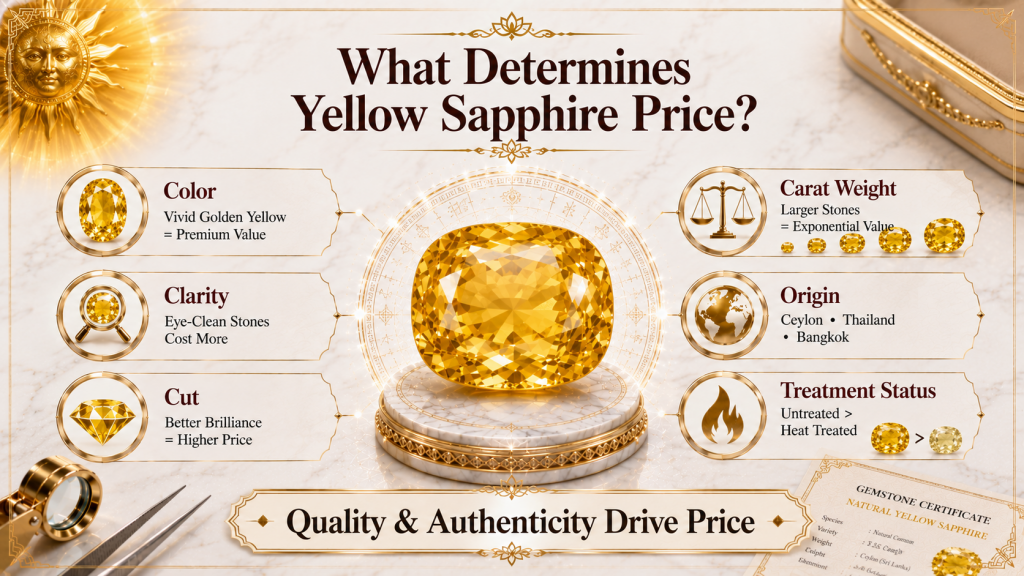
A well-proportioned faceted Pukhraj returns light evenly and maximises colour. It also hides minor inclusions better. An oddly cut stone — too shallow, badly symmetrical, wrong proportions — will look duller than the rough material deserved. Cutters make choices. Good choices cost more.
Carat weight scales the price non-linearly.
A 1-carat natural Ceylon yellow sapphire with good colour and clarity might be ₹8,000 per carat. A 5-carat stone with equivalent quality won’t be ₹40,000 total — it’ll be substantially more per carat because large clean specimens are genuinely harder to find. Weight and rarity compound together as size increases.
Origin Is Probably the Biggest Single Variable
Ceylon — Sri Lanka — produces yellow sapphires that are considered the world standard. The colour is characteristically pure, the clarity is typically excellent, and the stones form with a natural transparency that’s hard to replicate through treatment. Certified natural Ceylon Pukhraj runs roughly ₹1,000 to ₹1,00,000 per carat depending on the quality factors above. That range is real and wide because quality varies enormously even within Ceylon origin.
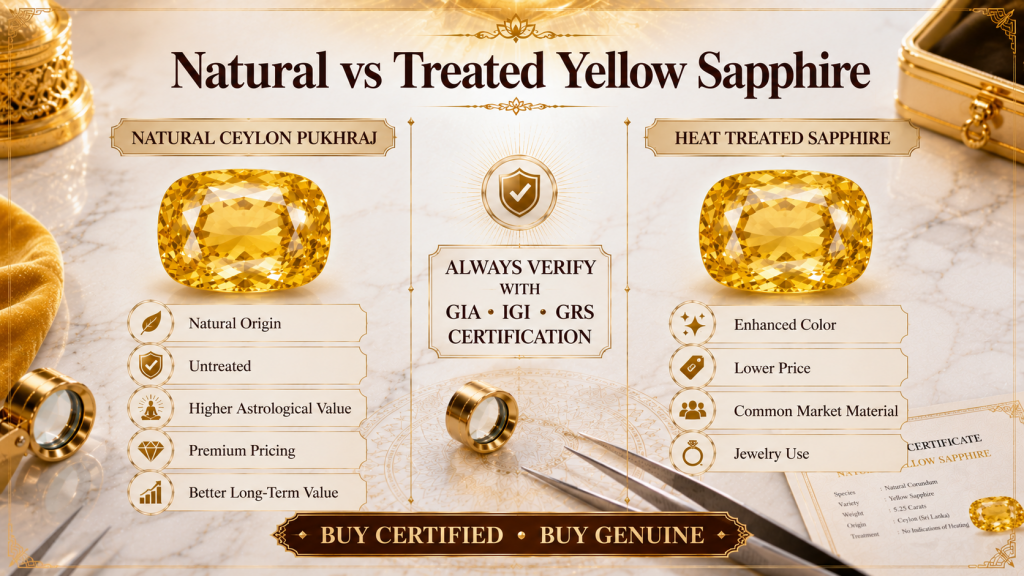
Thai and Bangkok stones are different in one critical way — most of them have been heat-treated. The heating changes and stabilises colour, making lower-grade rough look like premium material. Price drops accordingly. For a ring you’re buying purely for aesthetics, a treated Thai yellow sapphire might make sense. For astrological purposes, most Jyotish practitioners won’t recommend it. The treatment disrupts what they consider the stone’s natural energetic properties.
This distinction — treated versus untreated — is not a small thing in the Pukhraj market. It’s the difference between a stone that serves its astrological purpose and one that looks right but doesn’t function.
What Treatment Actually Does to Yellow Sapphire
Two treatments show up regularly in the market.
High-temperature heat treatment pushes colour toward a more desirable yellow range. Pale stones become vivid. Uneven colour becomes uniform. The change is permanent and the stone looks genuinely improved — which is exactly why treated stones get passed off as natural ones.
Lead glass filling addresses surface fractures and pits by filling them with lead-rich glass. The stone looks cleaner and more transparent than it actually is. These stones are also less durable — the glass filling can deteriorate. They’re worth a fraction of what natural untreated stones cost.
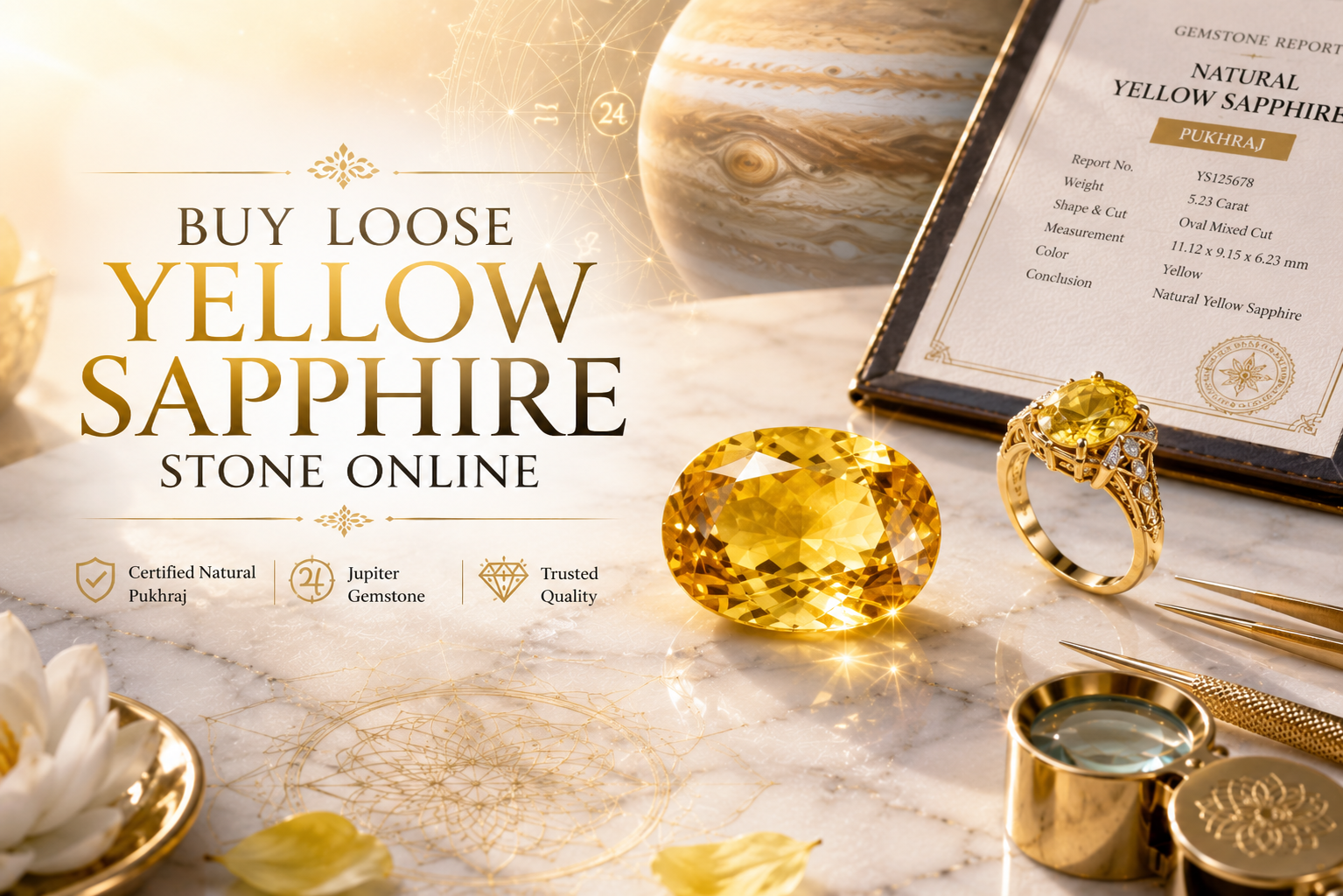
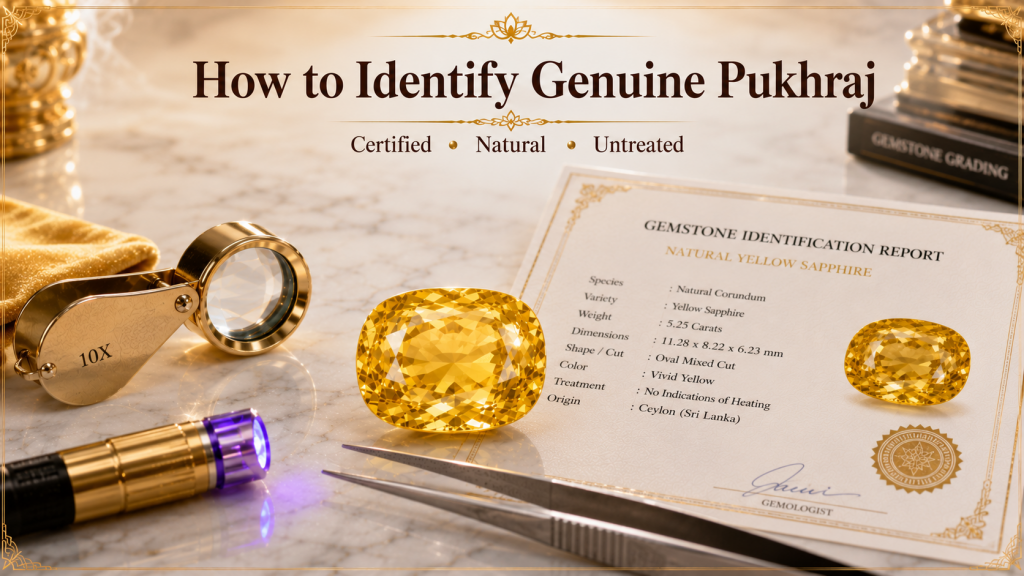
A certificate from GIA, IGI, GRS or another recognised international lab will disclose both of these treatments. If a seller’s certificate comes from a lab you can’t verify independently, that’s worth paying attention to. The certificate is the only thing standing between you and an expensive mistake.
Why Most People Don’t Get Results from Yellow Sapphire
The honest answer is usually one of three things.
First: the stone isn’t natural. Synthetic yellow sapphire, citrine, yellow topaz, and yellow glass are all sold as Pukhraj. They look similar enough that an untrained eye won’t catch it. A fake stone produces no astrological result regardless of how it’s set or when it’s worn.
Second: the stone is treated. A heat-treated Bangkok sapphire in a gold ring, worn on the correct finger at the right time — still not the same as a natural untreated Ceylon stone according to Jyotish tradition.
Third — and this matters — Jupiter may not be a benefic planet in your specific birth chart. Yellow sapphire is a Jupiter stone. If Jupiter is malefic for your ascendant, wearing Pukhraj can work against you rather than for you. This is why a proper chart reading before purchasing is not optional guidance. It’s the starting point.
How to Spot a Real Yellow Sapphire
Visually, a genuine natural yellow sapphire is crystal clear through its body. No layering. No haziness in patches. The colour is consistent throughout the stone, not concentrated near the surface or uneven across facets.
Traditional tests exist — warming the stone, checking colour change against a touchstone — but none of these replace laboratory testing. The only reliable authentication is a certificate from an accredited gemological lab with treatment disclosure clearly stated.
Buy certified. If the seller won’t provide a recognised lab certificate, or hesitates when you ask, that tells you what you need to know.
What Certified Natural Yellow Sapphire Actually Costs in India
Entry-level Ceylon Pukhraj — visible inclusions, lighter colour saturation — sits around ₹1,000 to ₹5,000 per carat. Mid-range stones with decent colour and eye-clean clarity run ₹5,000 to ₹30,000 per carat. Premium Ceylon yellow sapphire — vivid colour, excellent clarity, 3 carats and above — goes from ₹30,000 to ₹1,00,000 per carat. Exceptional pieces beyond that range exist.
Treated stones from Thailand will be cheaper at every size. That price difference isn’t a deal — it reflects what the stone actually is.
FAQ
What is natural yellow sapphire price per carat in India?
Certified natural Ceylon yellow sapphire ranges from ₹1,000 to ₹1,00,000 per carat based on colour, clarity, carat weight and treatment status.
Why is Ceylon Pukhraj more expensive than Bangkok yellow sapphire?
Ceylon stones are typically natural and untreated. Bangkok yellow sapphires are usually heat-treated to enhance colour, which makes them less expensive but also reduces their value for astrological use.
How do I verify if my yellow sapphire is real?
Get a certificate from GIA, IGI, GRS or an equivalent recognised gemological laboratory. The certificate must explicitly state origin and disclose any heat treatment or filling.
Does carat weight affect yellow sapphire price significantly?
Yes, and non-linearly. Larger stones become increasingly rare at good quality levels, so price per carat rises steeply with size rather than scaling proportionally.
What carat weight should I wear for Jupiter?
Most Jyotish recommendations fall between 3 and 7 carats, adjusted for body weight and chart specifics. Consult a qualified astrologer before deciding.
Tags:
buy pukhraj online,
certified yellow sapphire,
ceylon yellow sapphire price,
jyotish pukhraj,
natural pukhraj stone price,
natural yellow sapphire cost india,
natural yellow sapphire price,
original yellow sapphire,
pukhraj buying guide,
pukhraj price,
sri lankan pukhraj price,
untreated yellow sapphire,
yellow sapphire certification,
yellow sapphire gemstone price,
yellow sapphire price per carat