More than 4 generations old family tradition (Since 1937) of dealing in Pure Astro-Vedic quality jyotish gemstones, high quality genuine Rudrakshas and Authentic Vedic Yagyas.
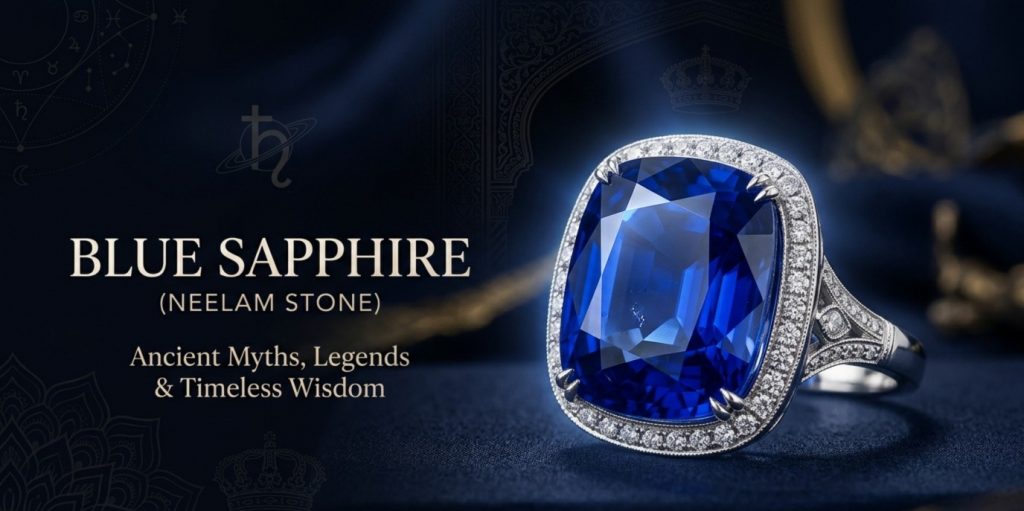
Ancient Myths, Legends, and Why This Gemstone Still Commands Respect
Nobody Is Neutral About This Gemstone
Ask ten people what they know about the Blue Sapphire and you’ll get ten very different answers. A Jyotish astrologer will talk about Saturn. A gemologist will mention corundum hardness and Kashmir origins. Someone’s grandmother will warn you not to wear one without consulting someone first. And whoever just got engaged might simply show you their ring and grin.
What’s interesting is that none of these people are wrong, exactly. The Blue Sapphire — Neelam, in Vedic and Hindi tradition — has genuinely accumulated that many layers of meaning over the course of human history. It didn’t get famous in one culture and spread. It somehow became important, independently, to civilisations that had no contact with each other.
That doesn’t happen with many gemstones. Diamonds are valuable because we collectively decided they are. Emeralds are beautiful in a way most people agree on. But the Neelam stone became mythologically significant across ancient India, Persia, Buddhist Asia, and medieval Europe — each tradition developing its own reasons, its own stories, its own warnings.
That kind of convergence is worth paying attention to.
First: What the Blue Sapphire Actually Is
Blue Sapphire is corundum — same mineral family as ruby, just coloured differently. Iron and titanium during formation are what give it that blue, and depending on the exact trace amounts, you can end up with anything from a pale cornflower to something so deep it looks almost like the stone is lit from inside.
On the Mohs scale it sits at 9. Diamond is 10. Everything else is softer. This matters because it means sapphires are genuinely hard-wearing — not just for jewellery purposes but historically, practically, in a world where gemstones were often carried for years without being reset or replaced.
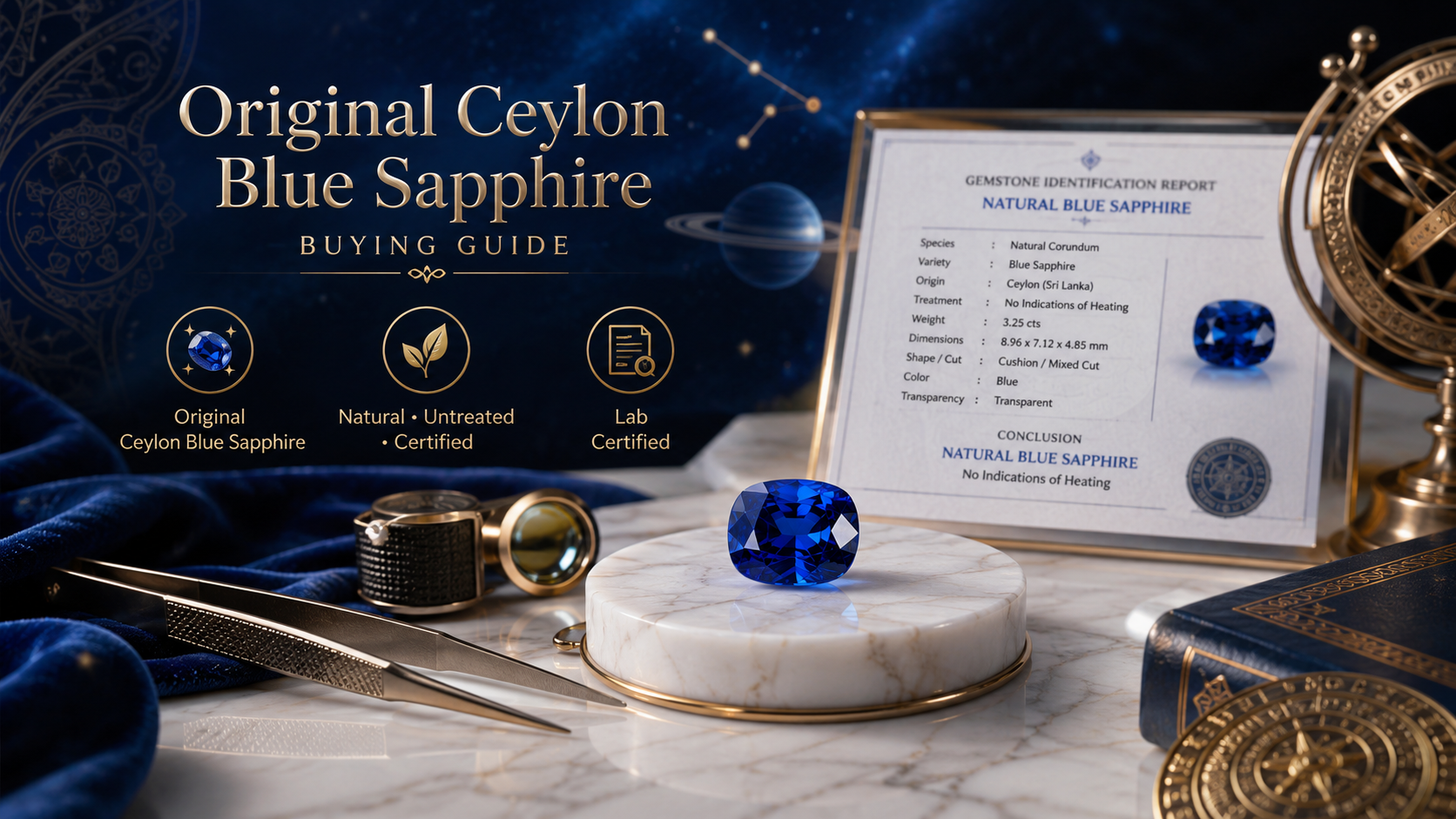
The finest stones come from three places gemologists still reference constantly: Kashmir (rare now, extraordinarily prized), Burma, and Sri Lanka — which the trade still calls Ceylon after the old colonial name. If someone offers you a “Ceylon sapphire” they’re talking about Sri Lankan origin, and it’s a compliment.
Vedic astrology — specifically the Jyotish system — assigns one gemstone to each of the nine primary celestial bodies. The Blue Sapphire belongs to Saturn. Shani Dev. And if you want to understand why so many people approach this stone with genuine caution rather than simple enthusiasm, that’s where you need to start.
The Vedic Way
What Shani Dev Has to Do With Any of This
Saturn in Vedic astrology is not the same as Saturn in Western astrology, though they rhyme. In Jyotish, Shani Dev is associated with karma — specifically the accounting of it. He governs discipline, delay, hardship chosen or imposed, and the eventual rewards that come to those who do the work. He also governs the consequences for those who don’t.
He is not a cruel planetary force. He is an exacting one. There’s a difference.
The Blue Sapphire, as his stone, carries that energy forward. Wear it when Saturn is favourably placed in your chart and things tend to move — careers shift, obstacles clear, opportunities appear with a kind of suddenness that feels less like luck and more like something long-overdue finally arriving. Wear it when Saturn is in a bad position relative to your chart and the effects can be the opposite, equally sudden and considerably less welcome.
This is why most experienced Jyotish practitioners recommend a trial period before permanent wearing. Three to seven days — wearing the stone loosely, in your dominant hand, paying attention. How do you sleep? How do your interactions feel? Does the week feel like it’s moving with you or against you? Saturn’s effects, people say, are fast. You’ll know.
The Vikramaditya Story
King Vikramaditya is one of those historical figures who sits at the exact boundary of history and legend in Indian tradition. Whether he was precisely who the texts say he was matters less than what the stories about him reveal.
The one involving Blue Sapphire goes like this: at a certain point in his reign, Saturn moved into a problematic position in his astrological chart. The consequences were not subtle. He lost his throne. His wealth disappeared. His standing among his own people collapsed in a way that must have felt catastrophic for a man of his stature.
His court astrologers identified the cause as unmitigated Shani influence. Their recommendation: a Blue Sapphire. He wore one. And the reversal, according to the legend, was just as dramatic as the fall had been. Power returned. His enemies, who had grown confident, retreated. What had been taken came back.
The lesson the story is teaching isn’t really about the stone, I think. It’s about acknowledging Saturn’s authority. The Neelam is the gesture of acknowledgment — the physical act of saying, I understand what you govern, and I am not trying to bypass you.
The Persian Belief That Starts With the Sky
Ancient Persian cosmological thought held that the Earth sat upon a giant blue sapphire — and that the colour of the sky was simply the stone’s reflection. Not a metaphor. An actual cosmological claim about the structure of the world.
From that foundation — literally — you can understand why Persian rulers treated this stone differently from other gems. To own one, to wear one, was to carry something that resonated with the physical architecture of existence. That’s not a small thing to assign to a gemstone.
Persian kings embedded sapphires in their crowns and ceremonial pieces. It was a ward against envy, against malevolent forces, against the particular kind of hostility that comes when powerful people attract powerful enemies. In a court culture where political survival was never guaranteed, a stone believed to deflect envy was more than decorative.
One legend from this tradition describes a king who received a Blue Sapphire in a dream — a divine figure pressing it into his hands. He found the physical stone, had it set, wore it — and the reign that followed was spoken of long after his death as a period of unusual wisdom and stability. Whether that story describes something that happened or something people needed to believe happened, I genuinely can’t say. Both possibilities are interesting.
Medieval Europe’s Version Was About Truth, Not Power
The European relationship with the Blue Sapphire was different in tone — less cosmic, more moral. Which tracks with the broader cultural preoccupations of medieval Christian Europe, where the big concerns were spiritual corruption, loyalty, and the detection of sin.
Clergy wore sapphires as protection against temptation and moral compromise. Kings wore them as a signal of divine sanction — the deep blue associated visually and symbolically with heaven itself. And somewhere along the way, a belief developed that the sapphire could detect dishonesty. Not as a metaphor. As a literal property of the stone.
The legend most often attached to this belief involves an English king who gave his queen a Blue Sapphire as a quiet test. The belief was straightforward: pure-hearted, the stone would maintain its brilliance. Betrayal would dim it. What happened next depends on the version you encounter. Some tellings leave it there. The ambiguity might be the point — the story’s staying power comes from the question it poses, not the answer it gives.
The Buddhist Tradition Is Quieter — Which Might Be Why It’s Lasted
In Buddhist traditions across South and Southeast Asia, the Blue Sapphire didn’t carry the political or cosmic weight it did elsewhere. It carried something else: stillness.
The stone’s colour — that particular blue, calm and deep and with a quality of boundlessness to it — was associated with sky-mind. The quality of awareness that serious practitioners spend years developing through meditation. Monks used sapphires as meditation objects. A focal point for concentration. Something to rest the gaze upon while the mind did its actual work elsewhere.
There is an account of a monk who meditated upon a Blue Sapphire over an extended period and began to experience visions of unusual clarity — a deepening of perception that, in the Buddhist framework, indicated genuine progress toward liberation. The story is less dramatic than the others. No fallen kingdoms, no dreaming kings. Just a person sitting with a stone, going somewhere inside.
What You Actually Need to Know Before Buying a Blue Sapphire
Natural and unheated is non-negotiable for astrological use. Heat treatment is extremely common in the sapphire trade — it improves colour and clarity but, according to Vedic astrological belief, eliminates the stone’s planetary efficacy entirely. If you want the gemstone to carry astrological weight, insist on a certified natural, unheated stone from GIA, IGI, or SSEF.
Try before you commit. Most experienced Jyotish astrologers recommend wearing a Blue Sapphire for three to seven days before having it permanently set. Pay attention to how you feel — your sleep, your energy, your mood, whether things seem to be moving in your favour or against it.
The metal matters. Silver is the traditional settings for Neelam rings. Some astrologers have preferences based on the individual’s chart — worth asking.
Finger placement in Vedic tradition: the Neelam stone is generally worn on the middle finger of the right hand. For women, the middle or ring finger may be recommended depending on the specific astrological reading. Saturday is considered the auspicious day to first wear it — Saturn’s own day.
The Enduring Appeal — Beyond Astrology
Not everyone who falls in love with a Blue Sapphire is thinking about planetary influences. That is perfectly fine. The stone earns admiration on purely aesthetic grounds too.
Its colour has made it one of the most sought-after stones for engagement rings across several generations. Sapphires sit at 9 on the Mohs hardness scale — genuinely practical for everyday wear. They age well. They hold their colour. A good sapphire worn daily for thirty years still looks like itself.
For women, blue sapphire rings range from delicate solitaire settings to bold statement pieces that carry real visual weight. For men, the Neelam stone ring has evolved from purely ceremonial designs rooted in astrological practice to clean, contemporary bands that work in modern contexts without losing any of the stone’s inherent gravitas.
A curated collection of Blue Sapphire rings — for women and men — selected for stone quality, authenticity, and craftsmanship reflects the understanding that a Blue Sapphire is not an ordinary purchase.
Frequently Asked Questions
Is Blue Sapphire really that powerful in Vedic astrology, or is that exaggerated?
It depends on who you ask, but the consensus among serious Jyotish practitioners is consistent: Neelam is considered the most fast-acting and most powerful stone in the Navaratna system. The caution around it is not marketing. It reflects genuine astrological tradition.
Who is Blue Sapphire typically recommended for?
Capricorn and Aquarius ascendants benefit most consistently, since Saturn rules both signs. Libra ascendants are also often recommended it, as Saturn is exalted in Libra. People going through Shani Mahadasha or Sade Sati are frequently advised to consider it — with proper consultation first.
What is the trial period actually supposed to reveal?
You are looking for signs of Saturn’s compatibility with your chart. Positive signs: sudden opportunities, improved sleep, a sense of things moving. Negative signs: unusual accidents, conflict appearing out of nowhere, a general feeling that things are working against you. These effects, if they come, come quickly — usually within the first three days.
What is the difference between Kashmir and Ceylon sapphires?
Kashmir sapphires are extraordinarily rare — the mines largely exhausted by the early 20th century — and prized for a velvety, slightly hazy blue with a quality people describe as ‘sleepy.’ Ceylon sapphires from Sri Lanka are more available, typically brighter and more lively in colour, still highly valued. Burma sapphires tend to be darker and more saturated.
Can Blue Sapphire be worn every day?
As a material, yes — sapphires are among the most durable gemstones available. A well-set ring in gold or platinum will hold up to daily wear without issue. Whether you should wear it every day in the astrological sense is worth discussing with your astrologer.
My astrologer told me not to wear Blue Sapphire. Should I buy one anyway for fashion?
That’s genuinely a personal decision. Many people wear Blue Sapphire simply as jewellery without any astrological intent and do so happily. If your concern is purely aesthetic and you’re not approaching it as a Jyotish remedy, the astrological warnings are less relevant to you.
What Centuries of Myth Actually Tell Us
Every culture that developed a mythology around the Blue Sapphire was drawn to it for a different reason, but landed in roughly the same emotional territory.
Power. Truth. Wisdom. The possibility that something in the physical world might connect you to something larger than yourself.
That is not a coincidence of geography or history. It’s a very human thing — the desire to find meaning in beautiful objects. To believe that what you carry on your body might matter beyond the aesthetic.
Whether the Neelam stone’s legends are literally true is a question each person settles for themselves. But what they point toward — the importance of acting with integrity, of respecting forces larger than you, of seeking clarity — those are not outdated ideas.
A blue sapphire women’s ring or a Neelam stone ring for men is, at its simplest level, a stunning piece of jewellery. At another level, it is an object carrying three thousand years of human attempt to understand fate, karma, and what it might mean to live wisely.
That is genuinely not nothing.
Blue Sapphire rings for women and men — crafted with authenticity and selected for those who want both beauty and meaning in a single piece.
If you’re seeking authentic guidance for career, health, or relationship concerns, or wish to explore genuine Vedic remedies, visit our webpage at purevedicgems. Our site features trusted astrology consultations, high-quality gemstones, Rudrakshas, and Vedic rituals, all rooted in deep knowledge and traditional practices. Discover how our holistic approach can support your well-being and spiritual growth.
Genuine Products and Satisfied Customers are our first and foremost priority
Firstly, I want to give compliment to the website. By chance, I came to know the shop from the Internet only. The design of the website attract me a lot as well as it gives many useful knowledge about Astrology, gemstones, etc. After that, I feel thankful to Mr.Vikas Ji and his staffs for their understanding, support me from A to Z and help me solve all my problems. Whatever I don\'t understand, they guide me very slowly, clearly and remove all my doubts. They are great people - I have to say!!! Thanks a ton. Finally, the products are very good and give me positive result till now (nearly 3 months). The rings are well-designed - even many Indians, they also gave me compliments on the rings; the gems are high quality - very stunning. Just only compliments - no any doubts. I definitely come back and purchase more products from this shop. In the future, if anyone need Astrology products, I will highly recommend Pure Vedic Gems to them!!! With love and all my best wishes to all of you! Yen Van (VietNam)
As recommended by Astrologer, I purchased the gemstones. I must say that they have a Unique role. After 3 months of wearing them, intuitively these have guided me in the right direction and given me a lot of strength in my convictions and getting beyond false sense of securities in life. Rest future will tell, how these prisms actually affect one. I am grateful to Vikas Mehra Ji for his time, his advice and detailed and patient way of dealing with customers. Thank you! Regards
The service was wonderful. Delivery and updates were very prompt and the pictures were incredibly appreciated. The ring itself has been fantastic. I wear it everyday and can feel the effects of it. Very grateful to have found you and will recommend you to friends looking for gamestones and use your service for any of my own future needs!
Hare Krishna All I bought two gem stones from Pure Vedic Gems. I was bit confused about gem stones because it was my first time experience. I cruised around many websites and made phone calls in India, but didn\'t get any satisfactory answers. I contacted Pure Vedic Gems, they followed up my quiries nicely. Vikas ji the owner of Vedic Gems gave me very valuable advices. It took me long time to finalize the products, but staff had lots of patience. Pure Vedic Gems team answered all my questions and helped me to select the products. They helped me on every step of this process. I will highly recommend Pure Vedic Gems to any customers especially Overseas Clients, because it is very hard to find right place to buy gems with complete package (including rings). They have given certificates of Gems and done the proper puja process too. And one more thing to mention, they have Astrologer Team which can help you out if you are not sure of right gem for you on very nominal charges. Full marks to Vikas Mehra ji and his team. Thanks a million Regards Baljit Bains
It was great talking to Vikas, I found him very knowledgeable, and he helped me choose the right product. Pure Vedic Gems team equally is very very helpful, He always sorted out all my quaries & was very responsive.I received the product on time & its a wonderful peace of gem. One doesn’t need to worry about product’s authenticity when buying from Purevedicgems.
Right away as soon as I started my order i was contacted by pure vedic gems team to make sure everything was set up perfectly for my ring to be made. They walked me through the whole process up to delivery. The stone was very good quality and well energized and I felt the difference as soon as I started wearing it. The craftsmanship of the ring was great aswell. I am grateful to have found purevedicgems and I cant wait to make my next purchase :)
Hi Vikasji, Its my pleasure to write feedback about the interaction that we had. I am very impress with the quality of the gemstone, reasonable pricing, finishing and perfection with with it is embedded into ring. The overall services such as - day to day interaction , resolving queries with quick responses and delivery on time in secure packing. I had received excellent customer service for first purchase of a another gemstone last year, the same experience this time as well. I would continue to use Purevedic for future purchases and would highly recommend to others.
A Final end, destination when u are searching for pure unheated untreated Vedic Gemstones. The Very first day when I saw website and videos of oceanic knowledge and an unsaid promise for pure Ratana and consultation. I wish Mr Vikas ( whom I have never met ). But I wish to..... But I bought Emerald from Pure Vedic Gems. It\'s really very nice quality as promised. Nowadays when every one in market promises for true stones, the one trusted stop is Mr Vikas whose true and valuable guidance will surely make u go for a real stone , none other than Pure Vedic Gems. My best wishes are with them and Vikas ji too.. May the supreme power, lord of us all shower blessings on them...
I bought 2 gemstones (Yellow Sapphire & Red Coral) from Pure Vedic Gems and I am very pleased with the products and customer services. The gemstones were high quality and very beautiful. PURE VEDIC GEMS teams was very helpful throughout the journey. He helped me from the purchase to delivery of the product. Thank you