Untreated Red Coral Gemstone Online — What to Know Before Buying Moonga for Mars
Vikas July 18, 2026 in
Astrology Untreated Red Coral Gemstone Online — What to Know Before Buying Moonga for Mars
Red coral is unlike every other gemstone recommended in Vedic astrology. It’s not a mineral. It’s not crystalline. It doesn’t form underground over millions of years under geological pressure. It grows in the ocean — built by living marine organisms over decades — which makes it one of the most unusual and, in many ways, most misunderstood stones in the Jyotish tradition.
It’s also one of the most faked, most treated, and most incorrectly sourced gemstones in the Indian market right now. If you’re buying untreated red coral online for Mars, what you don’t know about this gemstone will cost you.
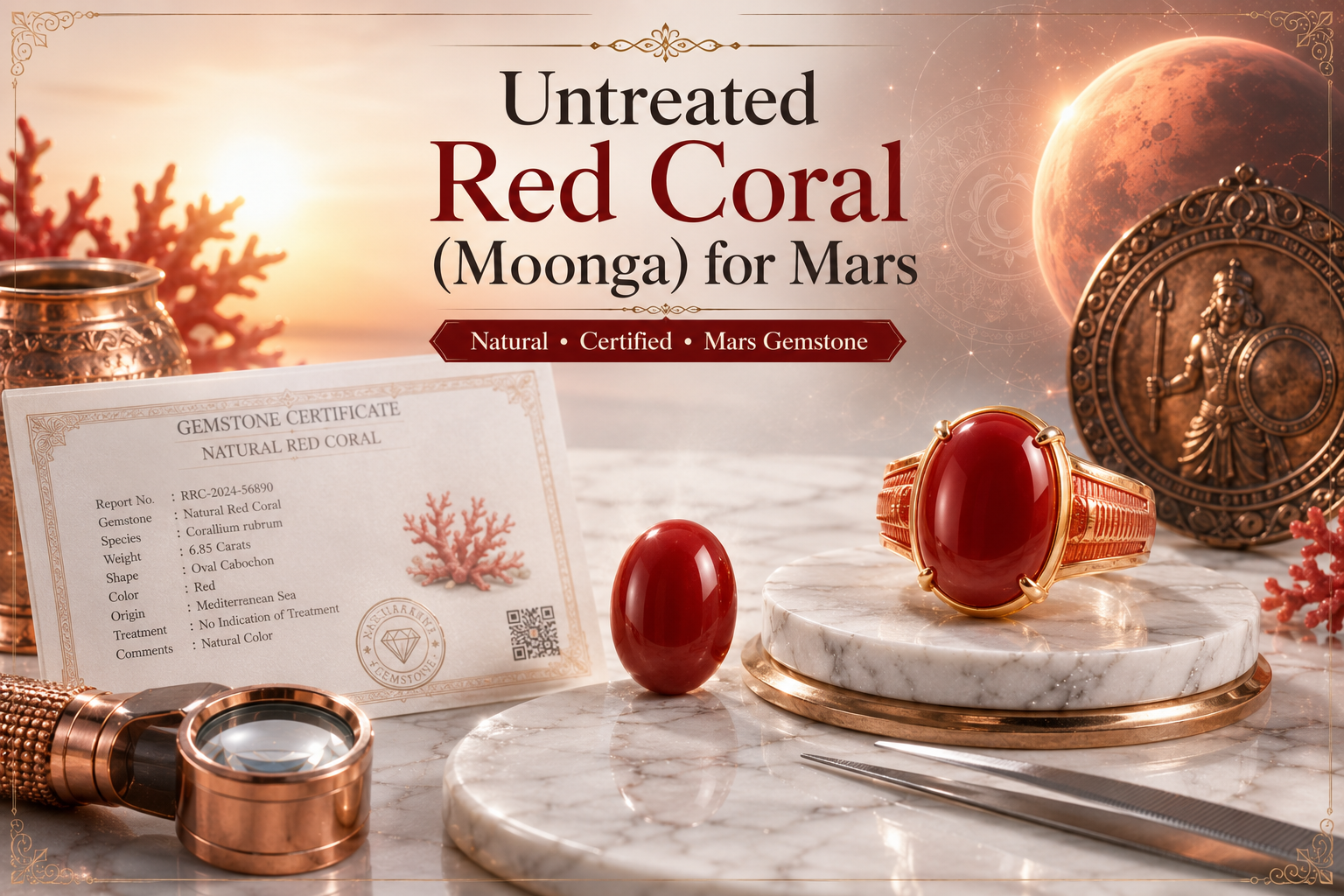
Moonga — called Lal Moonga in Hindi and Pavalam in South India — is an organic gemstone. It forms from the skeletal remains of marine polyps, tiny sea creatures that build calcium carbonate structures over long periods in specific ocean conditions. The result is a dense, smooth, intensely coloured material that has been used in jewellery and astrological practice for thousands of years.
Because it’s organic rather than mineral, red coral behaves differently from sapphires or emeralds. It’s softer — around 3.5 on the Mohs scale — which means it scratches more easily and requires more careful handling. It’s also porous, which makes it susceptible to damage from perfumes, chemicals and prolonged water exposure. A real Moonga worn daily needs basic care that a sapphire doesn’t.
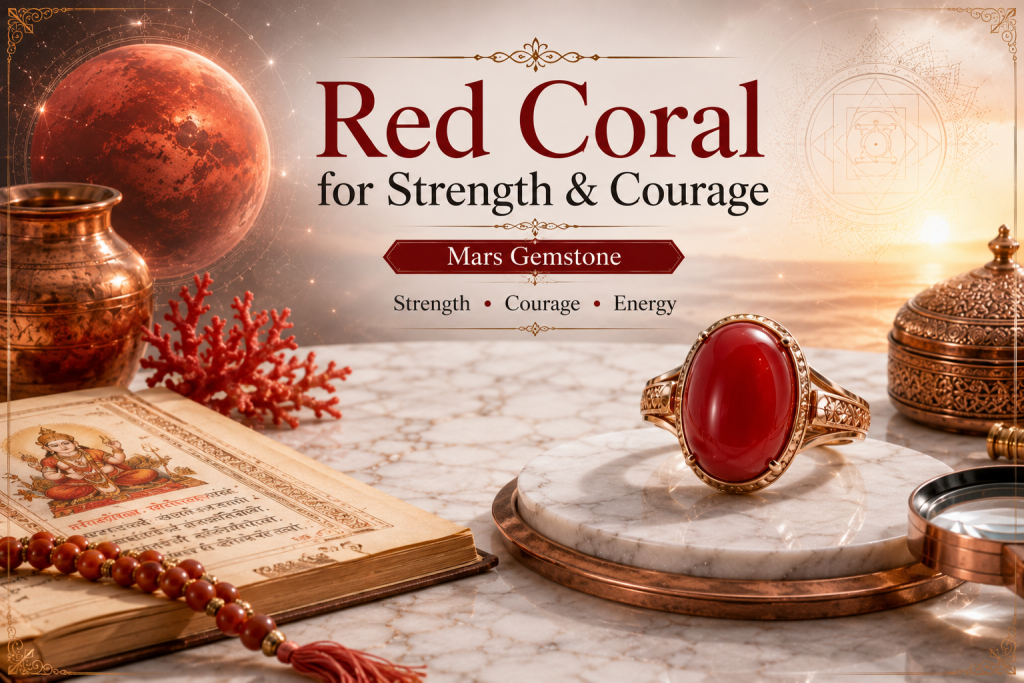
In Vedic astrology, red coral is the Ratna of Mangal — Mars. Mars governs courage, energy, physical strength, decisiveness, and vitality. When Mars is weak or afflicted, the wearer may experience low energy, indecisiveness, blood-related health issues, or difficulty asserting themselves. Red coral is also one of the primary remedies recommended for Manglik Dosha — a chart condition involving Mars that is widely believed to affect marriage prospects and marital harmony.
The Treatment Problem in Moonga
Most red coral available online has been treated in some way. Dyeing is the most common issue — pale or unevenly coloured coral is dyed to produce that uniform deep red that buyers associate with quality. The dye fades over time and the stone gradually loses both its appearance and, according to Jyotish practitioners, its astrological effectiveness.
Wax coating is another common treatment. It improves surface lustre and masks surface damage or porosity. Resin filling is used to stabilise fragile specimens. All of these treatments are widespread, all of them are rarely disclosed by sellers, and all of them are considered to compromise the stone’s natural energy for Mars.
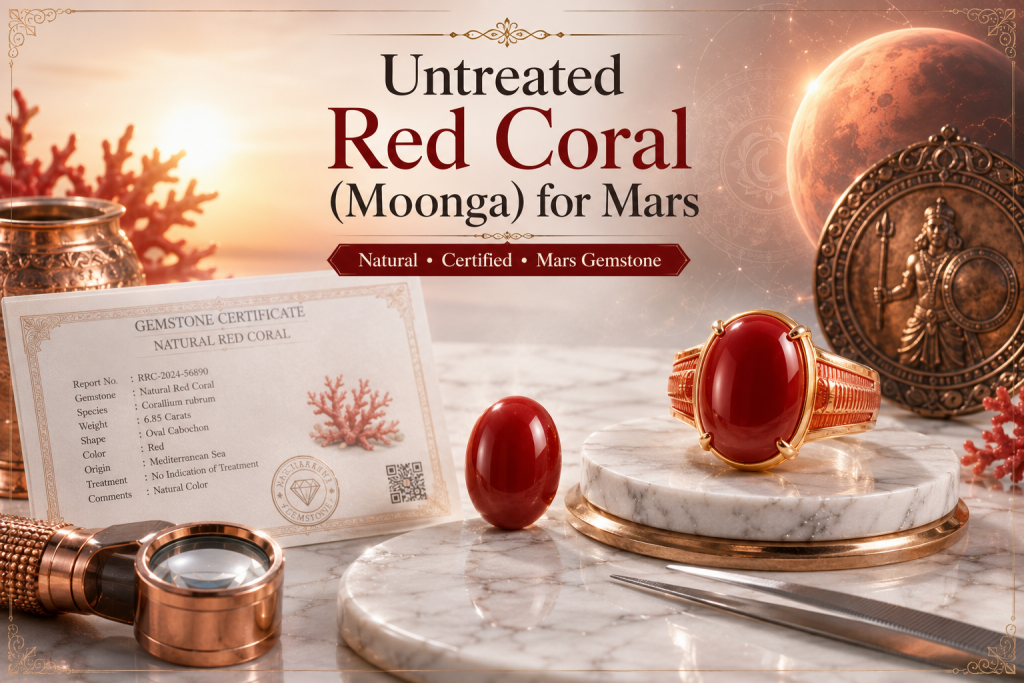
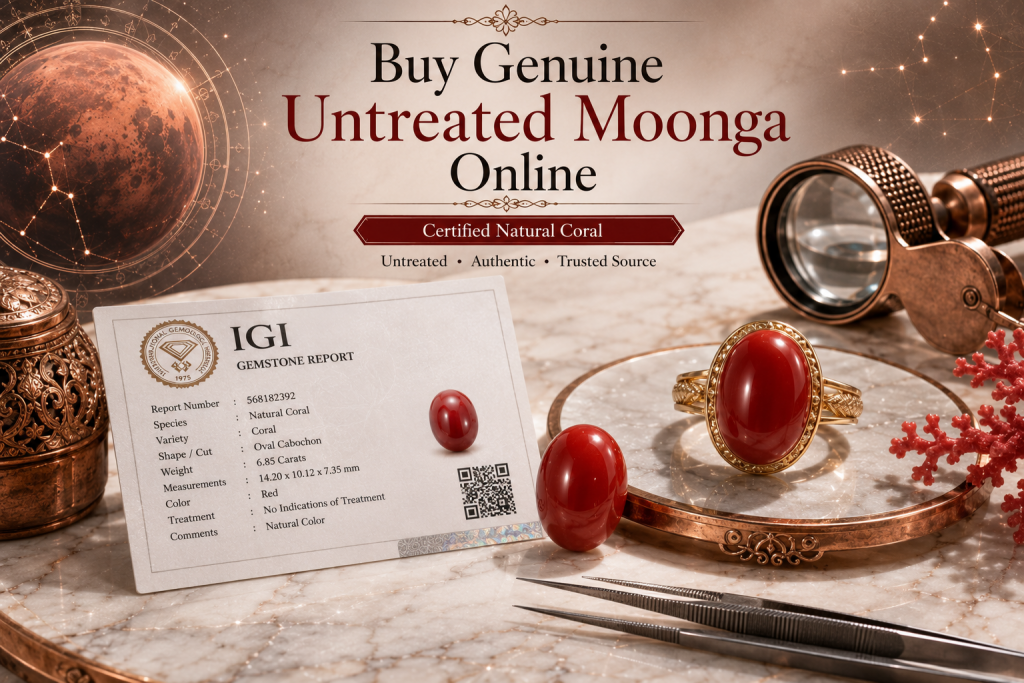
A certificate from IGI or IIGJ that explicitly confirms the coral is natural and untreated is the only reliable way to verify what you’re actually buying. Without that, you’re largely trusting the seller’s description — which in this market is not a reliable basis for purchase.
Synthetic and Imitation Coral Are Everywhere
Glass, plastic, dyed howlite, and synthetic coral flood the lower price ranges. They look convincing in photographs. They cost a fraction of natural untreated Moonga. They carry no astrological value.
The visual test most often cited — real coral feels slightly warm to the touch and has a subtle texture — is not reliable enough for a purchase decision. Laboratory certification is the only test that counts.
Colour Is the First Thing That Matters
The most valued Moonga for astrological use displays a vivid, even, ox-blood red — deep and saturated without being so dark it reads as brownish in shadow. This specific colour range is considered most potent for Mars in Jyotish tradition.
Lighter pink or salmon-coloured coral is lower grade and less recommended astrologically. Orange-red is acceptable but sits below deep red in both price and astrological preference. Uneven colour — patches of pale against deeper red — suggests either lower quality material or a treated stone where the dye hasn’t penetrated consistently.
Surface and Texture
Natural untreated coral has a smooth, slightly matte surface with a natural lustre. The texture should feel uniform — no pitting, no chalky patches, no areas that feel different from the rest of the surface. Heavily pitted surfaces or unusual smoothness can indicate wax coating or resin filling.
A coral with completely flawless surface uniformity at a low price point is almost certainly treated. Natural untreated Moonga at good quality has its own surface character — smooth but organic, not artificially perfect.
Shape and Form
Red coral for astrological use traditionally comes in a triangular or oval cabochon shape. The triangular Moonga — called Trikonam — is specifically preferred in some regional Jyotish traditions. Oval and round cabochons are widely acceptable. The stone should have no cracks running through its body as these are considered to reduce both durability and astrological effectiveness.
Where the Best Untreated Red Coral Comes From
Italian Mediterranean Coral
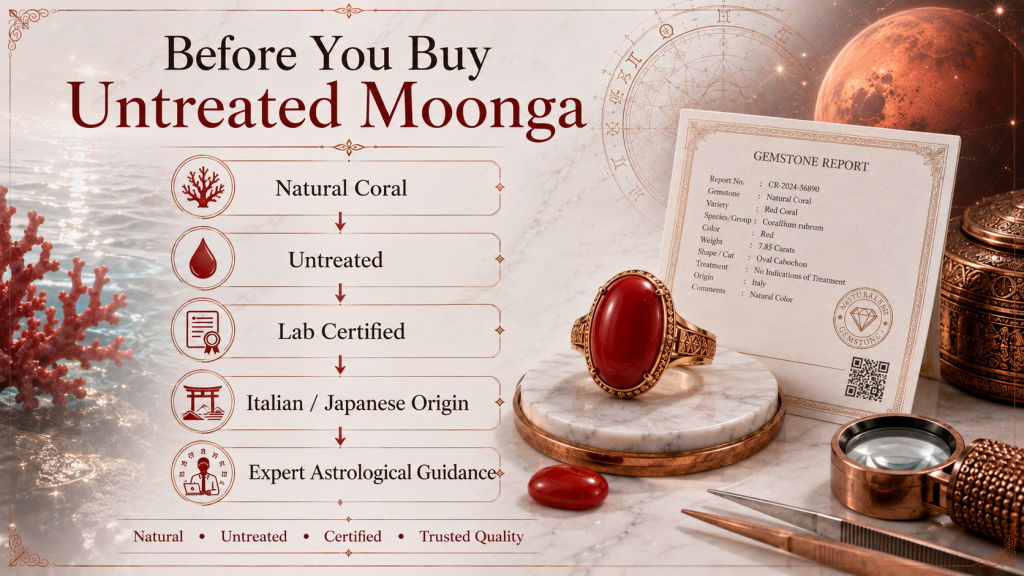
Italian coral — harvested from the Mediterranean Sea, particularly around Sardinia and Sicily — is considered the finest available for astrological use. The colour is characteristically rich and even, the density is excellent, and Italian Moonga has the longest history of use in Vedic gemstone tradition. It commands the highest prices and the most consistent Jyotish recommendations.
Japanese Coral
Japan produces red coral of excellent quality, particularly from deep-water harvests in the Pacific. Japanese Moonga tends toward a slightly darker red and is considered equally effective astrologically. It’s the primary alternative when Italian coral at the required quality or size isn’t available.
Both Italian and Japanese origins should be documented on the certificate. Origin claims without lab backing are not worth acting on in this market.
What Untreated Red Coral Gemstone Price Looks Like Online
Natural untreated certified Moonga from Italian or Japanese origin starts around ₹500 to ₹2,000 per carat at entry level — lighter colour, minor surface irregularities. Good quality with vivid colour and clean surface runs ₹3,000 to ₹8,000 per carat. Premium deep red specimens in larger sizes — 5 carats and above — go from ₹8,000 to ₹20,000 per carat and beyond for exceptional pieces.
Most Jyotish recommendations for Mars suggest a minimum of 5 to 6 carats, sometimes scaled to body weight. A quality 5-carat certified untreated Moonga puts the realistic budget between ₹15,000 and ₹1,00,000+ depending on origin and colour grade. Stones priced significantly below this range claiming Italian natural untreated status need independent verification before purchase.
FAQ
Which ascendant should wear red coral for Mars
Aries and Scorpio ascendants benefit most as Mars is their ascendant lord. Cancer and Leo ascendants may also be recommended Moonga under specific chart conditions. Always consult a qualified Jyotishi before wearing.
What is the minimum carat for Moonga to work astrologically
Most practitioners recommend 5 to 6 carats minimum. Some scale this to body weight at roughly 1 carat per 10 kilograms of body weight.
How do I know if my red coral is treated
Get it certified by IGI or IIGJ with explicit treatment disclosure. Visual tests alone are not reliable. The certificate must state natural and untreated clearly.
What finger should red coral be worn on
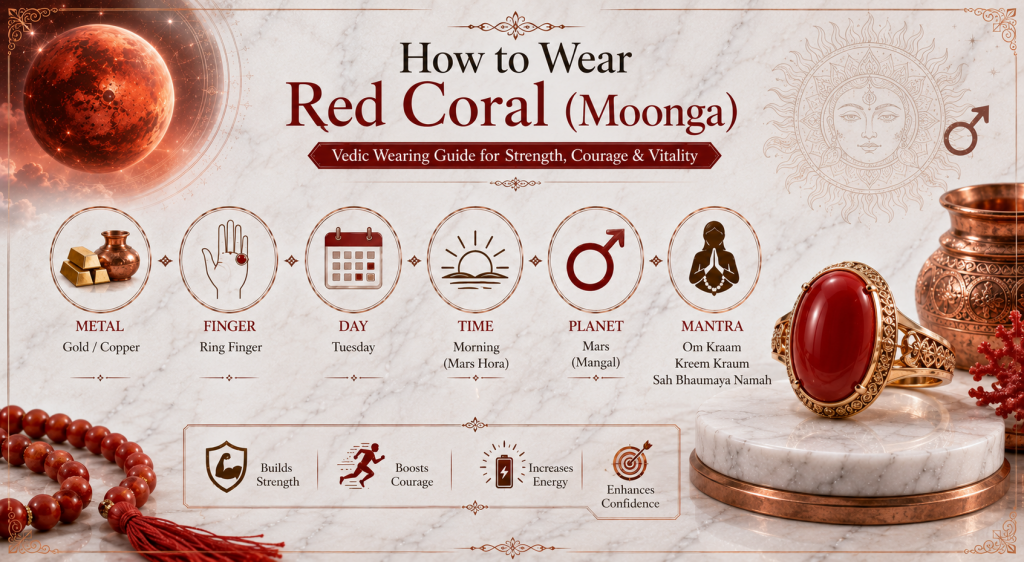
The ring finger of the right hand, set in copper or gold, worn on a Tuesday morning during Mars hora according to Vedic tradition.
Is Italian coral better than Japanese for Mars
Both are considered excellent. Italian Mediterranean coral is the most consistently recommended and commands a slight premium. Japanese coral is a strong alternative at comparable quality levels.
Tags:
buy red coral online India,
certified moonga gemstone,
certified red coral,
genuine red coral,
Italian Red Coral,
Japanese Red Coral,
lal moonga stone,
Mangal gemstone,
Mars Gemstone,
Moonga Ratna,
natural Italian coral,
natural moonga stone,
natural red coral,
original coral gemstone,
original moonga stone,
red coral for astrology,
untreated moonga,
untreated red coral,
untreated red coral gemstone online,
Vedic astrology red coral