

















Blue Sapphire Gemstone Price and Quality Guide for Buyers in Delhi
Blue Sapphire Gemstone Price and Quality Guide for Buyers in Delhi
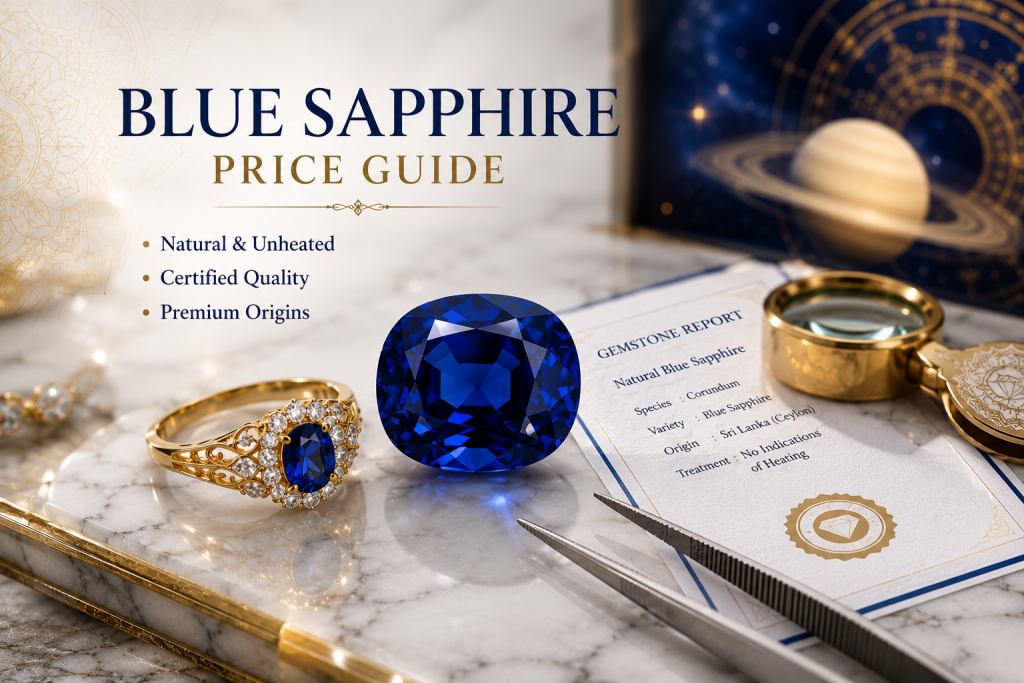
Most people shopping for blue sapphire in Delhi start with one question — how much should this actually cost — and end up more confused after researching than before they started.
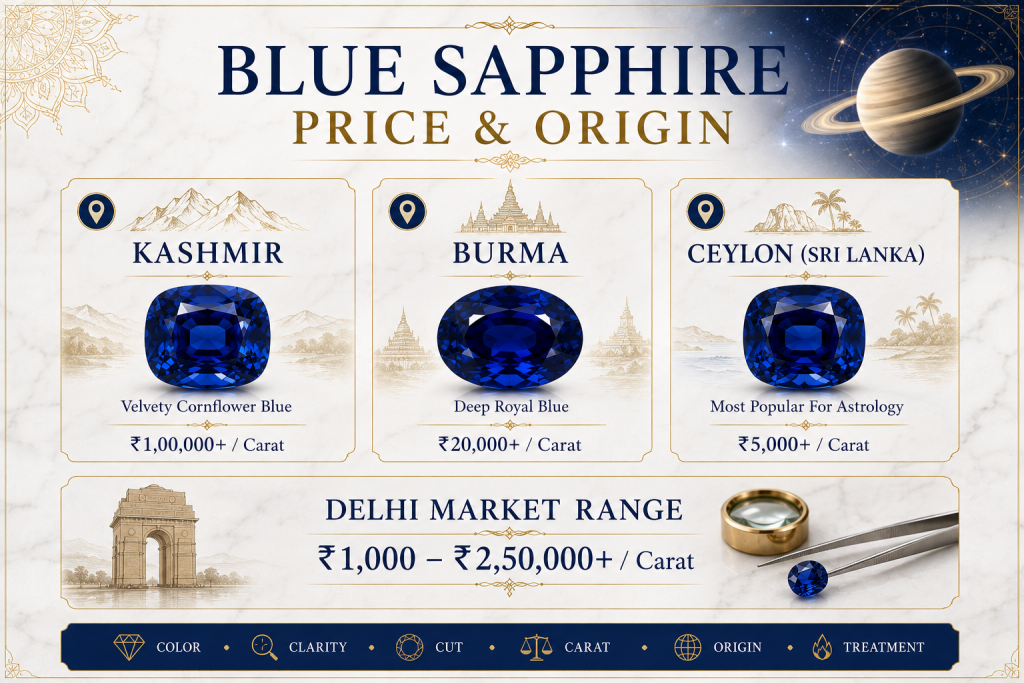
That confusion is understandable. Blue sapphire price in Delhi runs from roughly ₹1,000 per carat at the low end to ₹2,50,000 per carat or more at the top. Not a typo, not a scam. It reflects real, dramatic differences in what’s actually being sold, and understanding those differences before walking into any Delhi gemstone market is the only way to know whether a price is fair.
Why the Price Range Swings So Wildly
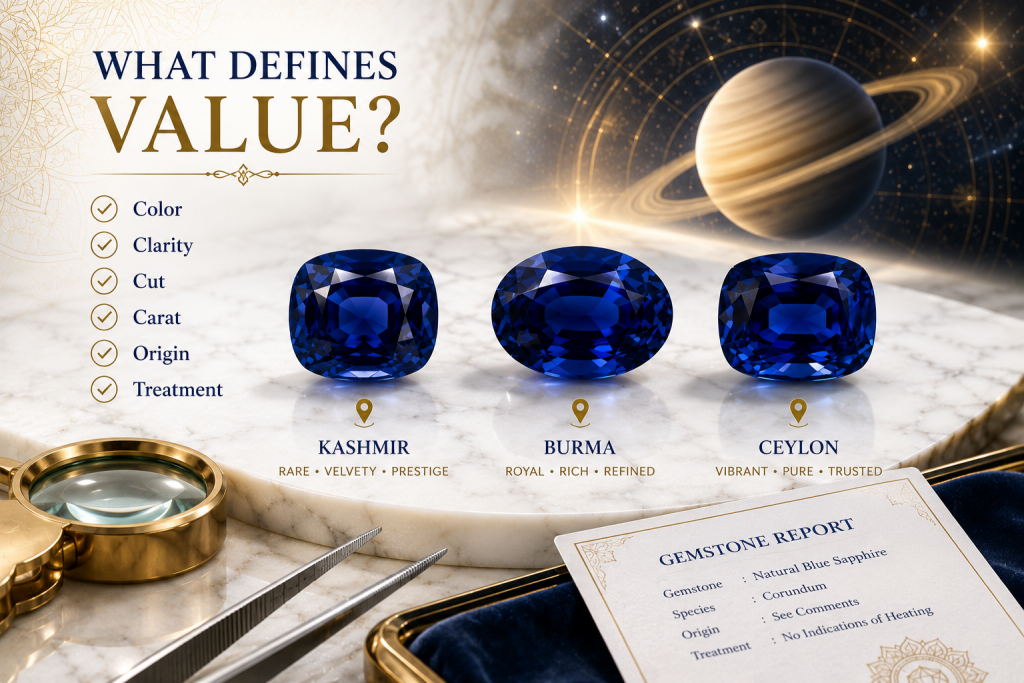
Six factors determine where any given stone lands on that spectrum — cut, color, clarity, carat weight, origin, and treatment. Each moves the price independently. They compound rather than average out, which is exactly why two stones that look similar at a glance can be priced ten times apart.
Cut does more than shape the gem. It hides imperfections and pulls maximum brilliance out of the rough material. A well-faceted stone in oval mixed, emerald cut, or cushion mixed costs noticeably more than an irregular or poorly proportioned one of equivalent rough quality. This gets overlooked constantly, partly because it’s harder to assess at a glance than color.
Color is where most of the value actually sits. Blue sapphire is corundum — naturally colorless, with trace iron and titanium producing the blue. The two most valuable shades have specific trade names. Royal Blue is deeply saturated and rich. Cornflower Blue is softer, almost velvety. Both command real premiums over pale or overly dark stones.
Clarity works a little differently here than people expect. Generally, fewer visible inclusions means higher value — straightforward enough. But there’s a genuine exception worth knowing: extremely fine particle clouds inside the stone can scatter light in a way that creates a velvety appearance without hurting transparency, and in some cases this actually raises value rather than lowering it. Still, as a broad rule, clearer means pricier.
Carat weight matters more than buyers expect, because flawless natural blue sapphire above a few carats is genuinely uncommon. Price doesn’t just rise with size — it rises faster than size, since large clean stones get progressively harder to source.
Origin Explains Most of That Massive Price Gap
This is where the ₹1,000 to ₹2,50,000 spread actually starts to make sense.
Kashmir sapphire is the most coveted origin on earth — that signature velvety Cornflower Blue, with characteristic fine inclusions giving it extra depth. Kashmir material starts around ₹1,00,000 per carat and climbs to ₹15,00,000+ per carat for exceptional pieces. The original Kashmir mines are mostly depleted now. That’s precisely why genuine Kashmir-origin sapphire costs what it does — there isn’t much left to mine.
Burma, formerly known as Myanmar, is the second major premium source. Prices start around ₹20,000 per carat and reach ₹5,00,000 or above for the finest examples. Burmese stones are prized for deep, rich color that in many cases rivals Kashmir material directly.
Sri Lanka — Ceylon — is the most accessible and widely available origin, and not coincidentally the one used most often for astrological purposes. Ceylon sapphire starts around ₹5,000 per carat and can reach ₹5,00,000 or more for premium specimens. Greater availability keeps the price floor reasonable across the entire quality range, which is exactly why most Jyotish practitioners point buyers toward Ceylon material when they’re shopping specifically for Neelam stone.
Treatment Is the Hidden Factor That Decides Whether the Stone Works
High-temperature heat treatment routinely improves color or enhances clarity in commercial blue sapphire. Glass-lead filling sometimes fixes pits and cracks, improving how transparent the stone looks. Both are widespread in the market.
For jewelry, treated stones are perfectly legitimate and considerably cheaper. For astrology, treatment is the line between a stone that delivers results and one that doesn’t — at least according to the Vedic tradition. And this single distinction explains something that confuses almost every first-time buyer.
Why So Many People Get Nothing From Wearing Blue Sapphire
This number gets repeated often in the gemstone trade, and it deserves a real explanation instead of a vague warning: roughly 90 percent of people who wear blue sapphire for astrological reasons report no noticeable result.
Blue sapphire is considered the fastest-acting stone in the corundum family — tied to Saturn, capable of producing rapid shifts in wealth, confidence, and resolution of ongoing troubles. The most prized specimens show that deep Royal Blue or soft Cornflower Blue saturation. But the stone only behaves this way under three specific conditions, and most commercially available “blue sapphires” fail at least one of them without the buyer ever realizing it.
Is it actually real. The market has a genuine fake-stone problem. Sellers passing off synthetic or simulant material as natural blue sapphire at natural-stone prices are common enough that verification should be assumed necessary, not treated as an extra precaution. A fake stone won’t produce any astrological effect no matter how it’s worn or how correctly the ritual is followed.
Is it heated. Plenty of genuinely natural blue sapphires have still gone through heat treatment to improve color or clarity. A proper certificate will state this plainly. If heating happened, the tradition holds that the desired result simply won’t follow — the heat is believed to disrupt the stone’s natural energetic transmission even though the underlying material is real corundum.
Is it treated in other ways. Beyond heating, sapphires sometimes go through additional high-temperature processes purely to improve cosmetic appearance. These increase visual appeal without increasing actual value, and according to the tradition, wearing such treated stones delivers no astrological benefit regardless of how good the stone looks sitting on your finger.
This is the actual answer to why so many people wear what they believe is a powerful Neelam and feel nothing. The stone might genuinely be corundum. It might genuinely be naturally blue. But if it’s been heated or otherwise treated along the way, the tradition is unambiguous that it won’t deliver what untreated Neelam is supposed to deliver.
What a Properly Sourced Blue Sapphire Stone Should Look Like
Natural blue sapphire connected to Saturn traditionally comes from three places — Sri Lanka, Burma, and Kashmir. The stone is associated with effectiveness in business, career, health, and marriage when worn correctly, and is specifically recommended for people moving through Shani Sade Sati, Saturn’s difficult seven-and-a-half-year transit.
The tradition also links genuine Neelam to protection against accidents, theft, and natural calamities, and considers it particularly useful for people working in martial arts, drama, and cinematography — fields that demand courage and resilience under pressure.
A stone properly sourced for astrological use should show a faceted or cabochon cut depending on intended use, Ceylon origin for the most readily available astrological-grade material, color ranging from light to medium to dark blue with genuine saturation, transparency somewhere between translucent and fully transparent depending on grade, and most importantly, confirmed unheated and untreated status backed by certification.
What to Check Before You Buy Anything in Delhi
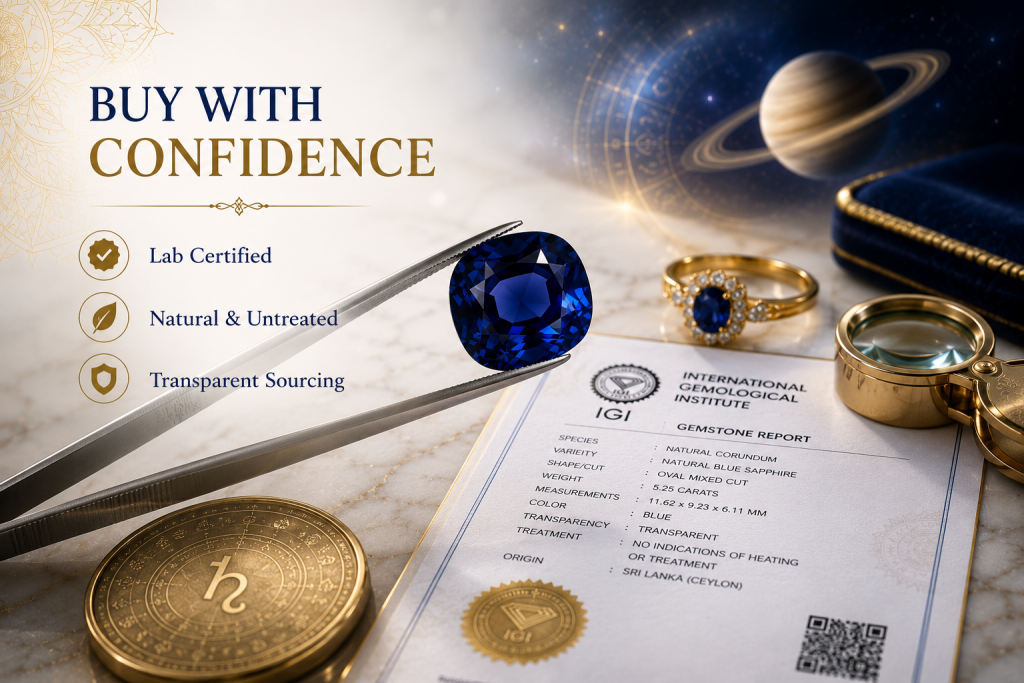
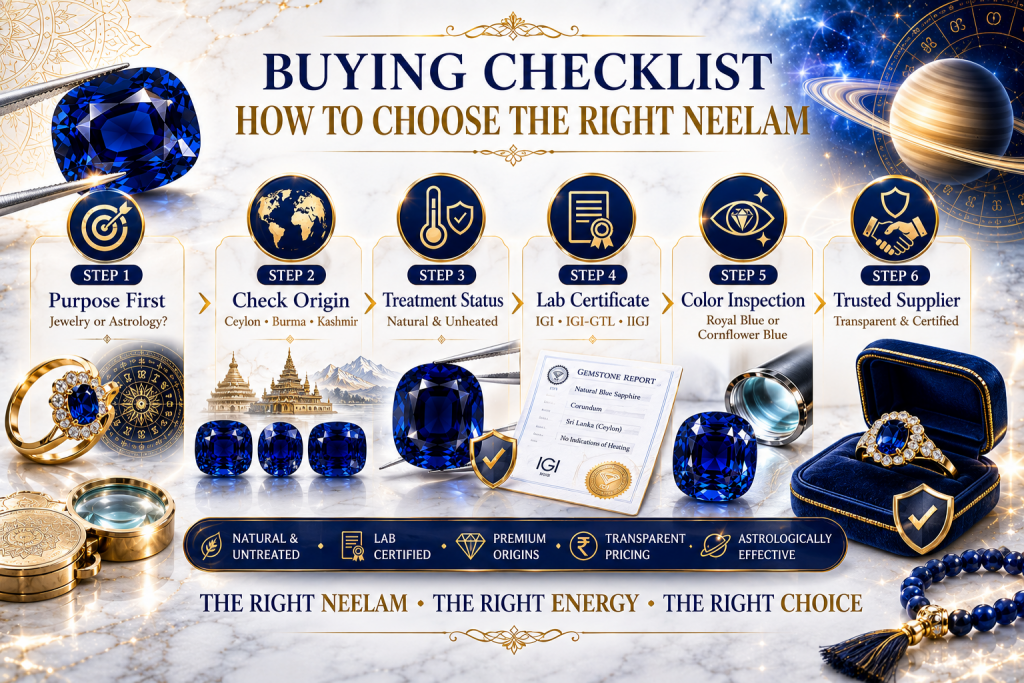
Ask for a government lab certificate — IGI-GTL, IIGJ, or IGI are common and reliable benchmarks in the Indian market. The certificate needs to state explicitly whether the stone has been heated or otherwise treated. That single line determines whether the stone has any real chance of producing astrological results.
Compare the price against the claimed origin. A stone priced like commercial Ceylon material but sold to you as Kashmir origin should raise an immediate question, since genuine Kashmir sapphire starts at roughly fifty times that price floor. Look at the stone’s color under natural daylight, not just the shop’s lighting — color shifts more than people expect between the two.
And before buying anything for astrological purposes, confirm with a qualified astrologer that Saturn’s actual placement in your birth chart calls for this particular remedy in the first place. Perfect sourcing means nothing if the stone was never the right fit for your chart to begin with.
Where This Leaves You
Blue sapphire prices in Delhi span an enormous range because cut, color, clarity, carat weight, origin, and treatment status each move value independently and then compound together. For jewelry, a well-cut, attractively colored heated stone from any origin is a perfectly reasonable buy. For astrological use specifically, only natural, unheated, untreated material from Ceylon, Burma, or Kashmir — verified through a government lab certificate that addresses treatment status directly — will deliver what the tradition associates with genuine Neelam. That gap between the two purchases is exactly why so many people who buy “blue sapphire” for astrological reasons end up with nothing to show for it.