How to Test Ruby Stone Purity at Home | Easy Ways to Identify a Genuine Manik Stone
Vikas June 11, 2026 in
Astrology How to Test Ruby Stone Purity at Home
You bought a deep red gemstone. Someone told you it’s a natural ruby — genuine Manik, one of the most prized stones in the world. It looks right. The color is vivid. The price seemed fair.
Then the doubt arrives.
That doubt is worth listening to. The red gemstone market has more imitations, composites, and synthetics than most buyers realize. Glass rubies, garnet substitutes, lab-grown stones sold without disclosure, and composite rubies — natural ruby material fused with leaded glass — all circulate regularly. Some are obvious. Others are genuinely difficult to catch without equipment.
The tests below won’t replace a gemological laboratory report. But they’ll catch the most common deceptions and give you a solid sense of what you’re holding before you spend serious money.
What You Might Actually Be Holding
Before testing, it helps to know what the common substitutes actually are.
Glass is the crudest imitation — too flawless, lighter than natural ruby, and soft enough to scratch easily. Easy to catch with basic tests.
Red spinel is a legitimate gemstone in its own right, but gets sold as ruby because the colors can look similar. It’s softer — hardness 8 versus ruby’s 9 — and doesn’t fluoresce the way natural ruby does under UV light.
Red garnet is another natural stone used as a simulant. Different refractive index from ruby, different hardness, different behavior under testing.
Composite ruby is the tricky one. These contain actual natural ruby material but are filled with leaded glass to improve clarity and appearance. They look convincing. They’re much less durable and considerably less valuable than solid natural ruby. And they’re common.
Synthetic ruby is the hardest to catch at home. Lab-grown ruby has identical chemical composition and crystal structure to natural ruby. The difference is origin — earth versus laboratory — and the internal characteristics that origin produces. No home test definitively identifies a synthetic. That requires professional equipment.
The At-Home Tests
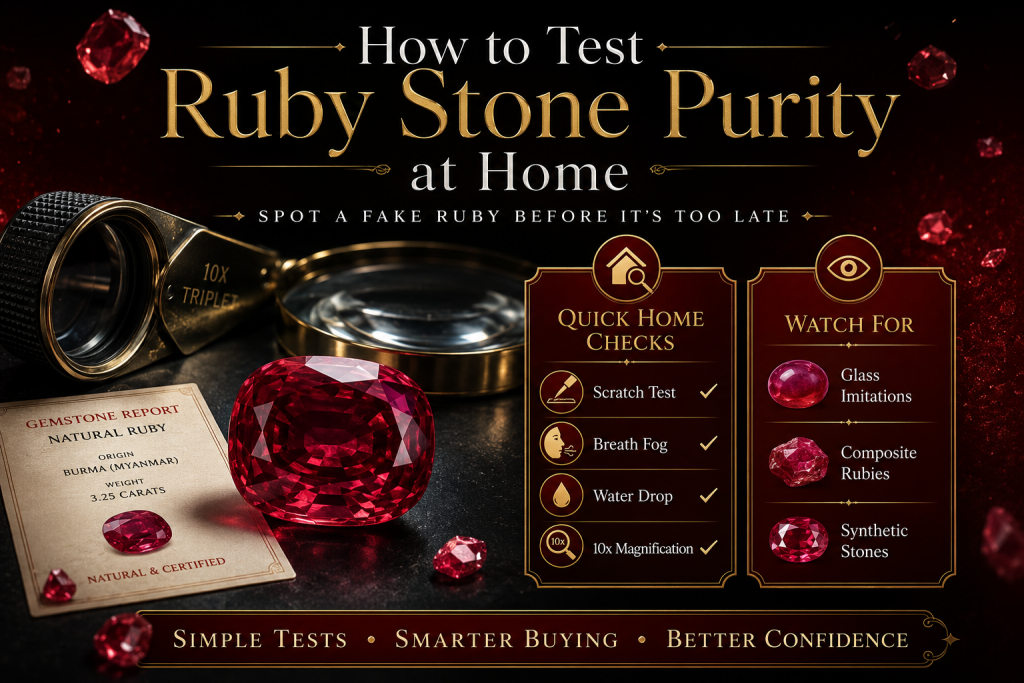
Scratch Test
Natural ruby is hardness 9 on the Mohs scale — harder than glass, harder than most metals, harder than the vast majority of materials it will encounter. This hardness is testable.
Take a glass surface — a plain drinking glass works — and gently attempt to scratch it with the edge or corner of your stone. A natural ruby will scratch the glass cleanly without any damage to the stone itself. Glass imitations won’t scratch glass. Garnet will scratch glass but is softer than ruby and will show wear itself over repeated testing.
One caution: don’t scratch your ruby against another stone you care about. The hardness works both ways.
Breath Fog Test
Natural ruby conducts heat efficiently, which means fog from your breath dissipates from its surface very quickly. Breathe onto the stone — the way you’d fog a mirror — and watch what happens.
On a genuine ruby, the fog clears almost immediately. On glass, it lingers noticeably longer.
Quick, non-destructive, and useful as a first filter. Not definitive on its own but helpful when combined with other tests.
Water Drop Test
Place a single drop of water on the flat surface of the stone. On a natural ruby, the drop holds its shape — surface tension keeps it rounded, almost standing up on the stone’s surface. On glass or lower-quality imitations, the drop spreads and flattens more readily.
This tests surface characteristics and provides information about the stone’s density and surface quality. Again, a supporting test rather than a standalone conclusion.
Magnification Test
This is the most informative home test available, and it requires nothing more than a 10x jeweler’s loupe — available inexpensively online — or a strong magnifying glass.
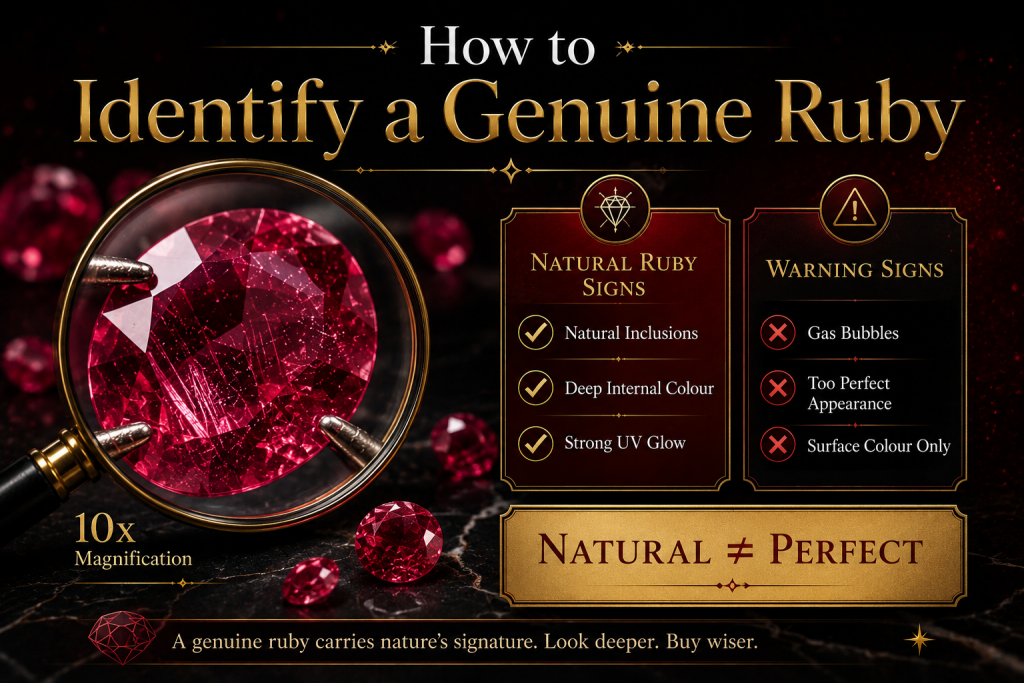
What to look for in a natural ruby: inclusions. Natural earth-mined rubies almost always contain internal characteristics from their formation — fine needle-like structures called silk, small crystal inclusions, growth lines, minor fractures. These are not defects. They’re evidence of natural formation and they’re expected.
What’s suspicious: gas bubbles. Round, spherical bubbles inside the stone indicate glass. A stone that appears completely flawless under magnification is also worth questioning — genuinely inclusion-free natural rubies exist but are extremely rare and command prices that reflect that rarity. A perfect-looking stone at a moderate price is almost certainly synthetic or composite.
Composite rubies show something specific under magnification: a network of gas bubbles trapped in the glass filling material, often with a slightly different luster between the ruby areas and the glass-filled areas.
UV Light Test
Natural ruby contains chromium — which is responsible for both its red color and its characteristic fluorescence under ultraviolet light. Under a UV lamp or blacklight, a natural ruby glows a vivid, intense red. Sometimes almost fiery. This is one of the more distinctive characteristics of genuine Manik stone.
Red garnets typically show little to no fluorescence under UV. Red spinel responds differently. Glass shows no fluorescence.
The caveat: some synthetic rubies also fluoresce strongly under UV because they share the same chromium content as natural stones. This test helps distinguish ruby from common simulants but doesn’t separate natural from lab-grown.
Signs That Point Toward Synthetic
Lab-grown ruby is the genuinely difficult case. The same chemistry, the same hardness, the same fluorescence. But a few indicators help:
A stone that’s too perfect — uniform color saturation, no inclusions under 10x magnification, no growth lines — is suspicious when priced below what such perfection would cost in natural material. Genuinely flawless natural rubies are among the most expensive colored stones in the world. If the price doesn’t reflect that, the stone probably isn’t what’s being claimed.
Lab-grown rubies sometimes show curved growth lines under magnification rather than the straight or angular growth lines of natural crystals. This requires magnification and some practice to identify, but it’s one of the few indicators that can distinguish lab-grown from natural without professional equipment.
Gas bubbles that are almost but not quite perfectly round — slightly irregular rather than perfectly spherical — can indicate the flame fusion process used in some synthetic production.
When Home Tests Aren’t Enough
These tests catch obvious imitations. They don’t provide certainty, and they won’t distinguish natural from lab-grown reliably.
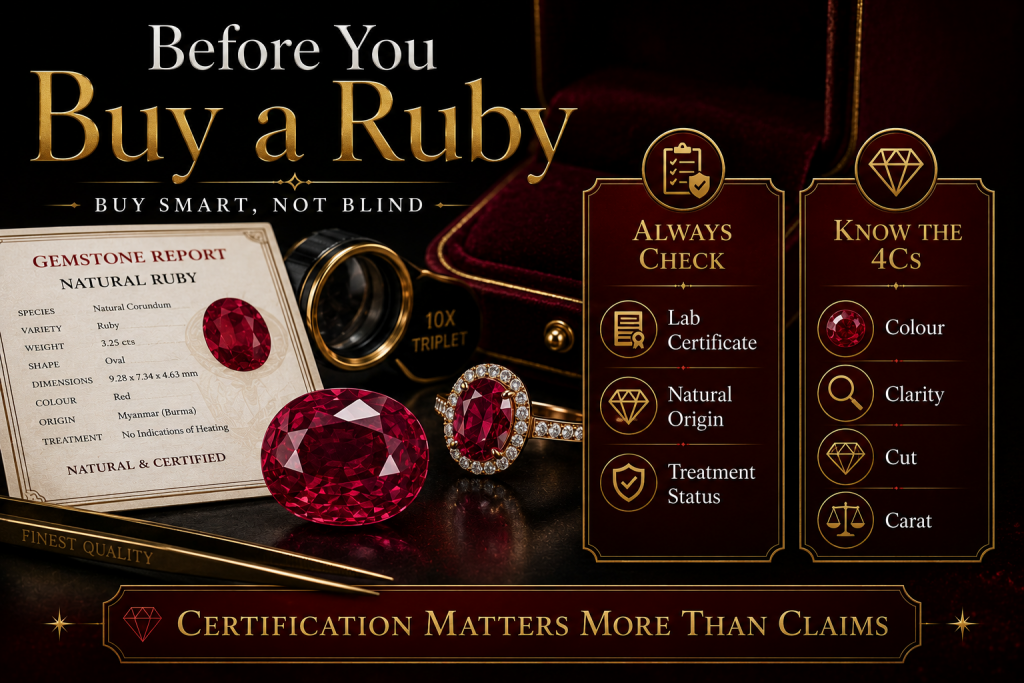
For any significant purchase — anything above a few thousand rupees — a certificate from an independent gemological laboratory is worth the cost. GIA, GRS, Gübelin, and several Indian labs provide reports that specify natural versus synthetic origin, treatment status (heat treatment, fracture filling), geographic origin where determinable, and quality characteristics.
That report does something no home test can: it provides documented proof of what you actually own, which matters both for your peace of mind and for resale value.
Buying Smart From the Start
The most efficient way to avoid fake ruby anxiety is to buy certified natural material in the first place.
Ask for the lab report before purchase, not after. A reputable seller provides certification as a matter of course. A seller who becomes vague or defensive when asked for documentation is information worth acting on.
Know the 4Cs for ruby: color (vivid red with no orange or purple cast commands premiums), clarity (minor inclusions are normal, eye-clean is desirable), cut (proportions affect color and brightness), and carat weight (fine rubies above 2 carats are genuinely rare and priced accordingly).
If the price seems dramatically favorable for the quality being claimed — particularly for stones presented as untreated Burmese or fine Ceylon ruby — that’s worth investigating before committing. Pigeon blood Burmese ruby at Thai commercial prices is almost always either from a different origin, heat-treated, composite, or synthetic. The market is consistent enough in this pattern that unexpectedly low prices are a signal rather than a bargain.
If you’re seeking authentic guidance for career, health, or relationship concerns, or wish to explore genuine Vedic remedies, visit our webpage at purevedicgems. Our site features trusted astrology consultations, high-quality gemstones, Rudrakshas, and Vedic rituals, all rooted in deep knowledge and traditional practices. Discover how our holistic approach can support your well-being and spiritual growth.

Tags:
certified ruby,
composite ruby test,
fake ruby identification,
genuine ruby identification,
how to check ruby stone,
how to identify original ruby,
how to test ruby stone purity at home,
manik stone test,
natural ruby guide,
natural ruby testing,
original manik stone,
pure ruby stone,
ruby authenticity test,
ruby buying guide,
ruby gemstone authenticity,
ruby magnification test,
ruby scratch test,
ruby stone purity test,
ruby UV test,
synthetic ruby vs natural ruby