Moonga Stone (Red Coral): Complete Guide to Benefits, Astrology, How to Wear, Types & Price
Vikas June 8, 2026 in
Astrology Moonga Stone (Red Coral): Complete Guide to Benefits, Astrology, How to Wear, Types & Price
Moonga Stone is not a mineral.
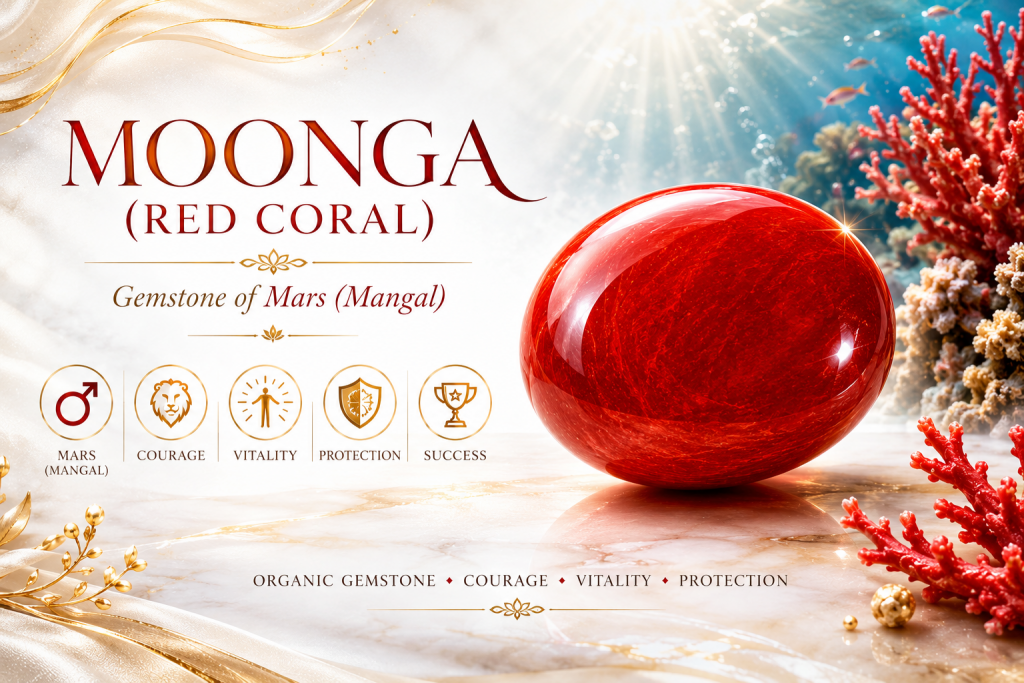
That sounds like a minor technical detail but it actually changes everything about this gemstone — how it forms, what it feels like, why it behaves differently from ruby or sapphire in your hand, and why astrologers across centuries have treated it as something distinct from stones pulled out of rock.
Every other planetary gem in Vedic astrology is a mineral. It formed under geological pressure deep inside the earth. Red Coral grew on the ocean floor. Inside living coral polyps. Layer by layer of calcium carbonate secreted over years by tiny marine creatures until what remained — after the creature died and the skeleton was harvested and polished — was a gemstone that feels warm, slightly porous, and unmistakably alive in a way mineral stones are not.
The names it carries across traditions tell you something. Moonga. Lal Moonga. Praval Ratna. Sinduja. Mangalmani. Vidrum. Latamani. Maheya. Different languages, different traditions, all arriving at the same stone. And all of them connecting it to the same planet — Mars. Mangal. The planet of fire, courage, blood and the energy that makes things actually happen.
The scientific name for gem-quality red coral is Corallium — a genus of marine organisms that builds skeletal structures from calcium carbonate (CaCO₃). The colour comes from carotenoid pigments and proteins incorporated during biological formation. Not surface treatment. Not dye. The red runs through the material because it was produced there, by the creature, as it grew.
This matters practically. A stone whose colour is intrinsic behaves very differently from one whose colour sits on the surface. Natural red coral, broken or cut, shows the same colour throughout its cross-section. Treated coral — bleached and re-dyed, which is common in lower-quality commercial material — shows the original pale base colour at any uncoated edge or fracture.
Physically, Red Coral sits between 3.5 and 4 on the Mohs hardness scale. Softer than most gemstones worn in jewellery. Brittle. Porous. Sensitive to acids, heat, perfume and household chemicals in ways that sapphire or diamond simply are not. This is not a weakness exactly — it is just the character of an organic material. Pearl has similar vulnerabilities. Understanding them from the start shapes every decision about how you wear and care for the stone.
| Property | Details |
|---|
| Composition | Calcium Carbonate (CaCO₃) |
| Colour | Pale salmon to deep ox-blood red |
| Hardness | 3.5 – 4 Mohs |
| Refractive Index | 1.486 – 1.658 |
| Specific Gravity | 2.6 – 2.7 |
| Crystallinity | Hexagonal |
| Luster | Waxy to dull |
| Fracture | Splintery |
Mars and What This Stone Actually Governs
In Jyotish, Mars — Mangal — is the planet of fire. Not metaphorically. Mars governs the literal fire of the body — blood, muscles, the adrenal system, the heat that produces decisive action. It also governs courage, competitive instinct, physical endurance, ambition, siblings, landed property and the capacity to begin things and see them through.
A strong, well-placed Mars in a birth chart produces a particular kind of person. Energetic. Direct. Physically capable. Someone who acts when action is needed rather than deliberating indefinitely. Someone who competes without apologising for wanting to win.
A weak or afflicted Mars produces the reverse. Chronic low energy. Confidence that collapses under pressure. Projects started and abandoned. A kind of inward-turning anger that damages the person who carries it more than anyone else. Blood-related health difficulties. Difficulty with brothers. Disputes over property.
Red Coral is worn to strengthen Mars’s positive influence. That is the foundational logic. Every benefit associated with Moonga — courage, vitality, blood health, professional drive, protection — comes directly from what Mars governs in the Vedic system. The stone is not claiming to do random things. It is doing the things its ruling planet does.
Who Should Wear Red Coral
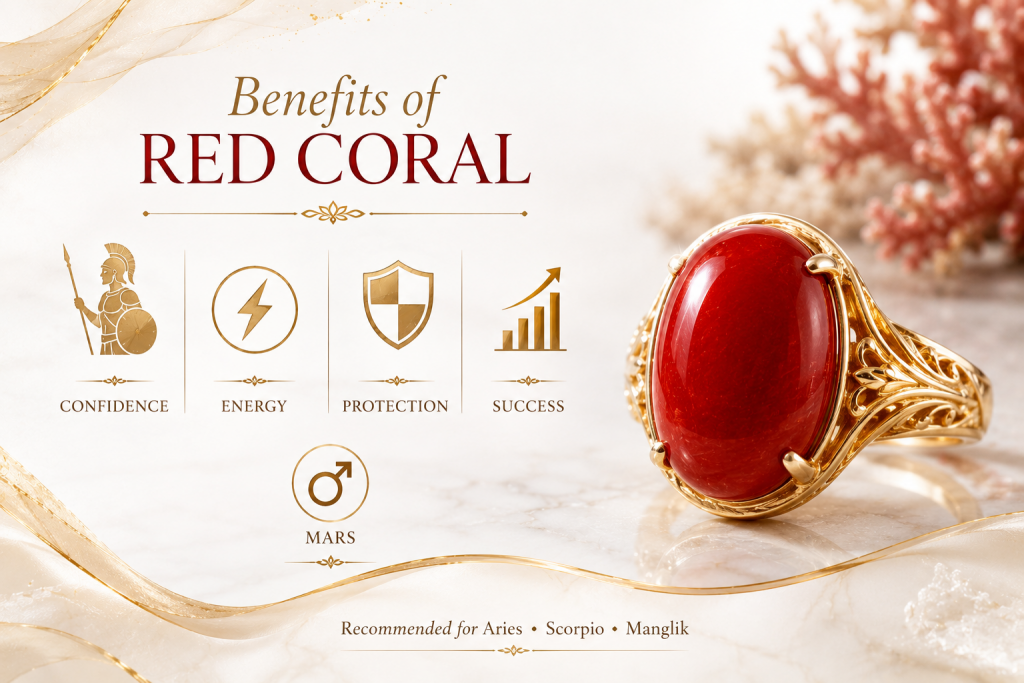
Aries (Mesh) and Scorpio (Vrishchik) ascendants are the clearest candidates. Mars rules both signs. For these natives, Red Coral strengthens the chart ruler — straightforward and generally safe recommendation.
Mangliks — people with Mars placed in the 1st, 4th, 7th, 8th or 12th house, creating Manglik Dosha — are specifically recommended Red Coral. The dosha is primarily associated with difficulties in marriage timing and compatibility. Wearing Mars’s stone is believed to channel the planet’s energy more productively, reducing the dosha’s challenging effects rather than amplifying them.
People in Mars Mahadasha or Antardasha. Mars rules a seven-year major period in the Vimshottari system. Wearing his stone during that window is a well-established practice that most Jyotish sources consistently support.
Professionals in demanding fields. Military. Police. Surgeons. Competitive athletes. Politicians. Anyone whose daily work requires the qualities Mars directly governs — physical endurance, decisive action under pressure, competitive instinct, courage in confrontational situations.
Leo, Sagittarius, Pisces and Cancer ascendants may also benefit. It depends on Mars’s specific house placement and what he rules in the individual chart. This is where general guidance ends and personal chart analysis becomes necessary.
A genuine caution worth stating plainly: for some ascendants — particularly Gemini and Virgo — Mars functions as a malefic. Wearing his stone in those configurations can make a difficult planetary influence stronger rather than redirecting it beneficially. Do not rely on your sun sign or moon sign alone here. A proper ascendant assessment from a qualified Vedic astrologer before purchasing is worth the effort.
Benefits of Wearing Red Coral Stone
Courage and Confidence
The most direct benefit and the one most immediately felt by most wearers. Mars is the planet of courage — not recklessness, which is afflicted Mars territory — but the grounded, steady kind of courage that allows a person to act when action is needed. People who find themselves chronically hesitant, who abandon projects before completion, who lose confidence under competitive pressure — these are recognisable Mars deficiency signatures. Red Coral is the traditional remedy.
Wearers consistently describe something similar. Not a sudden personality transformation. More like a quieting of the internal resistance that was getting in the way.
Physical Vitality
Mars governs physical strength, muscle and the adrenal system. Red Coral is associated with improving stamina and reducing chronic fatigue — the kind that does not have an obvious medical cause but drains a person’s capacity to sustain effort over time. This is why the stone appears so consistently in recommendations for sportspeople, surgeons and anyone in physically demanding professional roles.
Blood and Immune Health
In Vedic anatomy, Mars governs blood. Red Coral’s traditional health associations include white blood cell production, circulatory strength and cardiovascular support. It also appears in traditional practice recommendations for arthritis, rheumatism and bone density — conditions associated with Mars’s domain over muscles, joints and the body’s structural integrity.
Traditional metaphysical associations. Not medical claims. Worth knowing for anyone approaching gemstones holistically.
Emotional Recovery
Afflicted Mars does not always manifest as aggression. Sometimes it turns inward — unresolved anger that never finds expression, emotional paralysis after trauma, the inability to move forward after loss or failure. Red Coral is associated with transforming this stagnant Mars energy into forward momentum. People dealing with emotional trauma from accidents, failures or grief frequently find it recommended in this specific context.
Protection
Red Coral appears as a protective talisman across independent traditions that had no contact with each other. Ancient Mediterranean. South Asian Vedic tradition. West African royal courts. The convergence is significant — when unrelated cultures land on the same protective association for a stone, something consistent is being observed across them.
It is specifically associated with protection from evil eye (nazar), psychic interference, accidental harm and the intensified challenges of difficult planetary periods.
Manglik and Relationship Benefits
For Mangliks, the path toward marriage can feel genuinely obstructed. Red Coral works on two levels here — reducing the Manglik Dosha’s influence on marriage timing and compatibility, and bringing Mars qualities into the relationship itself: passion, directness, vitality, the kind of honest intensity that sustains long-term connection rather than the surface pleasantness that eventually collapses.
Professional Drive and Success
Mars governs ambition and competitive instinct. Business ventures that have stalled. Athletic performance that has plateaued. Competitive situations where confidence is actually the deciding factor. These are the domains where Red Coral’s traditional application is most specific and most consistent.
Types of Red Coral Gemstone
Mediterranean Red Coral — Corallium Rubrum
From the coastal waters of Italy, Spain, Greece, Morocco and Croatia. This species produces a range of colour gradations — from pale pink through salmon to vivid scarlet — within a single population. Fine Mediterranean specimens show uniform red without white streaks or specks running through the branches.
Italian coral from the waters around Sardinia and Sicily has the longest documented history of gemstone use in both jewellery and astrological contexts. It remains the benchmark in European and Western markets and is widely used in the Indian astrological trade. Fully effective for planetary purposes. More accessible in price than Japanese material.
Japanese Red Coral — Corallium Japonicum and Corallium Elatius
Sourced from deeper Pacific waters off the Japanese coast. This is where most Vedic astrologers and gemologists with serious experience in coral point when asked for the finest material.
Corallium japonicum produces the most uniform, intense and saturated red colour available in any coral species — deep ox-blood that holds throughout the piece without colour breaks or variation. Corallium elatius can reach extraordinary size and produces some of the most valuable coral available anywhere. Japanese Red Coral commands prices two to five times higher than comparable Italian material. The colour quality and uniformity justify the premium for serious astrological use.
Other Sources
Taiwan, Algeria and Hawaii produce red coral at lower volumes. Generally considered of lesser astrological significance than Italian or Japanese material. Worth knowing about. Not the first recommendation for someone purchasing specifically for planetary purposes.
How to Wear Red Coral: The Full Method
https://www.purevedicgems.com/wp-content/uploads/2026/06/how-to-wear-red-coral.png“>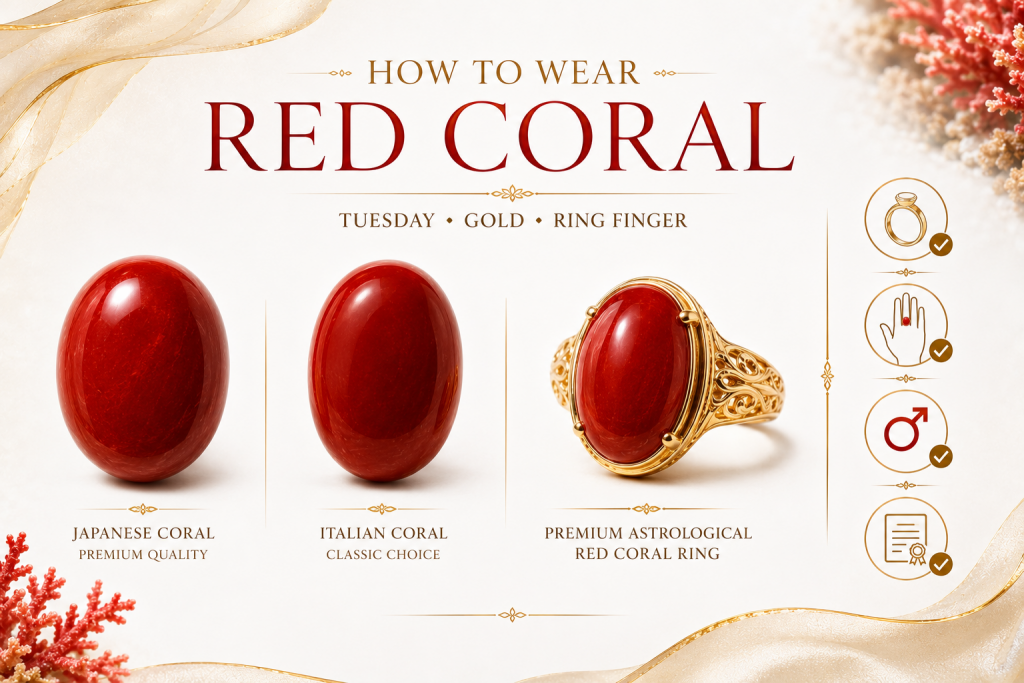
Metal. Gold is the traditional first choice — Mars and gold share a fire quality that is considered harmonious in Jyotish. Silver, copper and Panchdhatu are acceptable alternatives.
Finger. Ring finger of the dominant hand — right for right-handed individuals, left for left-handed. Some traditional sources mention the index finger as an alternative. Your astrologer can advise based on your specific chart.
Weight. Calculated astrologically — typically between 5 and 12 carats for most adults, based on body weight and chart requirements. Do not guess at this. Carat weight for a planetary stone matters.
Day and timing. Tuesday morning — Mangalvar — between 5:00 AM and 7:00 AM, during Shukla Paksha. Tuesday is Mars’s day. The waxing moon phase is considered auspicious for activating planetary gemstones.
Activation. The night before: immerse the coral ring in raw cow’s milk and Ganga Jal, or clean water if Ganga Jal is unavailable. The following morning, place the ring on a red cloth with a Mars Yantra drawn in saffron or red sandalwood powder. Hold the ring in both hands and chant:
Om Ang Angarkay Namah (ॐ अं अंगारकाय नमः)
108 times. Wear the ring immediately afterward.
Form. Ring is the most common and most recommended form. Pendant is effective — the stone must touch skin directly. Closed-back settings that prevent skin contact reduce the stone’s energetic transmission.
Red Coral Price in India
| Variety | Price Range Per Carat |
|---|
| Italian Red Coral | ₹500 – ₹5,000+ |
| Japanese Red Coral | ₹6,000 – ₹15,000+ |
The gap between Italian and Japanese pricing is real and significant. Japanese material’s superior colour uniformity and rarity in sustainable harvesting conditions drives a premium that has only increased as stricter ocean harvesting regulations reduce supply. Italian coral remains the most widely purchased variety in the Indian market — effective, accessible and well-documented in both jewellery and astrological use.
Prices shift with supply conditions, international harvesting regulations and market demand.
What Actually Drives Red Coral Quality and Price
Colour first. Always colour first. Deep, uniform ox-blood red throughout the stone — not concentrated on the surface, not varying between the front and back, not fading toward the centre. This is the benchmark. Everything else is secondary to it.
Treatment status. Natural untreated coral is worth dramatically more than bleached and re-dyed material. Common treatments include bleaching, polymer infusion, surface coating and dyeing. These improve appearance initially. They do not hold. And in astrological tradition, treated material is considered significantly less potent. Always ask. Always get documentation.
Surface quality. Minor organic texture is normal and expected in genuine coral. What reduces value and astrological efficacy: black spots, deep grooves, visible cracks, white streaks running through the material, patches where colour breaks down completely.
Origin. Japanese commands the premium. Italian is the standard. Other origins are priced lower for reasons that relate to both colour quality and rarity.
Shape. Oval and round are most expensive — they require the most material to cut. Triangular and capsule shapes are priced lower. Shape does not affect astrological potency at all.
Size. Larger pieces of genuine uniform quality are disproportionately rare. Price per carat increases meaningfully as quality and size both rise.
How to Identify Genuine Red Coral
Look at the luster. Genuine Red Coral has a waxy, slightly subdued luster — not glassy, not mirror-bright. A stone that looks too shiny has likely been heavily surface-coated. Real coral’s surface has a quality that is warm and slightly matte compared to mineral gems.
Cross-section colour. If you can examine a broken edge or drill hole, genuine coral shows the same colour throughout. Dyed imitations show pale material under the surface coating.
Under magnification. A 10x loupe reveals the organic structure of genuine coral — faint growth lines, natural pores, slight grain patterning that follows the creature’s biological formation. Synthetic resin or glass shows none of this. Too smooth and too uniform inside is always a warning.
Temperature. Coral feels cool initially and warms gradually. Plastic and resin warm almost immediately.
Weight. Specific gravity of 2.6 to 2.7 — heavier than plastic of equivalent size, consistent feel when bounced gently in the palm. Imitations either feel noticeably lighter or wrong in a way that is hard to articulate but easy to notice once you have held genuine material.
Laboratory certificate. Non-negotiable for serious purchase. A certificate from a recognised gemological laboratory should specify: natural versus synthetic origin, treatment status, species identification where possible. No certificate from an independent reputable lab means the origin claim is unverified. Walk away or price accordingly.
Red Coral in Jewellery
Beyond planetary gemstone use, Red Coral carries a long and genuinely distinguished jewellery history.
In Nigeria, coral has been worn by royal lineage for centuries. The ‘Coral Highness’ necklace — combining red coral beads with other precious materials — remains an active symbol of status and ceremony in traditional courts. In the ancient Mediterranean, carved coral amulets were worn for protection going back thousands of years. In South Asia, Moonga is carved into deity forms — Ganesha, Buddha — that carry devotional meaning alongside aesthetic beauty.
Red Coral is also the traditional 35th wedding anniversary gift. The association makes symbolic sense — fire, sustained passion, vitality, the quality of love that does not cool after three and a half decades. A Moonga ring or pendant given at 35 years carries both the aesthetic of the stone and centuries of that specific symbolism.
In settings, Red Coral’s softness requires protective craftsmanship. Raised bezels or protective prongs that guard the stone from impact are not optional embellishment — they are essential. A jeweller who sets coral the same way they set sapphire does not understand the material.
Caring for Red Coral
Soft. Porous. Sensitive to acid. Those three qualities define everything about how Red Coral should be handled.
Calcium carbonate dissolves in acid. That includes perfume, hairspray, lemon juice, vinegar and most household cleaning products. Not edge cases — things coral wearers encounter in ordinary daily life. The rule is simple: coral goes on after everything else and comes off before anything involving water or chemicals.
Cleaning: soft damp cloth only. For carved pieces, a soft toothbrush with plain water reaches crevices without risk. No soaking. No ultrasonic. No steam. No chemical solutions. Gentle wipe, pat dry, done.
Storage: separately from harder gems that scratch it. Velvet-lined box or individual soft pouch. Some ambient humidity is better than completely airtight storage — coral, like pearl, is an organic material that does not thrive in sealed dryness.
Remove before swimming. Before bathing. Before exercise. Before heavy physical work. The combination of impact risk, chemical exposure and moisture is genuinely damaging over time, and the damage to coral is not reversible.
FAQ
What is Red Coral stone in astrology?
Red Coral — Moonga or Lal Moonga — is the primary gemstone of Mars (Mangal) in Vedic astrology. Mars governs courage, physical strength, blood health, ambition and decisive action. Red Coral is worn to strengthen Mars’s positive influence in the birth chart. Primary recommendations: Aries and Scorpio ascendants, Mangliks, people in Mars Mahadasha.
What are the main benefits?
Increased courage and confidence. Improved physical vitality and stamina. Blood and immune system support. Emotional recovery from trauma and loss. Protection from negative energies and evil eye. Professional drive in competitive fields. Relationship and marriage benefits for Mangliks. These all derive directly from Mars’s domains in Vedic anatomy and astrology.
Who should wear Red Coral?
Aries and Scorpio ascendants primarily. Mangliks — Mars in the 1st, 4th, 7th, 8th or 12th house. People in Mars Mahadasha or Antardasha. Military, police, surgeons, athletes, competitive professionals. Gemini and Virgo ascendants should consult an astrologer first.
Italian vs Japanese Red Coral — what is the real difference?
Italian coral (Corallium rubrum) from Mediterranean waters shows a range of red shades and is widely effective for jewellery and astrological use. Japanese coral (Corallium japonicum) produces the most uniform and intense ox-blood red available — considered the finest variety by most experienced astrologers and gemologists. Japanese commands ₹6,000 to ₹15,000 per carat versus ₹500 to ₹5,000 for Italian. The colour quality difference is real and visible.
How should Red Coral be worn?
In gold on the ring finger, Tuesday morning between 5–7 AM during Shukla Paksha, after overnight immersion in raw cow’s milk and Ganga Jal, placed on a Mars Yantra and the mantra “Om Ang Angarkay Namah” chanted 108 times. Stone must touch skin directly.
Does shape affect astrological benefit?
No. Oval, round, triangular, capsule — shape does not affect planetary potency. It affects price. Round and oval cost more because they require more material to produce. The stone’s astrological work is the same regardless of how it is cut.
What is Red Coral price in India?
Italian: ₹500 to ₹5,000 per carat. Japanese: ₹6,000 to ₹15,000 per carat and above. Primary price drivers: colour depth and uniformity, origin, treatment status, surface quality and carat weight. Natural untreated material is always significantly more expensive than treated alternatives.
Why is genuine Red Coral getting more expensive?
Ocean pollution, rising sea temperatures and increasingly strict international harvesting regulations have all contracted supply. Demand from both jewellery and astrological markets has not contracted with it. The combination pushes prices upward consistently — especially for Japanese material, which faces the strictest harvesting controls.
Key Takeaways
- Red Coral is an organic gemstone — formed by living coral polyps, not extracted from rock — which gives it a warmth and character no mineral gem replicates.
- In Vedic astrology it is the primary gemstone of Mars (Mangal), governing courage, physical vitality, blood health and competitive drive.
- Aries and Scorpio ascendants are the primary candidates. Mangliks and people in Mars Mahadasha benefit specifically.
- Japanese Red Coral is the finest variety — the most uniform and intense colour available. Italian is widely effective and more price-accessible.
- Colour depth and uniformity throughout the stone is the single most important quality factor.
- Natural untreated coral is significantly more valuable than bleached or coated material — always request laboratory certification.
- Wear in gold on the ring finger, Tuesday morning 5–7 AM during Shukla Paksha, with the Mars mantra chanted 108 times.
- Soft and porous — last on, first off, clean with damp cloth only, store separately.
- Consult a Vedic astrologer before purchasing — Mars’s functional nature varies by ascendant.
If you’re seeking authentic guidance for career, health, or relationship concerns, or wish to explore genuine Vedic remedies, visit our webpage at purevedicgems. Our site features trusted astrology consultations, high-quality gemstones, Rudrakshas, and Vedic rituals, all rooted in deep knowledge and traditional practices. Discover how our holistic approach can support your well-being and spiritual growth.

Tags:
How to Wear Red Coral,
Italian Red Coral,
Japanese Red Coral,
Lal Moonga,
Mangal Stone,
Manglik Dosha Remedy,
Mars Gemstone,
Moonga Price,
Moonga Ratna,
Moonga Stone,
Red Coral Astrology,
Red Coral Benefits,
Red Coral Stone