Opal Stone (Dudhiya Pathar): What You Need to Know Before Buying
Vikas June 6, 2026 in
Astrology Opal Stone (Dudhiya Pathar): What You Need to Know Before Buying
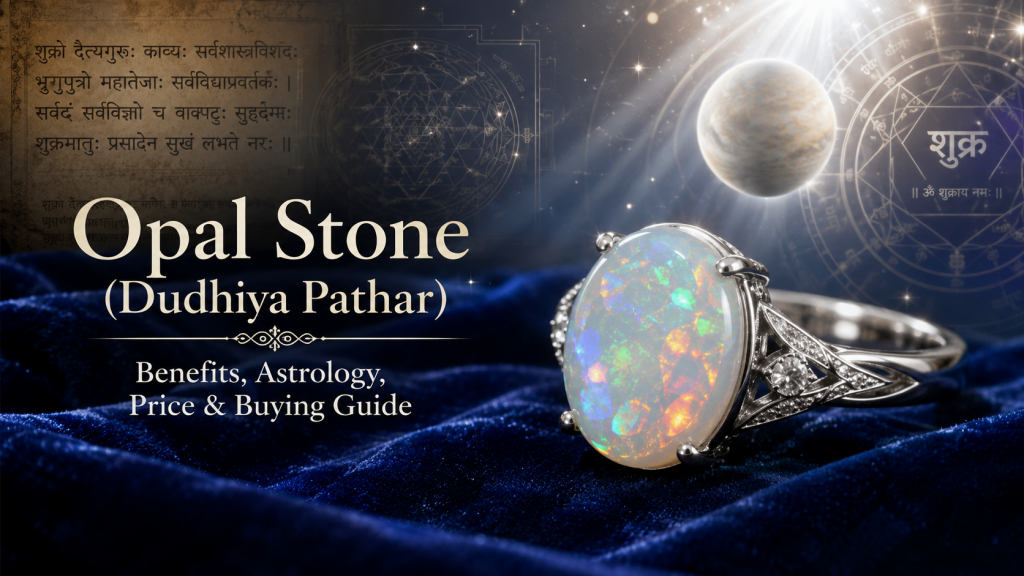
Most gemstones make their impression through color alone. Opal does something different — it moves.
The play of color inside a fine opal shifts as you rotate it, catching light differently from every angle, flashing red then green then blue then back to milky white. No two opals look the same. No single opal looks the same twice. That quality — what gemologists call play-of-color and what older traditions simply called fire — is what has made opal one of the most discussed, most debated, and most personally polarizing gemstones that exists.
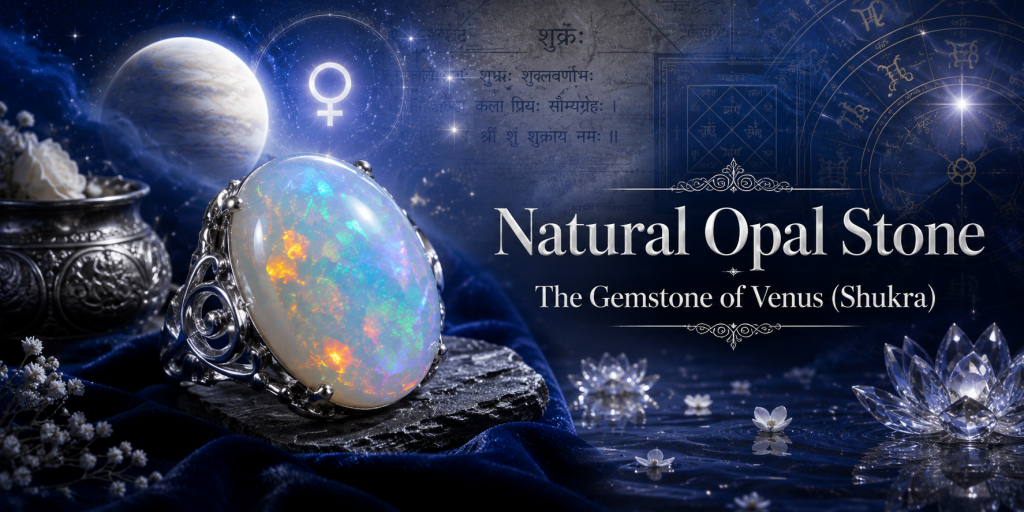
In Vedic astrology, opal belongs to Venus — Shukra — the planet of love, beauty, creativity, and luxury. It’s worn primarily as a substitute for diamond and white sapphire, offering similar astrological benefits without the price or the additional considerations those stones bring. Whether that substitution works as advertised depends on who you ask. But the tradition behind it is old, specific, and consistent.
What the Stone Actually Is
Unlike sapphire or ruby, opal isn’t crystalline. It’s amorphous hydrated silica — no fixed crystal structure, and significant water content, typically somewhere between three and twenty percent by weight. That water is responsible for both the beauty and the fragility. It contributes to the internal light-diffraction that produces play-of-color, and its loss — through heat, prolonged dryness, or sudden temperature change — is what causes opal to crack and craze over time.
The play-of-color happens because the opal stone’s interior contains tiny silica spheres arranged in a loose grid. Light entering the stone diffracts off those spheres and breaks into spectral colors that shift with viewing angle. Sphere size determines which colors appear. Smaller spheres produce blue and violet. Larger spheres produce orange and red. Red fire is rarer — and more valuable — because the spheres that generate it are less commonly formed.
Hardness 5.5 to 6 on the Mohs scale. This is the number that changes everything about how you need to treat opal compared to sapphire or ruby. A sapphire is a 9 — you wear it without thinking. Opal at 5.5 to 6 scratches from contact with harder materials, chips from impact, and requires considerably more care. Beautiful stone. Genuinely high-maintenance. First-time buyers underestimate this almost universally.
Venus and What Opal Governs
Shukra in Jyotish is the planet of love, beauty, creativity, luxury, and partnership. He’s associated with the refinements of life — comfort, elegance, artistic sensitivity, the ability to attract and enjoy abundance. A strong Venus in the chart tends to produce people with natural warmth, good relationships, creative ability, and an easy relationship with material comfort. A weak or afflicted Venus shows up as difficulties in love, creative blocks, lack of comfort despite effort, or an inability to enjoy what life actually offers.
Diamond is Venus’s primary stone in Vedic astrology. But diamond carries its own astrological considerations and its own price — both of which make it inaccessible or inadvisable for many people. White sapphire and opal are the established substitutes. Opal specifically is associated with Venus’s softer qualities — emotional openness, creative flow, relationship warmth — rather than diamond’s harder, more impersonal associations with luxury and prestige.
The opal stone’s name tells you something. It comes from the Greek Opallus — “to see a change.” That’s a good description of the optical phenomenon, but it’s also a fair description of what the tradition claims the stone does: it changes things, gradually and emotionally, in the domains Venus governs.
Who the Opal Stone Actually Suits
Taurus and Libra ascendants and moon signs are the clearest candidates. Venus rules both, making him a natural benefactor for these charts. His stone is considered genuinely supportive for these natives without requiring extensive analysis beyond confirming the basic placement.
Beyond those primary cases, people with a weak or afflicted Venus in the natal chart — regardless of ascendant — frequently receive opal stone recommendations. What does weak Venus actually look like in a chart? Difficulties in maintaining relationships, creative dissatisfaction, financial struggles specifically in the comfort and luxury domain rather than basic survival, a persistent sense of being unable to enjoy what life offers even when circumstances are objectively fine. These are the signatures that point toward a Venus remedy.
People in Shukra Dasha — Venus’s twenty-year major period in the Vimshottari system — often find Venus stones particularly effective during that window.
Professionally, opal comes up consistently for people in creative fields. Fashion, arts, writing, performance, design, jewelry making — professions where Venus’s qualities are the actual product rather than a background condition. The classical association is specific enough to be meaningful rather than generic.
October birthstone in Western tradition. Long established, worth noting for gifting purposes independent of any astrological framework.
One thing worth saying plainly: opal’s reputation is for gradual, emotional, relational change — not sudden material transformation. If you’re expecting the kind of dramatic overnight effect that blue sapphire is sometimes described as producing, opal probably isn’t your stone. If you need steady emotional support, creative opening, and relationship warmth over months rather than weeks, people report it working quietly and effectively.
What Opal Stone Does
Career and creative growth show up most consistently — specifically for people whose work is Venus-governed. Improved inspiration, better opportunities for recognition, removal of the specific creative friction that stops people from producing work they’re genuinely proud of. Less about discipline and hard work (that’s Saturn’s domain) and more about flow and reception.
Relationship harmony is the benefit most consistently mentioned across both classical texts and contemporary wearer reports. Venus governs love and partnership — opal is specifically described as nurturing emotional bonds, improving communication between partners, and supporting marriages experiencing friction. Not a magic fix for fundamental incompatibility, but a traditional support for exactly this domain.
Emotional balance and reduced anxiety. Venus’s influence at its best produces equanimity — the ability to engage with life’s emotional content without being destabilized by it. Opal is associated with steadying the emotional baseline, reducing reactivity, and replacing anxiety with something closer to trust.
Financial comfort and social grace. Not the kind of sudden financial gain associated with blue sapphire or the career authority associated with ruby — more the graceful, seemingly effortless quality that some people carry in their relationship with abundance. Venus governs luxury, not just wealth. Opal is associated with elevating the quality and comfort of life rather than simply increasing its material quantity.
Physical health in Venus’s domain. The reproductive system, kidneys, and skin in Vedic anatomy all sit under Venus’s rulership. Opal’s health associations cluster around these areas — hormonal balance, skin health, kidney and urinary function, immunity. Traditional framework, not medical prescription. Internally consistent with the planet’s domain in the way Jyotish health associations usually are.
Aura protection. Opal stone is described as creating a protective energetic field against negative influences, evil eye, and others’ ill intentions. The quality of protection here is softer than ruby’s solar shield — more about maintaining the wearer’s own positive energetic state than actively deflecting aggression.
Wearing It Correctly
Silver is the metal. This is near-universal for opal in Jyotish — consistent with Venus’s association with the softer, reflective metals. White gold and platinum are acceptable modern alternatives. Gold, which is preferred for ruby and yellow sapphire, is generally not recommended for opal.
Ring finger of the working hand. Right for right-handed individuals, left for left-handed. The ring finger is Venus’s finger in palmistry — the logic behind this placement is consistent across traditions.
Weight of one-tenth to one-twelfth of body weight in ratti. Someone weighing 60 kg should wear approximately 6 to 7 ratti. Confirm with an astrologer based on your chart — this is a baseline, not a fixed rule.
Friday morning between 5 and 7 AM, Shukla Paksha. Shukra-vaar — Venus’s day — during the waxing moon. These timing conditions together are considered optimal for beginning to wear a Venus stone.
Before wearing for the first time, purify the ring in raw milk and Ganga Jal. Chant the Shukra beej mantra 108 times with full attention:
Om Draam Dreem Draum Sah Shukraya Namah
(ॐ द्रां द्रीं द्रौं स: शुक्राय नमः)
Types Worth Knowing
Australian white opal is the benchmark — roughly 95% of the world’s finest opal originates in Australia, primarily Lightning Ridge for black opal and Coober Pedy for white opal. The play-of-color in fine Australian material is more consistent and more stable than other origins. It’s what most Jyotish sources specifically reference when recommending opal for Venus.
Ethiopian opal has become significantly more available and more affordable over the past two decades. The play-of-color can be spectacular. The caveat is important though — Ethiopian opal is hydrophane, meaning it absorbs water. When it comes in contact with moisture — including perspiration from daily wear — it can temporarily lose its play-of-color. The fire usually returns on drying. But for a stone worn on the hand daily, this characteristic matters and is often undisclosed at point of sale.
Mexican fire opal is transparent to translucent orange-red material — typically without the play-of-color of Australian or Ethiopian stones. Beautiful in its own right but a different product, different use, different associations.
Black opal from Lightning Ridge is the most gemologically valuable opal type. The dark body color makes the play-of-color appear dramatically more vivid. Fine black opal sits in a completely different price category from white opal.
For astrological use, Australian white opal with strong play-of-color is the consistent recommendation. Ethiopian is an acceptable second choice with the hydrophane caveat understood.
Price and What Creates the Range
Original opal stone price in India runs from approximately ₹1,000 to ₹1,00,000+ per carat depending on play-of-color intensity, origin, and treatment status. Fine Australian black opal exists well above this range.
Play-of-color intensity drives price more than anything else. How vivid are the flashes? How broad is the color spectrum — does the stone show blue-green only, or does it flash through the full range including red? How evenly distributed is the fire across the face of the stone? Red fire specifically commands a premium because the silica spheres that produce it are rarer than those producing cooler colors.
Origin creates clear tiers. Australian material commands premiums over Ethiopian for stability and fire consistency. Within Australian opal, Lightning Ridge black opal sits highest. Coober Pedy white opal is below that but still considered premium for white opal purposes.
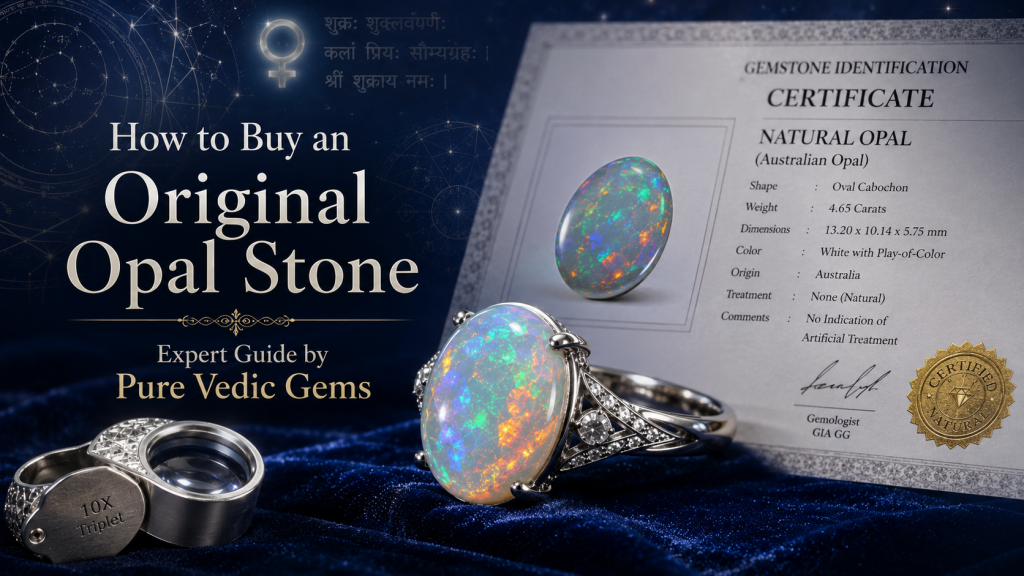
Treatment and construction status is where buyers most often get deceived. Doublets — a thin natural opal slice bonded to a dark backing material — can look strikingly similar to solid black opal and cost a fraction of the price. Triplets add a clear quartz or glass cap over the doublet. Both are legitimate products when disclosed and priced accordingly. Both are frequently not disclosed. Side-on inspection of the stone in its setting sometimes reveals the layered construction, but it’s often deliberately obscured by the setting style.
Natural untreated solid opal is worth significantly more than composite constructions. Ask specifically. Get it in writing. Certified by an independent laboratory.
Buying Without Getting Caught Out
The specific fraud risks with opal are different from other gemstones and worth understanding individually.
Doublets and triplets misrepresented as solid natural opal is the most common issue. A doublet has a thin natural opal layer — sometimes very thin — bonded to a dark backing. It shows play-of-color and can appear to be solid black opal. The price difference is enormous. Solid natural black opal of fine quality can be fifty times the price of a doublet of similar appearance. Always ask: is this a solid natural opal? Get certification that confirms it.
Ethiopian opal’s hydrophane characteristic is frequently undisclosed. Buyers who discover their stone’s play-of-color fading during wear sometimes believe the stone is damaged when it’s actually behaving normally for the material. It recovers on drying. But it’s information that affects buying decisions and daily wearability and should be disclosed before sale.
Synthetic opal is convincing and common. Laboratory-created opal shows excellent play-of-color — often more uniform and dramatic than natural material, which is itself a clue. Under magnification, synthetic opal shows a characteristic columnar pattern in the play-of-color that looks like a regular “lizard skin” or “snakeskin” pattern. Natural opal’s play-of-color appears more random and irregular. Certification is the reliable safeguard.
Price floors exist for quality material. Fine Australian white opal with strong fire has a real cost floor. Stones presented as “natural Australian fire opal” at prices that seem too good to be true are almost always Ethiopian, composite, or synthetic.
Care — This Matters More Than With Most Stones
Hardness 5.5 to 6 means opal scratches from contact with harder materials — which includes most things in daily life above a certain hardness. The water content means it’s sensitive to drying, heat, and extreme temperature changes. These aren’t theoretical concerns. They cause real damage to real stones worn by real people who weren’t told about them.
Cleaning means mild detergent in room-temperature water — not warm, not hot — and a soft cloth. Brief gentle cleaning is fine. Do not soak for extended periods. The porosity of opal means prolonged water exposure is a genuine risk, particularly for doublets where the layers can separate, and for Ethiopian material where water absorption is immediate.
What to avoid: ultrasonic cleaners, which can fracture the stone through vibration. Steam cleaning, which combines heat and moisture in the worst possible way for this material. Harsh chemicals, acids, oils, acetone. Hot showers. Doing dishes. Gardening. Any physically demanding activity where impact is likely.
Storage in a padded cloth pouch in a cool, moderately humid location. Not a very dry environment — opal needs some ambient humidity to maintain its water content. For long-term storage, wrapping in slightly damp cotton wool inside a sealed bag is the traditional jeweler’s method. Some display cabinets include a small glass of water specifically to maintain ambient humidity around stored opal.
If the stone looks dry or dull, fifteen minutes in lukewarm water often revives it by restoring surface moisture. If dullness persists after hydration, it may indicate internal crazing — micro-fractures from dehydration that are structural and not reversible. Prevention through proper storage is the only cure.
Bezel settings protect the edges better than prong settings. For a stone this soft, the setting choice matters practically, not just aesthetically.
Some Questions Worth Answering Honestly
How long before opal shows effects?
Forty-five to sixty days of consistent wearing is what most Jyotish sources suggest. That’s longer than the timeline given for blue sapphire, which is described as fast-acting, sometimes dramatically so. Opal’s influence is gradual and emotional — it works in the background rather than producing sudden noticeable events. If you stop wearing it after two weeks because nothing obvious happened, you’ve stopped too early.
Australian or Ethiopian — which is actually better for astrology?
Australian, consistently. The fire is stable, the quality is established, and the stone won’t temporarily lose its play-of-color from sweat and daily wear the way Ethiopian material can. Ethiopian opal is a legitimate second choice for someone who understands the hydrophane characteristic and accepts it. For a stone worn daily on the hand in India’s climate — where perspiration is a reality — the Australian stability matters.
Is the doublet issue really that common?
Yes. More common than most buyers realize, particularly in online markets where close inspection isn’t possible. The price difference between a solid natural opal and a well-made doublet of similar appearance is significant. Always ask the specific question: is this a solid natural opal? A reputable seller will answer directly and provide certification. A seller who deflects or provides only vague assurances about “natural” opal without specifying construction is worth walking away from.
Can opal be worn every day?
With the right precautions — yes, but with more mindfulness than most ring stones require. Remove it for physical work, household chores, exercise, gardening. A bezel setting instead of prongs. Clean gently and regularly. Store properly. People who do these things wear opal daily for years without problems. People who don’t often experience chipping, crazing, or loss of play-of-color within months. The stone rewards attention.
What makes a fire opal different from regular opal?
In technical gemological language, fire opal refers specifically to transparent to translucent orange-red opal from Mexico — which may or may not show play-of-color. In Indian jewelry market usage, “fire” often refers to the play-of-color visible in white opal, which is a different usage of the same word. When buying, don’t rely on the terminology — ask specifically whether the stone shows play-of-color, whether it’s solid natural material, and what its origin is. Those three questions cut through whatever marketing language surrounds the stone.
If you’re seeking authentic guidance for career, health, or relationship concerns, or wish to explore genuine Vedic remedies, visit our webpage at purevedicgems. Our site features trusted astrology consultations, high-quality gemstones, Rudrakshas, and Vedic rituals, all rooted in deep knowledge and traditional practices. Discover how our holistic approach can support your well-being and spiritual growth.

Tags:
Australian Opal Stone,
Certified Opal Stone,
Dudhiya Pathar,
Ethiopian Opal Stone,
Fire Opal Stone,
Natural Opal Stone,
October Birthstone,
opal gemstone,
Opal Stone,
Opal Stone Astrology,
Opal Stone Benefits,
opal stone for Venus,
Opal Stone Price,
Opal Stone Price in India,
Opal Stone Wearing Rules,
Original Opal Stone,
Shukra Ratna,
Venus Gemstone,
white opal stone,
Who Should Wear Opal Stone