Ruby Gemstone(Manik Stone): What You Need to Know Before You Buy
Vikas June 5, 2026 in
Astrology Ruby Gemstone (Manik Stone): What You Need to Know Before You Buy
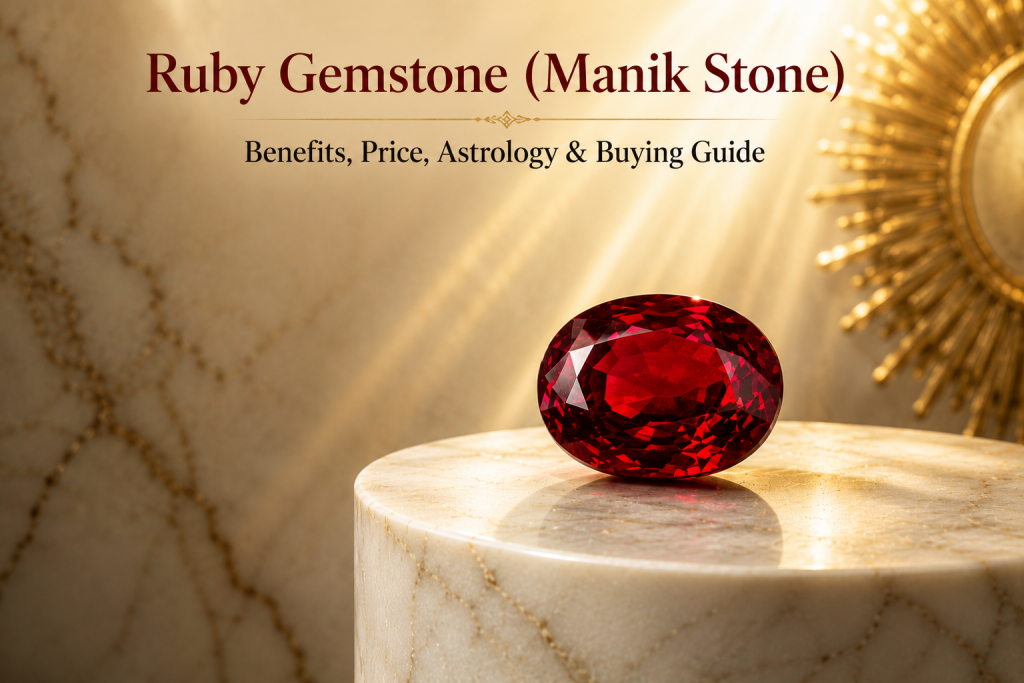
Have you ever looked at a ruby and felt like something inside it is alive?
That’s not imagination. The depth of color in a fine ruby — deep crimson with light moving through it — does something to the eye that most gemstones don’t. Sapphire impresses. Emerald intrigues. Ruby commands. There’s a reason it’s been called Ratna Raj — king of gemstones — across Indian languages and traditions for centuries. Titles that old, held that consistently, don’t attach to a stone by accident.
In Vedic astrology, ruby belongs to the Sun — Surya Dev — the planet of soul, authority, and life itself. That single association shapes everything about how the stone is understood, worn, valued, and coveted. Understanding it properly is the difference between wearing a beautiful red stone and wearing something that actually means something.
The Ruby Stone Itself
Ruby is corundum — same mineral family as sapphire. The red color comes from chromium: trace amounts of it locked into the aluminum oxide crystal during formation. The more chromium, generally the deeper the red, though at very high concentrations the color shifts toward dark and murky. The sweet spot collectors call pigeon blood red sits between those extremes — vivid, pure crimson with a slight blue fluorescence that makes the color seem lit from within rather than simply reflecting light off a surface.
Hardness 9 on the Mohs scale. No cleavage planes, meaning it won’t split along a structural weakness the way some beautiful but vulnerable stones do. For a ring worn daily, ruby is among the most practical choices available. That combination of color, rarity, and durability is part of why it’s sat at the top of the gemstone hierarchy in so many cultures simultaneously.
The stone carries different names depending on the tradition. Manikya and Padmaraga in Sanskrit. Chuni in Bengali. Kempu in Telugu and Kannada. Yaqoot-e-Ahmar in Arabic. Suryamani — Sun’s jewel — in devotional contexts. It appears in the Bible among precious and sacred stones. That kind of cross-cultural, cross-religious recognition across thousands of years isn’t coincidence. It’s a stone that did something to people wherever they encountered it.
Surya Dev and What This Stone Actually Governs
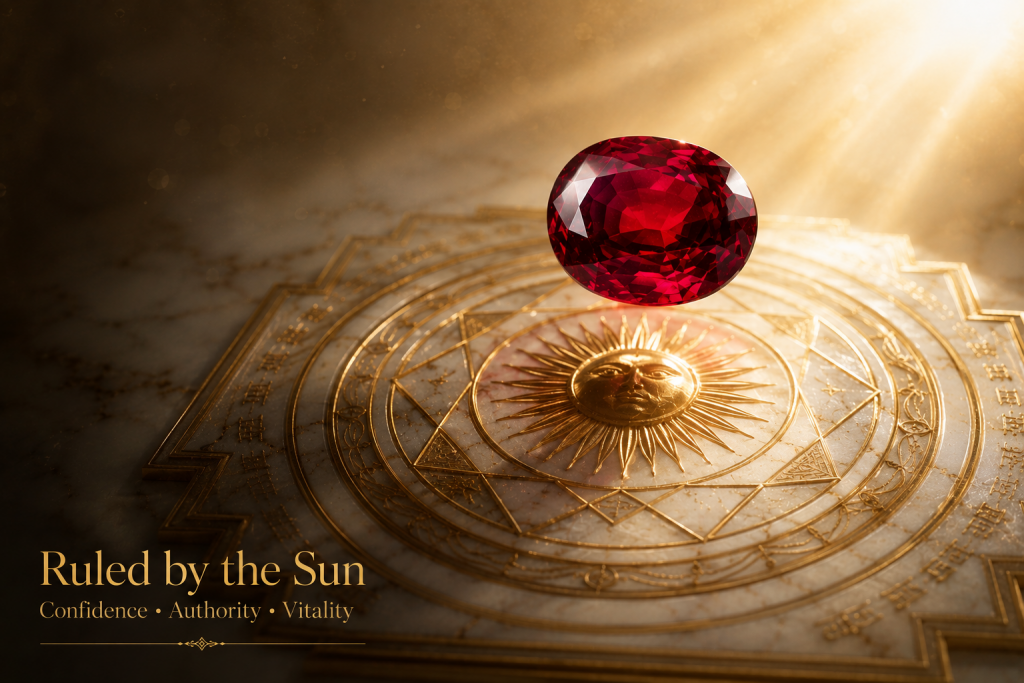
In Jyotish, the Sun isn’t classified the way planets are in modern astronomy. Surya is the Atma — the soul — the source of identity and life force. He governs authority, self-expression, confidence, vitality, the relationship with the father, and the capacity to lead. His position in the birth chart determines how clearly a person knows themselves, how naturally they command respect, and how their health and life force manifest across a lifetime.
A strong Sun in the nativity produces clarity of purpose and natural authority. A weak or afflicted Sun produces the opposite — self-doubt, health vulnerabilities, difficult relationships with authority figures, careers that never quite reach the visibility the effort deserves.
Ruby is the stone that channels Surya’s energy. Wearing it is believed to strengthen his influence in the chart — amplifying what he promises when he’s well-placed, and helping stabilize things when he isn’t. The dynamic is somewhat different from blue sapphire, where Saturn’s dual nature requires explicit caution. The Sun is generally considered a natural benefic for most charts. That doesn’t mean ruby suits everyone, but the caution level is lower than with Neelam.
Leo ascendants and moon signs are the most obvious candidates. The Sun rules Leo — his stone is naturally supportive for these natives, amplifying the leadership, confidence, and clarity of direction the ascendant already promises.
People with the Sun exalted in Aries, or strongly placed in his own sign or in an angular house, benefit from wearing his stone to bring out the best of what that placement promises. Career growth, recognition, genuine authority. Not just ambition — actual arrival.
People in Surya Dasha — the Sun’s six-year major period — often find ruby particularly potent during that window regardless of their ascendant.
Beyond chart positions, certain life situations point toward ruby consistently. Anyone in government service, administration, politics, medicine, or any role where public visibility and earned recognition matter. The Sun governs exactly that — not fame through luck but recognition through genuine quality. People who feel their work is consistently undervalued, overlooked, or not receiving the acknowledgment it deserves show up repeatedly in classical descriptions of who benefits from Manik stone.
People experiencing strained or distant relationships with their fathers. This is one of the more specific classical associations — the Sun governs paternal relationships, and ruby is believed to heal distance and improve communication in that bond in ways other stones don’t address.
People experiencing persistent low confidence, unclear life direction, or chronic low energy without obvious physical cause. These are Sun-governed deficiencies, and Manik stone is specifically credited with addressing them.
Who should be cautious: Taurus, Libra, Capricorn, and Aquarius ascendants. For some of these charts, the Sun rules challenging houses and wearing his stone without proper assessment can produce friction rather than support. The internal logic of Jyotish is consistent about this. Consult an astrologer before adopting ruby if your ascendant falls here.
What It Does — Honestly Described
Career and recognition. The most consistent benefit across both classical texts and contemporary reports. Not generic “career growth” — specifically the removal of blocks to visibility and authority. Ruby doesn’t make you work harder. It’s associated with making the work you’re already doing more visible, more respected, and more likely to produce the outcomes it deserves.
Confidence and vitality. The Sun governs life force and personal presence. People who wear ruby and report noticeable effects most often describe something in this domain — a clearer sense of self, more energy, less anxiety about being seen. Less of the background hesitation that stops capable people from occupying the space they’ve earned.
Heart health and circulation. The Sun governs the heart in Vedic anatomy. Ruby’s health associations cluster around cardiovascular vitality, blood circulation, and detoxification. A metaphysical framework, not a medical claim — but consistent with the planet’s domain in the way that all Jyotish health associations are.
Protection. Ruby is described as protective against negative energies, evil eye, and psychic interference. Whether that’s understood literally or as a strengthening of the wearer’s own psychological resilience, the reported experience is consistent: things that were draining or destabilizing seem to lose their grip.
Emotional steadiness. The Sun is associated with clarity and groundedness. Ruby is credited with reducing emotional volatility and anxiety — replacing turbulence with a more centered, stable relationship with difficulty. Not suppression of emotion but a reduction in reactivity.
Spiritual perception. The Sun is Atmakaraka — significator of the soul. Ruby’s spiritual associations are about clarity of self-knowledge rather than mystical experience. Knowing who you are. Knowing why you’re here. Activating the Manipura chakra — the solar plexus — which governs personal power and self-determination in the Tantric energy system.
Paternal relationships. Worth restating separately because it’s specific enough to be meaningful. If the relationship with your father is damaged, distant, or unresolved — and if the Sun’s placement in your chart reflects this — ruby is one of the few stones with a classical association precise enough to address it.
How to Wear It
Gold is the metal. Near-universal recommendation for ruby across Jyotish sources. Copper and Panchdhatu are acceptable alternatives in some traditions. Silver is generally avoided — the Sun’s energy is considered incompatible with silver’s lunar associations. Platinum is sometimes used in modern settings without specific objection.
Ring finger of the working hand. Right for right-handed, left for left-handed.
Weight: one ratti per 12 kg of body weight. Roughly 5 ratti — about 4.5 carats — for someone weighing 60 kg. Heavier stones carry stronger effects within the tradition. Confirm with an astrologer.
Sunday morning, 5 to 7 AM, Shukla Paksha — the waxing moon. Surya’s day, sunrise window, growing lunar energy. These timing conditions together are considered optimal for introducing a new Sun stone.
Before wearing for the first time, offer water to Surya Dev in a copper vessel at sunrise. Purify the ring in raw milk and Ganga Jal. Chant the Surya beej mantra 108 times with full attention:
Om Hram Hreem Hraum Sah Suryaya Namah
(ऊँ ह्रां ह्रीं ह्रौं सः सूर्याय नमः)
The offering to the Sun before wearing establishes a conscious relationship with the planetary energy the stone channels. The tradition treats gemstones as vehicles for planetary force — this ritual is how that connection is initiated intentionally rather than casually.
Origin, Quality and What Drives the Price
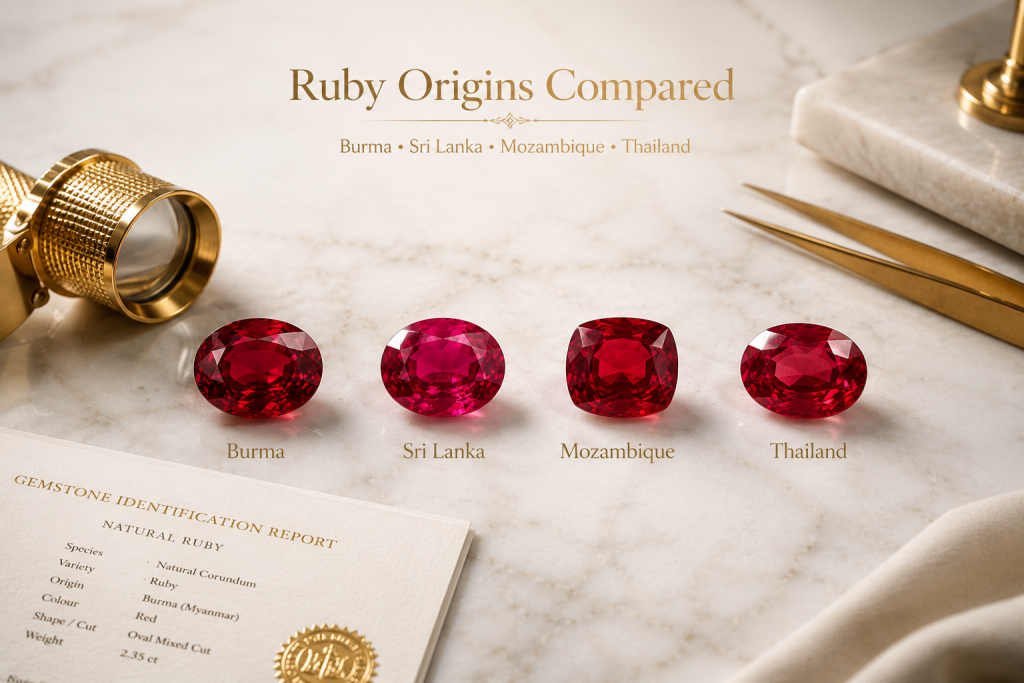
Ruby pricing in India runs from approximately ₹1,500 per carat for commercial heated material to ₹5,00,000–₹10,00,000+ per carat for exceptional untreated Burmese specimens. That range isn’t arbitrary — the factors that create it are specific and understandable.
Burmese rubies from Mogok are at the top of every quality hierarchy that exists for this stone. The pigeon blood red color — vivid pure crimson with the blue fluorescence that makes it glow — is most associated with this origin. Untreated Burmese rubies with fine color are genuinely scarce. They command ten to fifteen times the price of equivalent Thai stones, and that premium is real.
Sri Lankan (Ceylon) rubies sit just below. Known for natural color, excellent transparency, and strong astrological value in Jyotish practice. They often display a lighter, slightly purplish red rather than the deep crimson of Burmese stones. Many remain untreated, which makes them valuable both as gems and as astrological stones.
Thai and African rubies — primarily Mozambique and Tanzania from Africa — offer good color at more accessible prices. Thai stones tend toward darker saturation. African material has become increasingly important as Burmese supply has tightened. Both are legitimate and beautiful; neither carries the same provenance premium as Burma or Ceylon.
Treatment status changes the picture dramatically. Most commercial rubies have been heat-treated. This is stable, common, and the trade treats it as standard. But fracture-filling with glass or lead glass — very common in lower-grade material — is a different situation entirely. It substantially alters the stone, reduces durability, and is difficult to detect without laboratory testing. The Vedic tradition is consistent that untreated stones are preferred for astrological use.
Clarity follows its own logic in ruby. Natural inclusions — silk needles, fingerprint patterns, growth lines — are expected and normal. The characteristic silk of fine Burmese rubies contributes to the scattered red fluorescence that makes the color seem alive. A completely flawless ruby under magnification is worth questioning. Fine stones are not flawless; they’re just clean enough that inclusions don’t disrupt the visual experience.
Buying Without Being Deceived
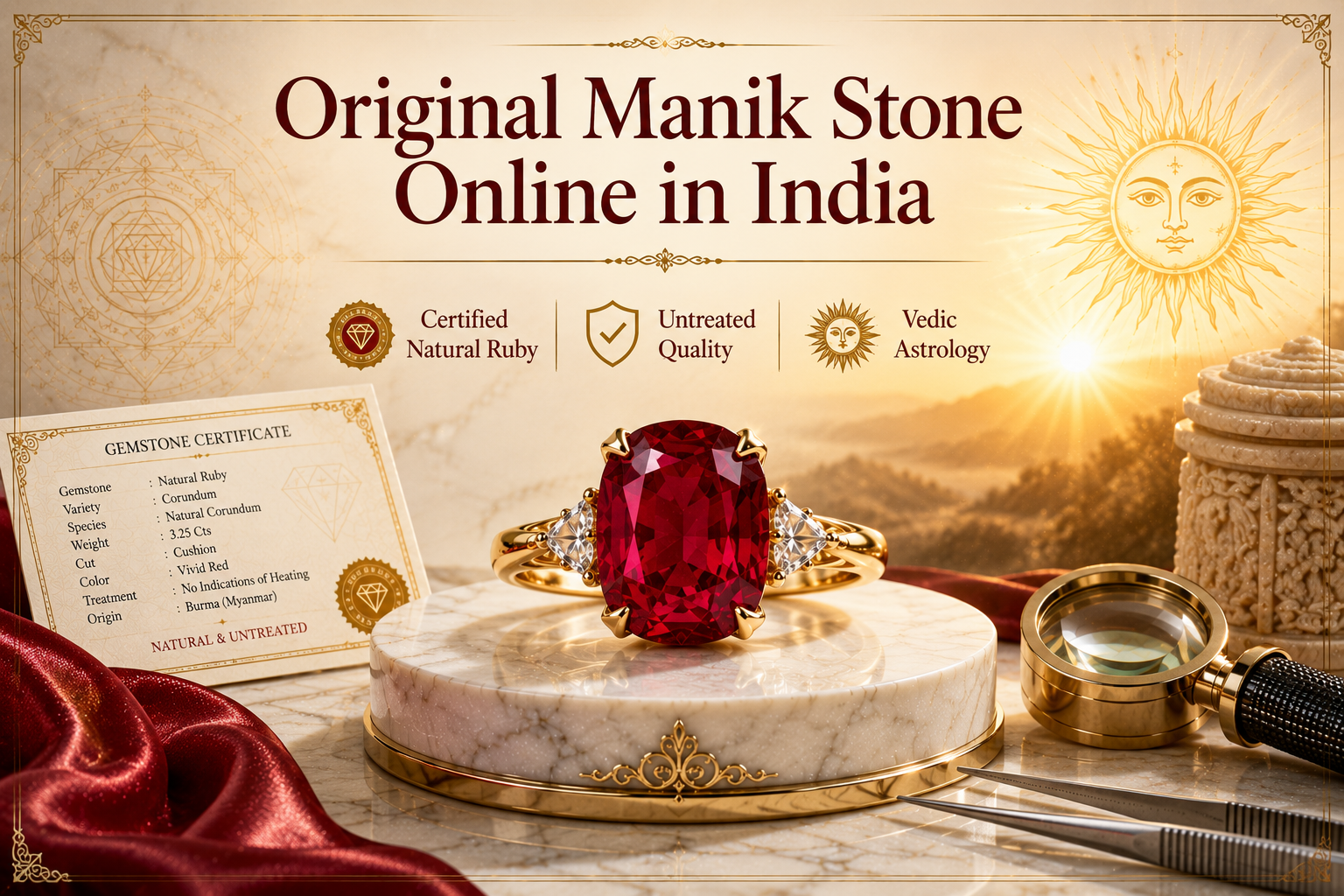
Certification matters more for ruby than almost any other colored gemstone. GIA, GRS, Gübelin, SSEF — independent laboratories that test the actual stone. The report should specify natural origin, treatment status (including fracture-filling), color, and weight. “No heat treatment” confirmation is specifically what to look for for astrological use. Glass-filling should also be explicitly addressed.
Glass-filling is common and under-disclosed. A significant proportion of commercially available rubies have been fracture-filled to improve apparent clarity and color. They look impressive under shop lighting. They degrade with wear, react to cleaning agents, and are worth a fraction of what untreated material costs. Laboratory testing is the only way to know reliably.
Synthetic rubies are harder to spot than people think. Lab-created rubies are chemically identical to natural ones. Curved growth lines and gas bubbles indicate synthetic origin under magnification — but advanced synthesis methods make visual detection increasingly unreliable. A certificate from a reputable laboratory is the safeguard.
“Pigeon blood red” gets used as a marketing term more than as a gemological description now. The actual quality — vivid pure red with blue fluorescence and no orange or brown cast, from a Burmese origin, untreated — is genuinely rare and genuinely expensive. A stone marketed as pigeon blood red at Thai commercial prices should prompt questions.
Care
Warm water, mild soap — baby shampoo works well — soak for ten to fifteen minutes. Soft brush around the setting. Rinse thoroughly. Pat dry with a soft cloth. Do this regularly. Surface residue from skin and products dulls the color in ways that are easy to prevent and easy to reverse.
Avoid strong chemicals including alcohol, acetone, and household cleaners. Extreme heat and prolonged direct sunlight are risks for some treated stones. Ultrasonic and steam cleaners are inadvisable for any fracture-filled material.
Store separately in a soft-lined box or pouch. Check settings periodically — stones worn daily can work loose gradually without obvious warning.
Some Questions Worth Answering Honestly
Why does ruby cost so much more than other red stones?
Supply and quality. Fine untreated Burmese ruby with pigeon blood color is genuinely scarce — it doesn’t exist in the quantity that market demand creates. When supply is limited and demand is consistent across cultures for two thousand years, price follows. The premium isn’t marketing. It reflects what you’re actually paying for.
Is treated ruby useless for astrology?
Heat treatment is considered less than ideal but not automatically disqualifying — some Jyotish practitioners work with carefully heat-treated stones of fine color. Fracture-filling and glass-filling are considered genuinely problematic, altering the stone substantially enough that the natural energetic quality is compromised. For serious astrological use, untreated is the consistent recommendation. Verify through certification.
Ruby with other gemstones — what’s compatible?
Pearl, red coral, and yellow sapphire generally work with ruby — compatible planetary energies, no classical conflict. Blue sapphire and ruby together require careful chart-specific assessment. The Sun and Saturn have a traditionally complex relationship in Jyotish — combining their stones without understanding how they interact in a specific chart is inadvisable. Emerald and diamond combinations also need proper astrological review before adopting.
How quickly does ruby show effects?
The Sun’s stone is generally described as relatively fast-acting in Jyotish — effects noticeable within a few weeks of correct wearing for most people. The nature of those effects depends entirely on the Sun’s placement in the individual chart. The stone amplifies what’s already there. If the Sun is strong, the amplification tends to be positive and immediate. If he’s weak or afflicted, the effects are more nuanced and chart-dependent.
What’s the difference between natural ruby inclusions and a problem stone?
Natural inclusions — silk needles, fingerprint patterns, small crystal inclusions, growth lines — are characteristic of the species and expected. They become a problem when they significantly disrupt the stone’s transparency, create obvious cloudiness visible to the naked eye, or run in patterns that create structural weakness. Eye-clean or near-eye-clean is the quality benchmark. Completely flawless under magnification is suspicious, not desirable.
Tags:
Burmese ruby,
Manik stone,
Manikya,
natural ruby,
Ruby astrology,
ruby benefits,
ruby gemstone,
Ruby Price,
Ruby Stone,
Surya Ratna