















How to Wear Pukhraj Stone (Yellow Sapphire)
Benefits, Types & Buying Guide
Pukhraj is Jupiter’s stone. Most people buying it know that much. The part that’s less understood is the gap between knowing that and actually getting it right — the wearing rules, who it’s actually suitable for, and what separates a stone worth wearing from one that just looks the part.
I’ll cover all of it, and I won’t pad the sections where there isn’t much to say.
How to Wear Pukhraj
The rules here are specific. They come from Vedic astrology’s internal logic, not ritual for its own sake.
Day and Time
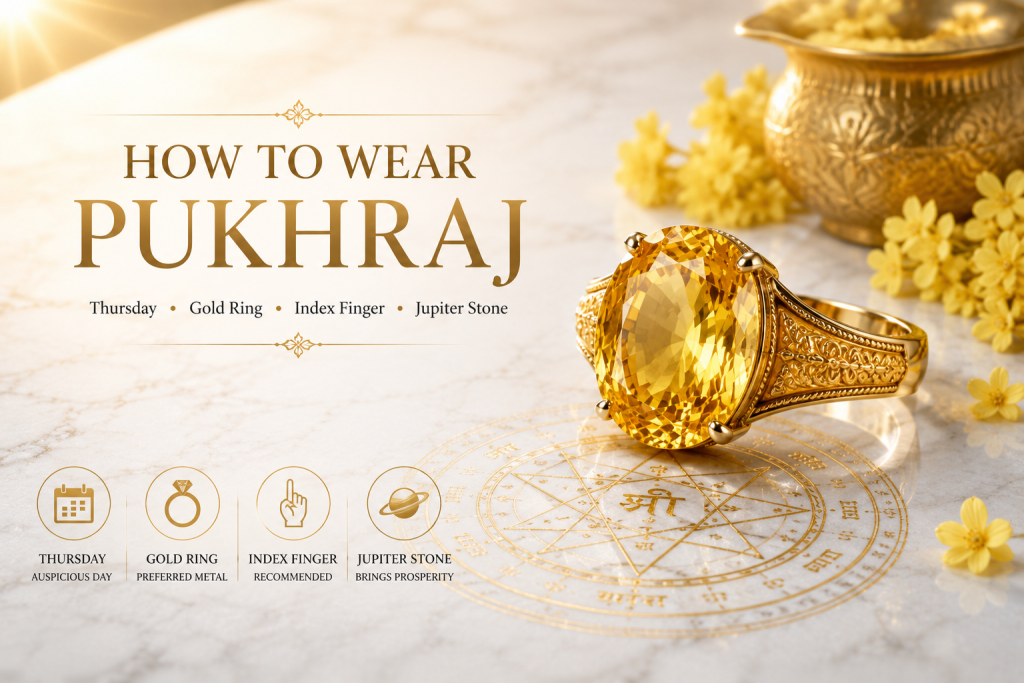
Thursday, between 5–7 AM, during the waxing moon (Shukla Paksha). Thursday is Jupiter’s day. The waxing phase is for building — not coincidental timing. Missing the window isn’t fatal, but wearing it on a random Tuesday afternoon isn’t ideal either. Wait for the next Thursday if you can.
Metal
Gold. This is near-universal across Jyotish sources and I’ve never seen a credible argument for anything else as the first choice. Panchdhatu (five-metal alloy) works if gold isn’t feasible. Platinum is fine. Silver is for Neelam — don’t use it here.
Finger
Index finger of the dominant hand. Jupiter’s finger in palmistry. Right hand if you’re right-handed, left if you’re left-handed. No ambiguity here.
Weight
One-twelfth of body weight in carats is the classical formula — 60 kg means roughly 5 carats as a starting point. Heavier stones are considered more effective within the tradition. Confirm with an astrologer if you’re unsure; the formula is a baseline, not a mandate.
Purification
Before wearing for the first time: soak the ring in raw milk, honey, and Gangajal for 30 minutes. Chant the Jupiter mantra 108 times, then put it on. The ritual isn’t decorative — it’s about conscious activation before sustained contact begins.
Mantra: Om Brim Brihaspataye Namaha (ॐ ब्रिम बृहस्पतये नमः)
| Aspect | Guideline |
|---|---|
| Day | Thursday |
| Time | 5–7 AM, Shukla Paksha |
| Metal | Gold / Panchdhatu / Platinum |
| Finger | Index finger, dominant hand |
| Mantra | Om Brim Brihaspataye Namaha |
| Weight | 1/12th of body weight in carats (minimum) |
Who Should Wear It
https://www.purevedicgems.com/wp-content/uploads/2026/06/whoshould-wear-pukhraj.png“>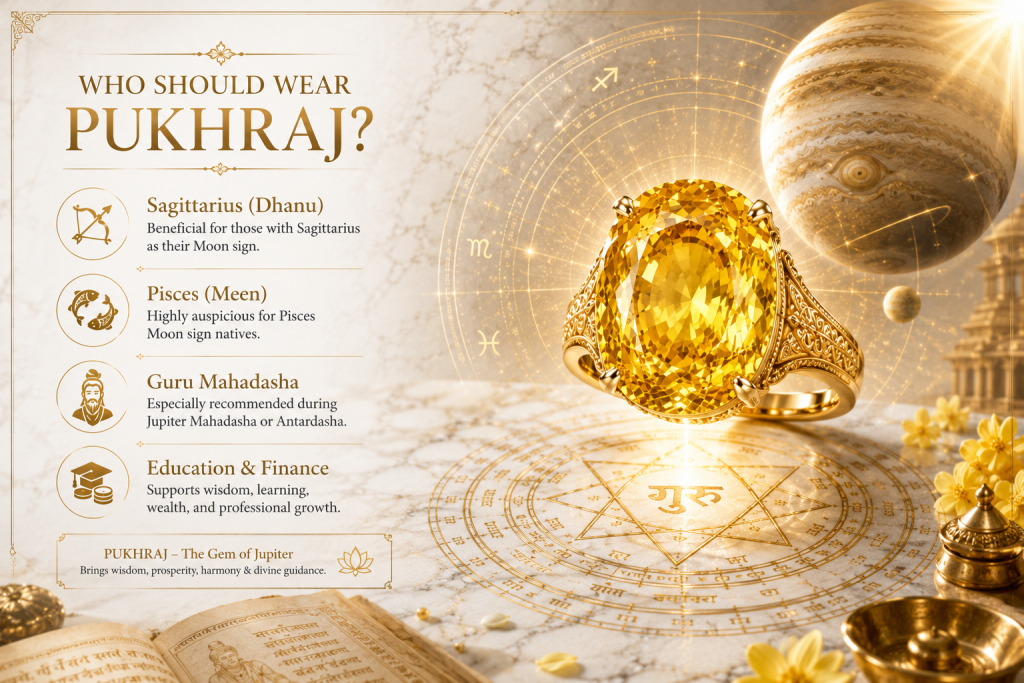
Pukhraj stone has a reputation as one of the safer planetary stones — Jupiter tends toward benefit in most charts, and the risk of adverse effects is lower than with Neelam or Hessonite. That said, ‘safer’ is not ‘suitable for everyone.’ The distinction matters when you’re about to spend serious money.
Clearly Suitable
Sagittarius and Pisces ascendants (and moon signs). Jupiter rules both — these natives get the most straightforward benefit with the least chart complexity to worry about. If your lagna or moon is in either sign, Pukhraj is generally fine without needing to dig deep into the chart.
Cancer, Leo, Aries ascendants — Jupiter rules favorable houses for each, but the individual chart still needs to be checked. Don’t skip that step.
Anyone with a weakened Jupiter in the natal chart, regardless of ascendant. A weak Jupiter tends to show up as poor judgment, financial ceiling, lack of clear direction. The stone strengthens the planet’s influence in whatever domain he governs for that specific chart.
People currently running Guru Mahadasha (Jupiter’s 19-year major period). The stone tends to work more actively during that window.
Professions Where It Makes Sense
- Education, research, academia — Jupiter governs knowledge transmission directly.
- Law, judiciary, finance — Jupiter rules dharma and artha, the two domains these professions operate in.
- Students in high-stakes exam preparation — sustained focus and judgment are Jupiter’s domains.
- Anyone dealing with delays in marriage — Jupiter governs the institution itself in the Vedic framework, not romance.
- Spiritual practitioners already on a path. Jupiter governs wisdom and material prosperity both, which is unusual among the planets.
Who Needs to Be Careful
Capricorn, Libra, Aquarius, Taurus, Gemini, Virgo ascendants — don’t wear Pukhraj without a proper consultation first. Jupiter governs challenging or neutral houses for these charts, and wearing his stone without assessment creates real risk of unhelpful effects. Get the full chart read.
What Pukhraj Stone Does
Career and Money
The most commonly reported benefit. The gains aren’t typically sudden — they’re more like sustained effort finally clearing whatever was blocking it. The promotion that should have happened, the financial momentum that keeps stalling. Jupiter governs expansion; when his influence strengthens, things that were stuck tend to start moving.
Mental Clarity
Sharper judgment under pressure, better retention, cleaner thinking. Jupiter governs practical wisdom more than raw intelligence — the kind that makes decisions hold up over time. Most relevant for executives, researchers, legal professionals, and competitive students.
Marriage and Relationships
Jupiter governs the institution of marriage, not attraction. Yellow sapphire is commonly recommended for relationship delays and instability — the effect is usually more patience and steadiness rather than anything dramatic. Worth knowing: this is one of the more specifically supported uses in the classical texts, not a vague catch-all.
Spiritual Practice
Steadier and more disciplined practice rather than revelations. Jupiter governs both material prosperity and spiritual wisdom simultaneously — the stone tends to reinforce consistency in whatever path is already there.
Physical Health
Jupiter governs liver, digestion, fat metabolism, immune function in Vedic medicine. The stone is associated with support in these areas. This is an astrological healing lens, not a medical claim — but the associations are long-established and internally coherent within the tradition.
Emotional Groundedness
More stable baseline — optimism that doesn’t collapse when things go wrong, patience, a kind of quiet confidence. People describe it as feeling more settled rather than more energized.
Fertility and Family
Specific traditional application with consistent classical backing. Some women wear Pukhraj with astrological guidance when seeking support for pregnancy or fertility. Alongside appropriate medical care, not as a replacement for it.
Types of Pukhraj Stone
By Origin
| Origin | What to Know |
|---|---|
| Ceylon (Sri Lanka) | Bright golden tone, top clarity — the standard for both jewelry and astrology |
| Myanmar (Burma) | Deeper color, genuinely rare, highest price tier |
| Thailand | Darker, frequently heat-treated, budget category |
| Madagascar | Vivid yellow, good clarity, best quality-to-price ratio |
By Color
Pale yellow is the low end — washed out, less effective for astrological use. Golden yellow is the recommended range — vivid, warm, what most Jyotish sources mean when they say ‘good Pukhraj.’ Canary yellow (intensely saturated, closer to pure bright yellow) is the rarest category and the most valuable when it’s genuine.
Treated vs. Untreated
Most commercially available yellow sapphires have been heat-treated to enhance color and clarity.
Heat treatment is structurally stable — it doesn’t weaken the stone. But for astrological use, untreated stones are strongly preferred across Jyotish sources; the belief is that treatment disrupts the stone’s natural energetic signature.
Untreated stones cost more — significantly more. That gap is real, not inflated. If astrological effectiveness is why you’re buying, insist on untreated and verify it through an independent certificate. For decorative jewelry only, a well-treated stone with good color is a perfectly reasonable choice.
Pricing
| Quality | INR per Carat | What It Means |
|---|---|---|
| Entry | ₹4,000 – ₹10,000 | Pale, included, almost certainly heat-treated |
| Mid | ₹10,000 – ₹25,000 | Decent saturation, reasonably clean |
| Premium | ₹25,000 – ₹50,000 | Vivid, clear, reputable origin |
| Top | ₹50,000 – ₹1,00,000+ | Rich golden, certified untreated, Ceylon/Burma |
Buying Without Getting Burned
The yellow sapphire market has real problems. Popular stone, wide price range, visual similarity to cheaper materials — conditions that reward misrepresentation.
A few things that actually protect you:
Care
Hardness 9, no cleavage — daily wear is fine without excessive concern. The practical issues are residue buildup and chemical exposure.
Clean regularly with warm water, mild soap, a soft brush around the setting, and a thorough rinse. Yellow sapphire picks up skin oils and product residue that gradually dull the surface. This is the most effective maintenance habit by a wide margin.
No ultrasonic cleaners or steam, especially for treated stones. No harsh chemical cleaners. Take it off for heavy physical work — settings are more vulnerable than the stone.
Store separately from other jewelry. Yellow sapphire scratches softer stones it contacts; harder materials can damage the metal setting. Have the setting checked periodically — stones worn daily work loose more often than people expect.
Questions Worth Answering
Why specifically Sagittarius and Pisces?
Jupiter rules both signs outright. For these ascendants, he’s the chart ruler — his stone works with the chart’s existing structure. For other ascendants, Jupiter governs different houses with different implications, and whether that’s beneficial depends entirely on the specific nativity. That’s why a blanket recommendation for everyone doesn’t hold.
Is there really a difference between yellow sapphire and yellow topaz?
Significant difference. Different mineral, different hardness, different optical properties, different astrological associations. The color looks similar to the naked eye — that’s the whole problem. Verify through certification.
Does heat treatment actually affect astrological effectiveness?
Within the Vedic tradition, yes — consistently, across sources. The belief is that treatment disrupts the stone’s natural energetic configuration. If astrological effectiveness matters to you, buy untreated and verify it. If you’re buying purely for jewelry, a treated stone with good color is perfectly fine.
My birth date is Sagittarius — is that enough to know Pukhraj suits me?
No. Sun sign is a starting point. Actual suitability depends on Jupiter’s placement, the house he rules, his aspects, and how he interacts with other chart factors. Birth time and location are both needed. Have a Jyotish astrologer check the full chart before buying.
What matters most when comparing two stones?
Color and treatment status. Vivid golden yellow with confirmed untreated certification puts you in genuinely fine Pukhraj territory. Pale color or undocumented treatment status, regardless of origin claims, doesn’t. Origin matters too, but those first two factors separate quality from commercial-grade material more reliably.