More than 4 generations old family tradition (Since 1937) of dealing in Pure Astro-Vedic quality jyotish gemstones, high quality genuine Rudrakshas and Authentic Vedic Yagyas.
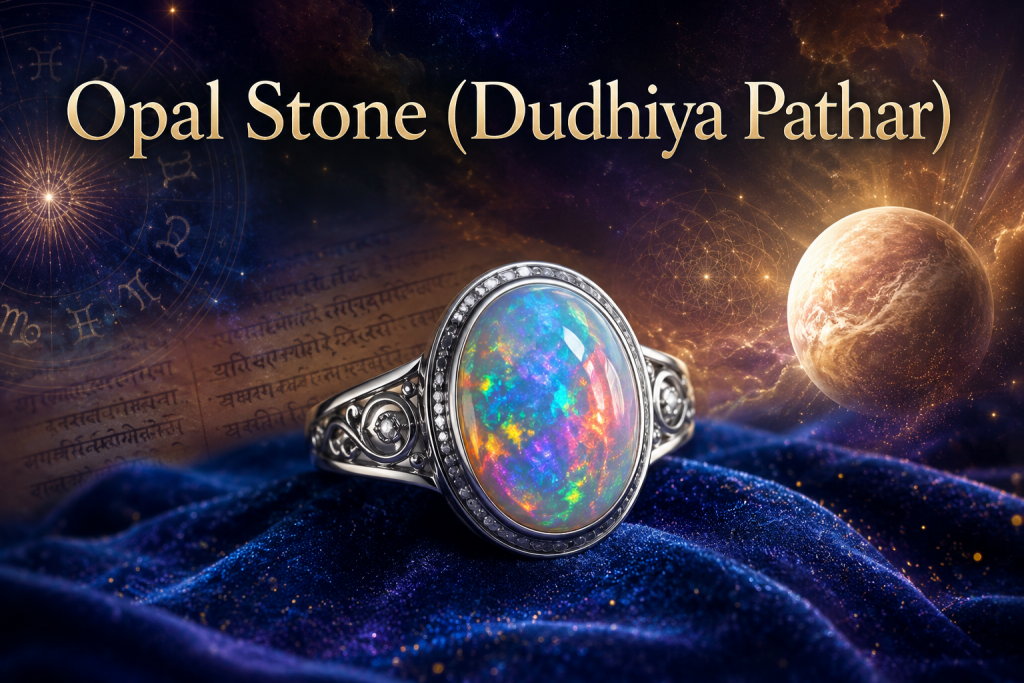
Opal Stone (Dudhiya Pathar) — Everything You Actually Need to Know
There is a moment that happens with opal that does not happen with other gemstones. You pick one up, tilt it slightly under a light, and the stone does something unexpected. A flash of green. Then red. Then a kind of electric blue that disappears before you can focus on it. You tilt it back and the whole thing starts again differently.
That is play-of-colour. And no photograph has ever captured it properly.
Opal — Dudhiya Pathar in Hindi — has been making people stop and stare for thousands of years. Ancient Romans ranked it above emerald. Arab traders believed the stones fell from the sky during lightning storms. Aboriginal Australians built it into their creation stories. Today it sits in the birthstone charts for October, in the gemstone recommendations of Vedic astrologers, and in the personal jewellery collections of people who simply could not walk past it in a shop.
This guide is the complete picture — what opal actually is, what Vedic astrology says about wearing it, how to identify a genuine stone, what you should pay, and where the world’s finest specimens actually come from.
What Opal Actually Is
The chemistry first, briefly: opal is a hydrated form of silica. Chemical formula SiO₂·nH₂O. That “n” is water, and a natural opal typically holds between 6% and 10% water by weight — though the range stretches from 3% at the dry end to as high as 21% in some specimens. That water content matters practically. It is part of why opal needs more careful handling than most gems, and part of why no two stones age identically.
Unlike quartz or diamond, opal has no crystalline structure. Gemologists call it a mineraloid — not a true mineral — because it forms differently and behaves differently from crystalline stones. It develops at low temperatures over extremely long time periods, slowly filling cracks and cavities inside host rocks. Sandstone, basalt, rhyolite, marl, limonite — opal turns up inside all of them.
What produces play-of-colour is a structure of microscopic silica spheres arranged in precise grid-like layers inside the stone. Light enters, hits that sphere arrangement, diffracts, and comes back out as colour. The sphere size determines which colours appear — larger spheres produce reds and oranges, smaller ones make blues and violets. Tilt the stone and you change the diffraction angle. The colour map shifts entirely. Every opal has a different internal sphere arrangement, which is why the display is never the same twice, even in two stones cut from the same rough.
No synthetic process has ever fully replicated this. Lab-created opals exist and are sold legitimately — but a trained eye can spot them. More on that shortly.
The Name Has Ancient Roots
The word opal goes back further than most buyers realise. The oldest known root is the Sanskrit “Upala” (उपल) — meaning jewel or precious stone. That became the Greek “Opállios” (ὀπάλλιος)”, which became the Latin Opalus. An etymological trail running from ancient India through Greece to Rome — which also maps, more or less, to opal’s actual trade history across those civilisations.
The 19th Century Reputation Collapse
Worth knowing about, even now. In 1829, Sir Walter Scott published Anne of Geierstein, a novel in which a character’s opal absorbed her fate and went lifeless at her death. Fiction. Entirely fiction. But European readers took it as some kind of warning and within a short time, opal sales across the continent collapsed. Prices fell by roughly 50%. Jewellers pulled it from displays.
It took decades to recover — and what finally turned things around was the discovery of Australia’s opal fields, which produced material so extraordinary that no superstition could survive contact with it. Today that episode is mostly a footnote. But it is a useful reminder that even the most enduring gemstone reputations can be derailed by a single story.
What Opal Means
Across cultures that had no contact with each other, opal accumulated similar meanings. Truth. Hidden things becoming visible. The full complexity of emotion held in a single object.
The shifting colours make the symbolism feel earned rather than assigned. A stone that never shows you the same face twice becomes a natural symbol for emotional depth, for change, for the kind of honesty that makes people uncomfortable. Ancient peoples believed opal could reveal deception. Medieval Europeans thought it could make the wearer invisible to enemies.
In modern crystal traditions the language is softer — creativity, hope, self-expression, emotional healing — but the underlying idea is consistent. This is a stone associated with the inner life. With what is real but not always visible.
In Vedic astrology, opal is assigned to Venus — Shukra — and Venus is one of the more consequential planets in any birth chart. Love and romantic relationships. Marriage. Beauty and aesthetics. The arts. Material comfort. Luxury. A person’s fundamental capacity for pleasure and emotional satisfaction.
When Venus sits weakened or afflicted in a horoscope, the effects show up in recognisable patterns. Troubled relationships that do not quite resolve. Difficulty in marriage. Creative ideas that never quite take shape. Financial instability that does not match effort. A low-grade dissatisfaction the person cannot precisely locate. Vedic astrologers recommend opal to address this — to strengthen Venus and, through that strengthening, restore what the planet governs.
There is something in how opal is described in astrological tradition that matches the stone’s actual character. It is said to work by absorbing the wearer’s emotional state, filtering the negative and returning something cleaner. Not forceful, the way ruby or blue sapphire are considered forceful. Gentle and reflective. That quality suits a wider range of people, which is part of why opal is one of the more broadly recommended Venus gemstones.
Opal is the traditional and modern birthstone for October. It matters most for Libra (Tula Rashi) — ruled directly by Venus — and to a lesser degree for Taurus ascendants. Astrologers sometimes recommend it for other placements too, depending on the individual chart. Worth getting that assessment before purchasing if you are wearing it for planetary purposes.
Crystal and Healing Beliefs Around Opal
Crystal healing traditions characterise opal as a stone of hope — specifically useful for people who feel emotionally stuck, creatively blocked or disconnected from a sense of forward movement.
The reflective quality shows up here too. Opal is said to mirror the wearer’s emotional state back clearly — which can be confronting but tends to be useful. Most meaningful change starts with honest self-awareness, and that is precisely what this stone is associated with supporting.
Healing associations that have remained consistent across traditional practices:
Blood purification and immune support. Kidney function and water retention. Hormonal regulation. Protective energy associated with the female reproductive system. Improved condition of skin, hair, nails and eyesight. Sharper memory and mental focus. Nervous system stability. Relief from migraines and persistent headaches. Support through menopause symptoms.
These are traditional beliefs, not medical claims. But the consistency across centuries and cultures gives them a different kind of weight than purely modern associations.
White Opal Specifically
White opal — the milky, luminescent variety — is what most people picture when they think of opal. Soft body colour, colourful fire visible across the surface. The most common variety and the most widely used for astrological wear.
Its energy, in crystal tradition, is considered gentler than black or fire opal. Good for emotional recovery. For people dealing with grief, heartbreak, prolonged anxiety or relationship difficulty, white opal is often described as a stone that supports without overwhelming — it does not rush anything.
What it is particularly associated with: restoring inner calm after disruption. Building self-confidence gradually rather than all at once. Supporting the slow release of stress and traumatic memory. Developing intuition. Sharpening decision-making. Deepening spiritual awareness over time rather than abruptly.
For first-time opal wearers, white opal is almost always the right starting point.
Opal and Libra (Tula Rashi)
Libra is the sign most directly aligned with opal — born between 23rd September and 22nd October, ruled by Venus, oriented toward balance, partnership and beauty. Opal works in direct alignment with all of that. It is also said to connect with the Sahasrara (Crown) Chakra, supporting spiritual awareness beyond the purely personal.
For Libra specifically, opal is associated with harmony in partnerships and professional collaborations. Processing and releasing old relationship pain. Career growth in creative, artistic and travel-related fields. Navigating legal and financial difficulties. Building confidence and expressive ability. Finding peace of mind that actually holds rather than briefly appearing and then disappearing.
Among the opal varieties, Fire Opal — orange to deep red — is considered the most powerful choice for Libra. It adds fire and directness to Libra’s natural diplomacy. Useful for a sign that sometimes waits too long to act.
Opal for Love and Relationships
Opal has always had its strongest cultural association here. A gemstone that directly strengthens Venus is, almost by definition, a gemstone about love.
The specific quality it is said to bring is emotional availability. Not performance of intimacy, but the actual thing — the willingness to be vulnerable that real connection requires. For troubled marriages, it is associated with reviving warmth and reopening communication. For people seeking romantic relationships, it is said to make the wearer more genuinely open — which is, practically speaking, what most people actually need.
Deepening physical and emotional intimacy. Building trust through better emotional honesty. Encouraging real forgiveness rather than surface-level peace. Reviving stability in relationships going through difficulty. These are the consistent relationship associations around opal across traditions.
The Different Types of Opal
Not all opals are the same stone. Each variety has a distinct visual character and its own position in the astrological and collector markets.
White Opal. Milky body tone, colourful fire. Most common, most accessible, most widely used for astrological wear. Good entry point.
Black Opal. Dark grey to jet-black body with extraordinarily vivid fire — the dark background makes colours appear far more intense than they would against a light tone. Rarest variety. Highest prices. Fine specimens come almost exclusively from Lightning Ridge, New South Wales. Nothing else looks quite like it.
Fire Opal. Warm body colour — yellow, orange, vivid red, sometimes with green flashes. Often transparent. Valued for body colour as much as play-of-colour. Mexico’s Querétaro region is the world’s primary source.
Crystal Opal. Transparent to semi-transparent body with strong internal fire. You can see the colour display from inside the stone. Visually extraordinary.
Boulder Opal. Found within ironstone host rock in Queensland. The rock matrix forms a natural backing that often intensifies the colour display. Each stone is one-of-a-kind in a way that even regular opals are not.
Matrix Opal. Opal diffused through host rock in thin veins. More earthy character, distinct aesthetic.
Ethiopian Opal. Volcanic origin, light body tone, strong play-of-colour. Major presence in the global market since 2008. Excellent visual quality relative to price — often the best value option for buyers who want Australian-level appearance at a lower cost.
How to Tell a Real Opal from a Fake
The market has a significant volume of synthetic opals, doublets and triplets at every price point. Some are sold transparently as what they are — synthetic opal has legitimate decorative uses. The problem is when these are presented as natural.
What to look at first. Move the stone slowly under a light. In a genuine opal, colour flashes shift, deepen and change character as the angle changes — appearing to come from within the stone. The display should feel alive, organic, slightly unpredictable. Synthetic opals typically show a too-perfect pattern — a kind of reptile-skin regularity that machine manufacture produces and nature does not.
Check the side profile. Tilt the stone and look at the edge. A solid natural opal is one continuous piece of material from top to bottom. Doublets and triplets — composites made of a thin opal slice glued to a dark or glass backing — show a visible seam at the girdle. That line is difficult to hide completely. If you see it, the stone is composite regardless of what the seller says.
Temperature and surface. Natural opal feels noticeably cool when you first pick it up and warms gradually. Plastic and resin imitations warm almost immediately. Real opal has a smooth, slightly waxy surface — not glassy, not rough.
Hardness. Natural opal falls between 5.5 and 6.5 on the Mohs scale — it resists casual scratching but is not especially hard. A stone that scratches instantly with minimal pressure is not genuine opal.
Under magnification. Look at the interior with a 10x loupe. Natural opals show organic imperfections — fine crazing, tiny sand inclusions, irregular internal patterning. Synthetic stones look suspiciously clean and perfect inside. Too perfect is a warning sign.
Weight. Genuine opal feels heavier than its size suggests, because of silica and water density. Plastic imitations feel noticeably light in the palm.
Who Should Actually Wear Opal
Primarily: people with Venus prominently placed or weakened in their Vedic birth chart. Libra (Tula Rashi) and Taurus ascendants — Venus ruling signs — are the most natural candidates. October-born individuals carry it as their traditional birthstone.
Beyond those groups: creative professionals who want to strengthen imaginative and expressive ability. Artists, musicians, designers, writers, actors. People working in fashion, film, beauty industries. Anyone dealing with relationship difficulty — troubled marriage, recovering from heartbreak, struggling with emotional connection. People who feel emotionally reactive, anxious or creatively blocked and want gentle support rather than forceful intervention.
For people choosing opal for beauty or general healing rather than planetary purposes, there are no particular zodiac restrictions. Its energy is gentle enough to suit most temperaments without creating imbalance.
How to Wear Opal: The Full Vedic Method
Carat weight. One-tenth of body weight in kilograms is the traditional calculation. 60 kg body weight means a 6-carat stone. Going significantly under this reduces the stone’s astrological effectiveness according to traditional guidelines.
Stone quality. Choose white opal or milky opal with clearly visible, vivid play-of-colour. More dynamic fire generally indicates greater astrological potency. Dull or patchy fire in a stone intended for planetary use is not ideal.
Metal. Silver is the preferred setting in Vedic astrology — it harmonises naturally with Venus energy. Platinum and white gold are acceptable. Panchdhatu (the traditional five-metal alloy) works well for those working within a tighter budget.
Finger. Ring finger of the dominant hand. Right hand for right-handed individuals. Left for left-handed.
Day and time. First wearing on a Friday morning, 5:00 AM to 7:00 AM, during Shukla Paksha — the waxing phase of the moon.
Mantra. Hold the ring in the right hand before wearing. Chant “Om Shum Shukraaye Namah” 108 times. This is the Venus activation mantra — the intention is to align the stone’s energy with the wearer’s personal aura before it makes contact with the body.
Jewelry form. Rings are most recommended in astrology — direct skin contact is considered essential for energy transmission. Pendants near the heart are a meaningful alternative. Bracelets work for those who want a less formal option.
Opal Stone Price in India
Australian Fire Opal sits at the top of the price range because of its global reputation for sustained brilliance. Ethiopian opal has become a genuinely respected mid-range option with strong visual quality. White opal is the most practical entry point for first-time buyers.
Prices shift with market supply, rough availability and trade policy changes.
What Actually Drives Opal Price
Origin moves the needle more than any other single factor. Australian stones — Lightning Ridge black opal, Coober Pedy white opal — set the global benchmark. Ethiopian and Mexican opals offer excellent value at comparable visual quality levels.
Fire brightness is the second driver. Vivid, broad, shifting colour play multiplies a stone’s value dramatically compared to dull or patchy fire in an otherwise similar specimen.
Pattern type matters alongside brightness. Broad flash — large sweeping areas of single colour — is the rarest and most expensive. Pinfire (tiny colour dots) is common and more affordable. Harlequin pattern — angular mosaic-like blocks — is exceptionally rare when genuine and priced accordingly.
Body tone follows a rule that surprises new buyers: darker backgrounds produce more visually intense fire because there is less competing light. This is why black opal consistently outprices white opal of equivalent fire quality.
Clarity. Sand inclusions, webbing, dead spots — areas with no fire — reduce both beauty and durability. Clean stones with even fire distribution across the full face are always worth more.
Cut. Almost universally cabochon — smooth domed oval or round. A well-proportioned dome maximises fire and reduces fragility in ring settings. Too flat and the display suffers. Too high and the stone is vulnerable to knocks.
Caring for Opal
More delicate than most gemstones. That is simply the reality of the water content and relatively modest hardness.
Clean with a soft cloth and mild soapy water. Gentle wipe, plain water rinse, pat dry. That is genuinely all it needs. Ultrasonic cleaners, steam, chemical jewellery solutions — all of these can damage opal. Sometimes immediately. Sometimes through repeated exposure over time. Do not use them.
Remove opal jewellery before swimming — chlorine is particularly damaging. Before bathing. Before washing dishes. Before physical work of any kind. Store in a soft pouch, separated from harder stones that can scratch the surface. In very dry climates, keeping the pouch somewhere slightly humid prevents the stone from drying out and developing surface crazing.
With that level of care, a natural opal keeps its fire and character for a very long time.
History and Sources
Before Australia appeared on European gem trade maps, the world’s primary opal source was Červenica in Slovakia — a site that supplied European royal courts for centuries. Roman emperors paid fortunes for fine specimens from there. Medieval courts believed opal held the powers of every gem whose colour it reflected.
Then the Australian fields opened, and the global picture changed permanently.
Australia
Roughly 95–97% of the world’s precious opal comes from Australia. South Australia alone accounts for about 80% of that national output.
Coober Pedy is probably the most famous opal mining town on Earth — and the discovery site of the Olympic Australis in 1956, the largest gem opal ever found. 17,000 carats. More than 11 inches long.
Lightning Ridge in New South Wales is the only reliable source of fine black opal anywhere in the world. Stones from there are among the rarest gemstones produced anywhere.
Mintabie — crystal and black opals, widely exported. Andamooka — matrix, crystal and black varieties. Queensland’s boulder opal fields around Yowah, Kynuna, Jundah and Quilpie — ironstone-hosted stones with unique character.
Australia also produces opalized fossils. Ancient marine shells, dinosaur bones, prehistoric wood replaced over millions of years by opal. Objects that sit at the intersection of palaeontology and gemology and are genuinely extraordinary.
Ethiopia
The trade did not notice Ethiopian opal until well after its initial discovery in the Menz Gishe District in 1994. The stone reached significant global prominence only after a major find near Wegeltena in the Wollo Province in 2008. Ethiopian opal forms in volcanic basalt — different geology from Australian sedimentary formation — but the visual character is remarkably similar. Light body tones, bright play-of-colour, excellent transparency in crystal specimens. In less than two decades it became a serious and respected part of the global opal trade.
United States
Virgin Valley, Nevada is the primary American source — black, crystal, white, fire and lemon opals. The black fire opal is Nevada’s official state gemstone. Notable mines include Rainbow Ridge, Royal Peacock, Bonanza and Opal Queen. Many American opals form through silicification of wood, occasionally preserving Miocene-era fossil material.
Mexico
Mexican Fire Opals — transparent to translucent yellow, orange and red stones, sometimes with unexpected green flashes — are among the most recognisable gems in the world. Primary sources are Querétaro and Jalisco. The Santa Maria del Iris mine, operating since 1870, is historically significant. Sold both as cut gems and in natural host rock — that form called Cantera Opal.
Elsewhere
Brazil, Czech Republic, Slovakia, Hungary, Turkey, Indonesia, Honduras, Guatemala, Nicaragua all have deposits. In 2008, NASA confirmed opal on Mars. Which surprised very few people who had spent serious time with this stone.
Before You Buy: A Practical Warning
Synthetic opals, doublets and triplets move through the market at every price level. Some sellers are honest about what they are offering. Many are not.
Get a laboratory certificate. Not optional — a genuine natural opal should come with documentation from a recognised gemological lab confirming it is 100% natural and untreated. No certificate is a meaningful red flag.
Be suspicious of prices that seem too good. Natural opal with real fire costs real money. When the price seems implausibly low for the visual quality, the stone almost certainly is not what it appears.
Check for the seam. Composite stones — doublets and triplets — have a visible glue line when viewed from the side. Natural solid opal does not.
Look at the fire pattern. Synthetic opals show a too-perfect regularity — beautiful but mechanical. Natural fire is organic, shifting, slightly unpredictable. Once you have seen the difference, it becomes difficult to confuse them.
Buy from dealers who are transparent about origin, treatment status and return policy. Ask for written documentation. Walk away from anyone who cannot provide it.
FAQ
What is opal stone?
Opal — Dudhiya Pathar in Hindi — is a hydrated silica mineraloid (SiO₂·nH₂O) without crystalline structure, typically containing 6–10% water by weight. Its defining characteristic is play-of-colour: light diffracting through microscopic internal silica spheres that produce shifting rainbow-like displays. No two opals produce identical patterns. In Vedic astrology it is the primary gemstone for Venus (Shukra), worn to strengthen love, creativity, relationships and emotional balance.
What types of opal exist?
White Opal (milky, colourful fire — most common), Black Opal (dark body, intensely vivid fire — rarest), Fire Opal (warm yellow/orange/red body colour), Crystal Opal (transparent with internal fire), Boulder Opal (within ironstone host rock), Matrix Opal (diffused through host rock in veins), Ethiopian Opal (volcanic origin, light body, bright play-of-colour). Each has distinct visual character and astrological application.
Which variety is best for astrological use?
White opal with clearly visible, vibrant play-of-colour is most widely recommended in Vedic tradition for strengthening Venus. For Libra ascendants specifically, Fire Opal in orange-to-red tones is considered most powerful — adding drive and energy to the sign’s natural diplomatic grace.
What is the real difference between Fire Opal and Black Opal?
Fire opal is defined by its warm body colour — yellow, orange or red — and is typically transparent, valued for body colour as much as play-of-colour. Black opal has a near-black body that makes colour play appear dramatically more vivid by contrast. Black opal from Lightning Ridge is significantly rarer and more expensive. Fine specimens rank among the most valuable gems sold anywhere.
Who should wear opal?
Primarily Libra (Tula Rashi) and Taurus ascendants, for whom Venus rules the chart. October-born individuals carry it as their traditional birthstone. Creative professionals — art, design, music, fashion, film — are natural candidates. People dealing with relationship difficulty, emotional instability or creative blocks. Consult a Vedic astrologer to confirm based on individual birth chart placement.
Which finger for opal?
Ring finger of the dominant hand — right for right-handed individuals, left for left-handed. Set in silver or platinum. First worn on a Friday morning during Shukla Paksha.
Key Takeaways
Opal is a hydrated silica mineraloid — its play-of-colour comes from light diffracting through microscopic internal spheres, making every stone genuinely unique. In Vedic astrology it strengthens Venus, making it most relevant for Libra and Taurus ascendants. White opal is the practical first choice for astrological wear. Black opal is the rarest and most collectible variety. Australia produces 95–97% of global precious opal supply — Ethiopia is the most important emerging source since 2008. The market has significant synthetic and composite volume — buy certified, from transparent dealers only. Wear in silver or platinum, ring finger, Friday morning during Shukla Paksha, with the Venus mantra chanted 108 times. Handle gently, clean simply, store separately.
If you’re seeking authentic guidance for career, health, or relationship concerns, or wish to explore genuine Vedic remedies, visit our webpage at purevedicgems. Our site features trusted astrology consultations, high-quality gemstones, Rudrakshas, and Vedic rituals, all rooted in deep knowledge and traditional practices. Discover how our holistic approach can support your well-being and spiritual growth.
Genuine Products and Satisfied Customers are our first and foremost priority
Firstly, I want to give compliment to the website. By chance, I came to know the shop from the Internet only. The design of the website attract me a lot as well as it gives many useful knowledge about Astrology, gemstones, etc. After that, I feel thankful to Mr.Vikas Ji and his staffs for their understanding, support me from A to Z and help me solve all my problems. Whatever I don\'t understand, they guide me very slowly, clearly and remove all my doubts. They are great people - I have to say!!! Thanks a ton. Finally, the products are very good and give me positive result till now (nearly 3 months). The rings are well-designed - even many Indians, they also gave me compliments on the rings; the gems are high quality - very stunning. Just only compliments - no any doubts. I definitely come back and purchase more products from this shop. In the future, if anyone need Astrology products, I will highly recommend Pure Vedic Gems to them!!! With love and all my best wishes to all of you! Yen Van (VietNam)
As recommended by Astrologer, I purchased the gemstones. I must say that they have a Unique role. After 3 months of wearing them, intuitively these have guided me in the right direction and given me a lot of strength in my convictions and getting beyond false sense of securities in life. Rest future will tell, how these prisms actually affect one. I am grateful to Vikas Mehra Ji for his time, his advice and detailed and patient way of dealing with customers. Thank you! Regards
The service was wonderful. Delivery and updates were very prompt and the pictures were incredibly appreciated. The ring itself has been fantastic. I wear it everyday and can feel the effects of it. Very grateful to have found you and will recommend you to friends looking for gamestones and use your service for any of my own future needs!
Hare Krishna All I bought two gem stones from Pure Vedic Gems. I was bit confused about gem stones because it was my first time experience. I cruised around many websites and made phone calls in India, but didn\'t get any satisfactory answers. I contacted Pure Vedic Gems, they followed up my quiries nicely. Vikas ji the owner of Vedic Gems gave me very valuable advices. It took me long time to finalize the products, but staff had lots of patience. Pure Vedic Gems team answered all my questions and helped me to select the products. They helped me on every step of this process. I will highly recommend Pure Vedic Gems to any customers especially Overseas Clients, because it is very hard to find right place to buy gems with complete package (including rings). They have given certificates of Gems and done the proper puja process too. And one more thing to mention, they have Astrologer Team which can help you out if you are not sure of right gem for you on very nominal charges. Full marks to Vikas Mehra ji and his team. Thanks a million Regards Baljit Bains
It was great talking to Vikas, I found him very knowledgeable, and he helped me choose the right product. Pure Vedic Gems team equally is very very helpful, He always sorted out all my quaries & was very responsive.I received the product on time & its a wonderful peace of gem. One doesn’t need to worry about product’s authenticity when buying from Purevedicgems.
Right away as soon as I started my order i was contacted by pure vedic gems team to make sure everything was set up perfectly for my ring to be made. They walked me through the whole process up to delivery. The stone was very good quality and well energized and I felt the difference as soon as I started wearing it. The craftsmanship of the ring was great aswell. I am grateful to have found purevedicgems and I cant wait to make my next purchase :)
Hi Vikasji, Its my pleasure to write feedback about the interaction that we had. I am very impress with the quality of the gemstone, reasonable pricing, finishing and perfection with with it is embedded into ring. The overall services such as - day to day interaction , resolving queries with quick responses and delivery on time in secure packing. I had received excellent customer service for first purchase of a another gemstone last year, the same experience this time as well. I would continue to use Purevedic for future purchases and would highly recommend to others.
A Final end, destination when u are searching for pure unheated untreated Vedic Gemstones. The Very first day when I saw website and videos of oceanic knowledge and an unsaid promise for pure Ratana and consultation. I wish Mr Vikas ( whom I have never met ). But I wish to..... But I bought Emerald from Pure Vedic Gems. It\'s really very nice quality as promised. Nowadays when every one in market promises for true stones, the one trusted stop is Mr Vikas whose true and valuable guidance will surely make u go for a real stone , none other than Pure Vedic Gems. My best wishes are with them and Vikas ji too.. May the supreme power, lord of us all shower blessings on them...
I bought 2 gemstones (Yellow Sapphire & Red Coral) from Pure Vedic Gems and I am very pleased with the products and customer services. The gemstones were high quality and very beautiful. PURE VEDIC GEMS teams was very helpful throughout the journey. He helped me from the purchase to delivery of the product. Thank you