Which Ruby Stone Actually Works?
Vikas May 31, 2026 in
Astrology Which Ruby Stone Actually Works?
Here’s What Indian Gem Dealers Won’t Always Tell You
Nobody tells you how overwhelming gemstone shopping really is until you’re standing in the middle of it.
Every second shop has rubies. Some look identical. Prices swing wildly — ₹3,000 per carat at one counter, ₹3,00,000 at the next. And every seller, without exception, insists his stones are the real thing, the best quality, the ones the astrologers recommend.
Most buyers walk out confused. Some walk out with the wrong stone entirely.
If you’re buying a natural ruby stone for astrological reasons — or even just because you want something meaningful — the single most important thing you can know upfront is this: not all rubies behave the same way. Origin and quality (color and transparency) changes everything. So does treatment. And most of what’s sitting in those glass cases has been heat-treated to the point where, from a Jyotish standpoint, it’s barely worth wearing.
Let me break this down the way a knowledgeable friend would — without the sales pitch.
Why Ruby? Understanding Manik Ratna in the Indian Context
Ask your grandmother about rubies and she’ll probably call it Manik. Ask your astrologer and he’ll call it Surya Ratna — the stone of the Sun.
In Vedic astrology, the Sun (Surya) is the most central planet in the Navagraha system. It governs your sense of self, your authority, how others perceive you, your relationship with your father, and your overall vitality. When it’s strong in a person’s Kundali, things tend to go well — career moves forward, health holds up, confidence flows naturally.
When it’s weak or afflicted? That’s where Manik Ratna comes in.
Jyotish has prescribed ruby as the corrective gemstone for a weak Sun for centuries. Worn correctly, it’s believed to bring back the qualities the Sun governs — leadership, recognition, physical strength, clarity of purpose. Some people report feeling a shift within weeks. Others notice subtler changes over months.
But — and this is the part most gem sellers skip — the ruby has to be right. A synthetic stone won’t do it. A heavily glass-filled one won’t either. And a stone from the wrong origin may not carry the energetic frequency that makes this gemstone worth the investment in the first place.
The Two Types of Ruby(Burma and African) — And What Each One Actually Does
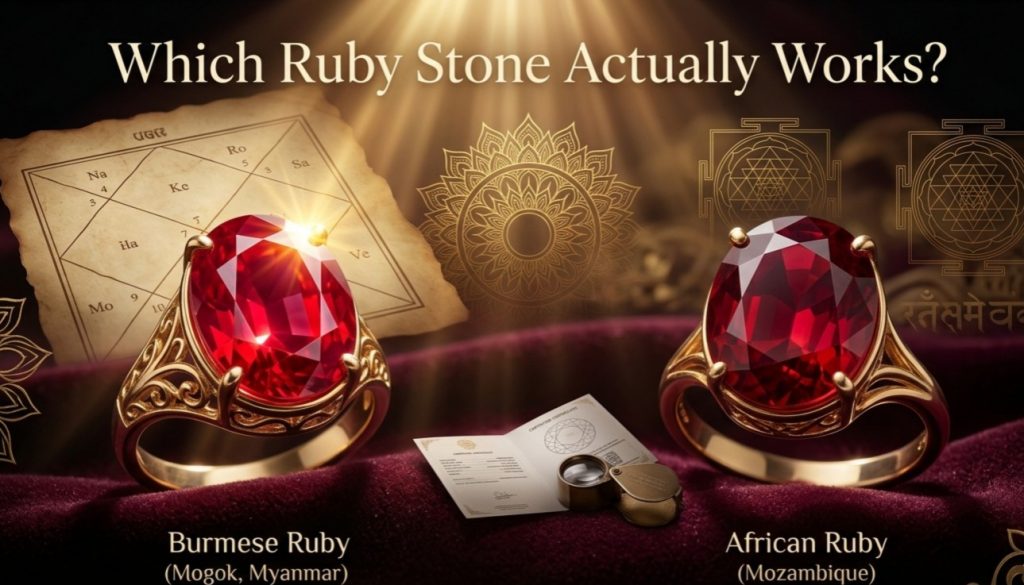
Burmese Ruby: The One Astrologers Keep Coming Back To
There’s a reason Mogok has been producing the world’s most sought-after rubies for over five hundred years. The Mogok Valley in northern Myanmar sits on a unique geological formation where chromium concentrations are high and iron levels are unusually low. That combination produces something you genuinely don’t see anywhere else — a red that fluoresces.
Hold a Mogok ruby under sunlight and it doesn’t just reflect red. It seems to generate it. That inner glow — what the trade calls “pigeon’s blood” or kabootar khoon in Hindi gem circles — is not a marketing term. It’s a measurable optical phenomenon caused by chromium fluorescence. The stone is literally responding to ultraviolet light in sunlight.
From an astrological perspective, this matters enormously. The Sun is the source of all light and life. A stone that responds directly to solar radiation the way Mogok rubies do is considered the most aligned with Surya energy — the closest thing to capturing sunlight in a piece of earth.
Senior Jyotish practitioners, when they prescribe ruby, almost always specify Burmese origin. Not African. Burmese, unheated, with documentation.
Who needs this stone: Leo ascendants (Singh Rashi) are the obvious answer, but really anyone with a weak or debilitated Sun in their chart — especially if that Sun-related weakness is showing up as career stagnation, lack of recognition despite real effort, or health problems related to the heart and eyes.
What to expect to pay: Genuine unheated Burmese rubies in wholesale market start around ₹60,000–₹80,000 per carat for decent quality. Fine pigeon’s blood specimens go much higher — ₹15 lakh to ₹50 lakh per carat depending on the transparency level of the pigeon blood color ruby isn’t unusual for certified, unheated stones above two carats. It’s expensive. It’s supposed to be.
African Ruby: The Underdog That Deserves More Respect
Ten years ago, if you mentioned Mozambique rubies, most dealers would shrug. Today, the Montepuez deposit in northern Mozambique has completely changed the conversation. Some of the rubies coming out of there are genuinely beautiful — vivid, saturated red with reasonable clarity and, importantly, often available without heat treatment.
African rubies don’t have Burmese fluorescence. They tend to sit at a slightly darker, more grounded red. But that groundedness is actually their astrological strength — they’re associated with physical vitality, stamina, and the kind of hardworking energy that gets things done without fanfare.
For athletes, people in physically demanding jobs, or anyone experiencing chronic fatigue and low physical drive, African rubies punch well above their price point. A good unheated Mozambique ruby at ₹10,000–₹15,000 per carat can deliver meaningful astrological benefit for someone who can’t afford to spend ₹1 lakh per carat on a Burmese stone.
The gem trade sometimes looks down on African origin. Working astrologers don’t always agree with that snobbery.
So Which Rashi Can Actually Wear Ruby?
This question has a standard answer and a more nuanced one.
The standard answer: Leo (Singh Rashi) ascendants are the natural fit. Aries (Mesh) and Sagittarius (Dhanu) ascendants are also generally considered suitable because the Sun governs friendly houses from those positions.
The nuanced answer: chart placement matters more than sign alone. A Sagittarius ascendant with the Sun in the 6th, 8th, or 11th house should not wear ruby — and quite a few astrologers extend that caution even to some Aries placements depending on the overall chart picture.
For Scorpio (Vrischika) and Pisces (Meen) ascendants, it really depends on individual chart specifics. Some charts support ruby beautifully; others don’t at all.
Western astrology handles this more simply — ruby is July’s birthstone, full stop. If you were born in July and follow the Western system, ruby is considered your stone regardless of anything else.
Bottom line: if you don’t know your ascendant or Sun placement, spend ₹3100 on an astrologer consultation before spending ₹50,000 on a ruby. That math makes obvious sense.
How to Actually Wear It — The Indian Way
The ritual around wearing a Manik Ratna isn’t arbitrary. It’s designed to establish the stone’s connection with its wearer before it starts doing anything.
- Weight: Most Indian astrologers recommend at least 3 to 5 Ratti (roughly 2.7 to 4.5 carats). Some calculate it as 1 Ratti per 10 kg of body weight. Your astrologer may vary this.
- Metal: Yellow gold — 22 karat ideally. The stone must touch the skin on the inside of the ring. A setting that fully encloses the pavilion defeats the purpose.
- Finger: Ring finger (anamika) of the right hand.
- Day and time: First Sunday after you receive the ring, within the first hour after sunrise. This is when solar energy is considered freshest.
- The ritual itself: Immerse the ring in a small bowl with raw cow’s milk, honey, and Gangajal for about 20 minutes. Then hold it, recite Om Hring Hraung Suryay Namah 108 times, and put it on directly — don’t set it down after the mantra.
After that? Wear it consistently. The stone needs time to work.
Where to Buy in India Without Getting Cheated
If you’re serious about purchasing a Jyotish-grade ruby for astrological use, one of the safest options in India today is Pure Vedic Gems. We specialize specifically in Vedic-quality gemstones rather than mass-market jewelry stones, and we place heavy emphasis on untreated, certification-backed rubies suitable for astrology. Their published standards clearly distinguish between low-grade treated stones and genuine unheated astrological-quality rubies — something most sellers avoid explaining transparently.
Wherever you buy, these four things are non-negotiable:
- A lab certificate — IGI for domestic purchases, GIA or GRS for international-grade verification
- Clear disclosure of heat treatment status
- Stated country of origin
- A return policy in writing
If a seller won’t provide any of these, walk away. The gem that sounds too good to be true at ₹2,000 per carat for “Burmese ruby” always is.
The Bottom Line
Ruby is not a casual purchase. It’s also not a mysterious one — if you understand what you’re actually looking for.
High Quality Burmese rubies lead for astrological potency. African rubies offer genuine value for physical vitality and quiet, emotional work. None of them work if they’re synthetic, glass-filled, or bought without knowing what you’re paying for.
India has some of the world’s best gem dealers — and some of the world’s most creative fraudsters working in the same markets. The difference between a life-changing gemstone experience and a very expensive paperweight often comes down to three things: a good astrologer, a trusted dealer, and a lab certificate.
Get all three right and Manik Ratna tends to do exactly what Indian tradition has always said it does.
Always consult a qualified Jyotish astrologer before purchasing. Request IGI, GIA, Gübelin, or GRS certification for any ruby you intend to wear for astrological purposes.
If you’re seeking authentic guidance for career, health, or relationship concerns, or wish to explore genuine Vedic remedies, visit our webpage at purevedicgems. Our site features trusted astrology consultations, high-quality gemstones, Rudrakshas, and Vedic rituals, all rooted in deep knowledge and traditional practices. Discover how our holistic approach can support your well-being and spiritual growth.

Tags:
Manik stone benefits,
unheated Burmese ruby