 +91-9310172512
 +44-7831491778
 +971-526686526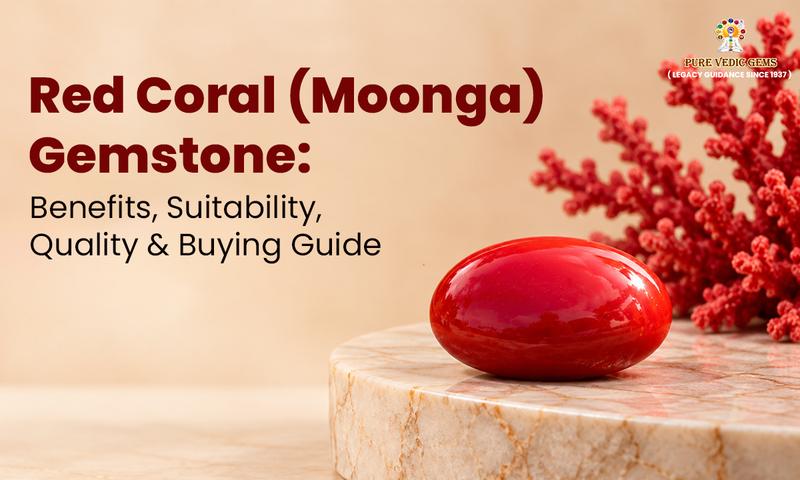
Red Coral (Moonga) Gemstone: Benefits, Suitability, Quality & Buying Guide
Red Coral, popularly known as Moonga, is one of the Navaratna gemstones associated with the planet Mars (Mangal) according to Vedic astrology. Red Coral is an organic gemstone that differs from other mineral gemstones like Ruby and Sapphire since it is formed from the skeleton of marine organisms.
If you aim to understand red coral gemstone benefits or use a red coral stone for astrological purposes, you shouldn’t judge it just by its colour. You need to take into account parameters regarding the naturality, the colour quality, the surface quality, any treatment done, the gemstone origin, the weight and the certificate.
This article covers important information about the meaning of red coral, who might need to wear it, how to understand the quality, the difference between Italian and Japanese coral, and what to pay attention to while acquiring a stone.
Red Coral Gemstone Benefits in Vedic Astrology
Red coral is believed to be linked with Mars and regarded as one of the Navaratna stones. In Vedic astrology, Mars is associated with bravery, confidence, vitality, will, and originality.
When it comes to astrology, simply choosing a red coral gemstone for its connection with Mars is not enough. Whether the stone is suitable or not is determined by the person’s horoscope.
Red Coral's Long-Established Meanings
- Bravery and confidence: Associated with the planet Mars and characteristics such as decisiveness and self-confidence.
- Energy and initiative: Traditionally attributed to action, motivation, and physical activity.
- Leadership: Sometimes viewed in traditional contexts where courage and decision-making are valued.
- Stubbornness: Connected to the ability to initiate and to persist.
Who Should Consider Wearing Red Coral?
Red coral has been regarded as a gem associated with Mars. After looking at the position and strength of Mars alongside other planetary factors, people make a decision.
Before buying Moonga for astrological use, consider:
- Kundli compatibility: Check if Mars is effective in strengthening according to one's Kundli.
- Intention: Ensure whether the stone is being bought for its traditional Mars qualities like bravery, confidence, or proactiveness.
- Quality: Select natural coral of the right colour and surface quality.
- Weight: Consider the recommended weight for astrological need rather than selection based on budget.
- Certification: For significant purchases, make sure to look for good laboratory documents.
How to Evaluate Red Coral Quality
A decent Coral is evaluated for its qualities beyond just its colour. While natural coral may show surface features, it does not mean that one needs to choose coral with a uniform colour as being of better quality.
Quality factors
- Colour: The Red Coral needs to be bright and evenly red or red-orange.
- Surface: Check the Coral for the presence of cracks, holes and even damage.
- Shine: Normally, coral does not shine too much and has a more subtle shine than other gemstones.
- Shape: Look for smooth shapes, as they are usually preferred for jewellery manufacturing and astrological purposes.
- Natural: Make sure that the Coral is natural and not artificial.
- Treatment: Check with the seller whether the Coral was dyed, heated or enhanced by means of impregnation.
Coral can be dyed or bleached, and an imitation coral can be made from glass or plastic.
Italian vs Japanese Red Coral: What Is the Difference?
While both Italian Coral and Japanese Coral can be observed in the gemstone market, they can be different in terms of colour, appearance, accessibility and cost.
Italian Red Coral
Italian Coral is usually identified with Mediterranean Coral and is commonly seen in the jewellery industry. It provides an affordable option for those looking for natural Coral.
Japanese Red Coral
The term Japanese Coral refers to coral types from the western Pacific, thus meaning that coral originating from this area can demand higher prices if it has well colour, sound surface quality and good characteristics.
However, it is worth mentioning that origin does not dictate the quality of the coral. The following factors should also be considered: colour, natural state, treatment, surface quality, dimensions and overall appearance.
Red Coral Price in India: Approximate Range
In India, prices for red coral vary widely based on different attributes such as source, colour, quality, size, treatment and certification. When comparing the price per carat of coral of lower and superior quality, we cannot consider only the price.
Indicative Red Coral Price Table
| Red Coral Type / Quality | Approx. Price Range* |
|---|---|
| Commercial natural Italian Coral | ₹800–₹1,500 per carat |
| Good-quality natural Italian Coral | ₹1,200–₹2,500 per carat |
| Premium natural Coral | ₹2,500–₹5,000+ per carat |
| Fine Japanese / premium-origin Coral | ₹5,000+ per carat |
These are indicative ranges, not fixed market prices. Actual prices can vary considerably according to colour, size, surface quality, origin, treatment and certification.
How to Identify Natural Red Coral before Buying
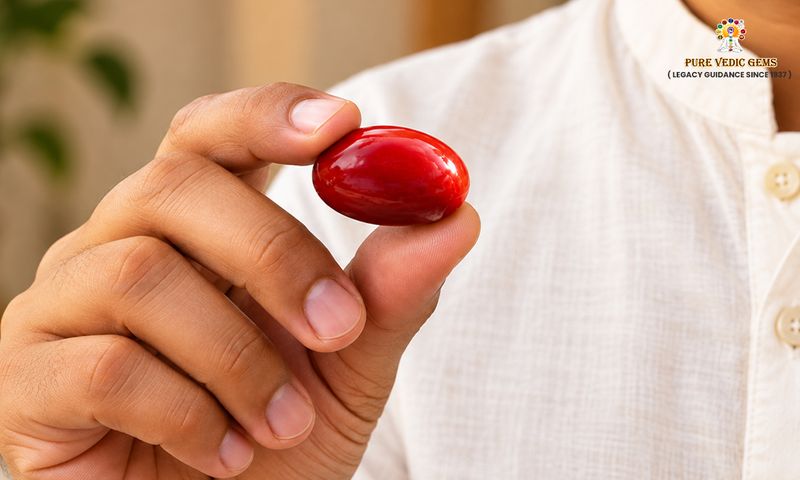
Visual examination may give valuable information; however, it can’t always help to determine nature and processing correctly.
If you want to make a worthwhile purchase, go through a qualified gemological assessment.
What to determine?
- Natural nature: Clarify whether the Coral is natural.
- Processing: Make sure it hasn’t been dyed, bleached or treated.
- Structure: Natural Coral is recognised by its specific surface and internal structures, which may be assessed by gemologists.
- Certification: In the case of your purchase being valuable, get a government laboratory certificate if it’s possible.
- Actual stone: Verify the details provided in the certification with the real Coral.
GIA states that, with the help of gemological methods, it is possible to make a distinction between naturally colored Coral and dyed coral, while procedures using a lens or other sophisticated methods may be needed to reveal treatments.
What is the traditional way of wearing red coral?
Traditionally, the Vedic astrological method includes some significant recommendations regarding the finger, metal, weight, and time of wearing the stone.
- Finger- red coral is worn on the ring finger.
- Metal- Red coral is usually made of gold, but the recommended metal may vary depending on the astrological prediction.
- Weight- The necessary weight of the stone must be defined in accordance with one’s astrological forecast.
- Day- Tuesday is identified as the day related to Mars and, therefore, the day for wearing red coral stone.
What Should You Check Before Buying Red Coral Online?
When purchasing Red Coral over the internet, you need to be very vigilant, both about the quality of the gemstone and the transparency of the seller. When a listing reads “Moonga”, for instance, it does not say anything about whether the Coral is natural, not treated or fit for your astrological needs.
Checklist for online buying
- Natural Coral: Verify the material is natural.
- Color and Surface: Look for clear images of the actual Coral.
- Treatment: Find out if there is any dyeing or bleaching.
- Origin: If it is of Italian or Japanese origin, have documentation for that.
- Certification: Verify the name of the Government laboratory that issued the report.
- Weight: Check reported carat or ratti weight against the actual stone.
- Seller: Check business information, the return policy and customer support.
Choose the Right Red Coral for Your Astrological Requirement
Before preparing to purchase Red Coral (Moonga), check if it falls under the rules of traditional suitability in your horoscope, and what should be the main characteristics of your stone’s natural state: colour, surface, quality, treatment, and certification. Believe it or not, relying only on colour or price may cause some difficulty in accurate comparison of two Corals, especially when understanding red coral gemstone benefits and suitability for astrological use.
Pure Vedic Gems has been around since 1937 and is known for selling natural and certified Navaratna gemstones, along with guidance of horoscope-based selection.
Related collection
Explore Natural Red Coral Stone (Moonga)
Compare certified pieces, treatment disclosures, and lab certificates.
Buying guidance
Frequently Asked Questions about Red Coral (Moonga)
What is Red Coral (Moonga)?
Red Coral, or Moonga, is an organic gem material traditionally associated with Mars (Mangal) in Vedic astrology and included among the Navaratna gemstones.
Who should wear Red Coral?
Red Coral is traditionally recommended after analysing an individual's Kundli and the position of Mars. It should not be selected solely because it is associated with Mars.
Which planet is associated with Red Coral?
Red Coral is traditionally associated with Mars (Mangal) in Vedic astrology.
What are the traditional benefits of Moonga?
Moonga is traditionally associated with courage, confidence, energy, initiative, determination and Mars-related qualities.
Which finger should Red Coral be worn on?
Red Coral is traditionally worn on the ring finger, generally after considering the individual's astrological recommendation.
Which metal is suitable for Red Coral?
Gold is commonly used for setting Red Coral in traditional astrological practice, although the suitable metal can depend on individual guidance.
What is the ideal weight of Red Coral?
There is no single ideal weight for everyone. Traditional astrological recommendations may consider body weight and horoscope factors when determining the required carat or ratti.
How can I identify natural Red Coral?
Check its natural status, treatment information and laboratory documentation where available. For expensive Coral, professional gemological testing is more reliable than home tests.
What is the difference between Italian and Japanese Coral?
Italian Coral is commonly associated with Mediterranean Coral, while Japanese Coral refers to Coral from the western Pacific region. Colour, quality, treatment and size should be considered along with origin.
What should I check before buying Red Coral?
Check natural status, colour, surface condition, treatment, origin claims, weight and certification and seller credibility before purchasing.

Comments
Checking account…
Loading…